

The best web search API in 2026, by use case
Accuracy on SimpleQA, price per 1,000 requests and measured latency for eight web search APIs, with the pick for agents, RAG, low latency, low token use and free tiers.
Quick answer. There is no single best web search API; the right one depends on what your app does with the results. For AI agents that need the answer, not a list of links, browserfoundry by Keirolabs deep finds the answer to 96.5% of SimpleQA questions at $1.78 per 1,000 requests (Startup plan), the lowest price among APIs scoring above 93%. For the cheapest raw results, Keirolabs lite costs $0.03 to $0.10 per 1,000 on a plan (all 10 priced). For raw Google rankings, use Serper. For "find pages like this one", use Exa. Prices and scores below were checked in October 2026.
The best web search API for each job
| If you need | Pick | Why | Price per 1,000 |
|---|---|---|---|
| Answers for an AI agent, few tokens | Keirolabs deep | 96.5% on SimpleQA, returns ~900 tokens of evidence plus a found / not-found flag | $1.78 (Startup) / $5.33 (Essential) |
| The cheapest search results | Keirolabs lite | Titles, URLs and snippets, 15 to 600 requests a minute | $0.03 (Startup) / $0.10 (Essential) |
| Search plus full page text for RAG | Keirolabs content | Ranked results with clean markdown in one call | $1.33 (Startup) / $4.00 (Essential) |
| Raw Google SERP data | Serper | Google's own ranking as JSON, ~1 to 2 s | $1.00, falling to $0.30 at 12.5M |
| Semantic "find similar" search | Exa | Embedding-based retrieval, no keyword overlap needed | ~$7 search, contents extra |
| The lowest latency | Parallel (Turbo) | ~200 ms median, per Parallel's docs | $1 |
| An independent, non-Google index | Brave Search API | Brave runs its own index | $5 |
| Plug-and-play inside LangChain | Tavily | Long-standing framework integrations | $8 pay-as-you-go |
| Many Google verticals (Maps, Flights, Scholar) | SerpAPI | 40+ engines and verticals | $15 at the $75 plan |
The rest of this page shows how we got these numbers and where each pick falls short.
Accuracy vs price: the full comparison
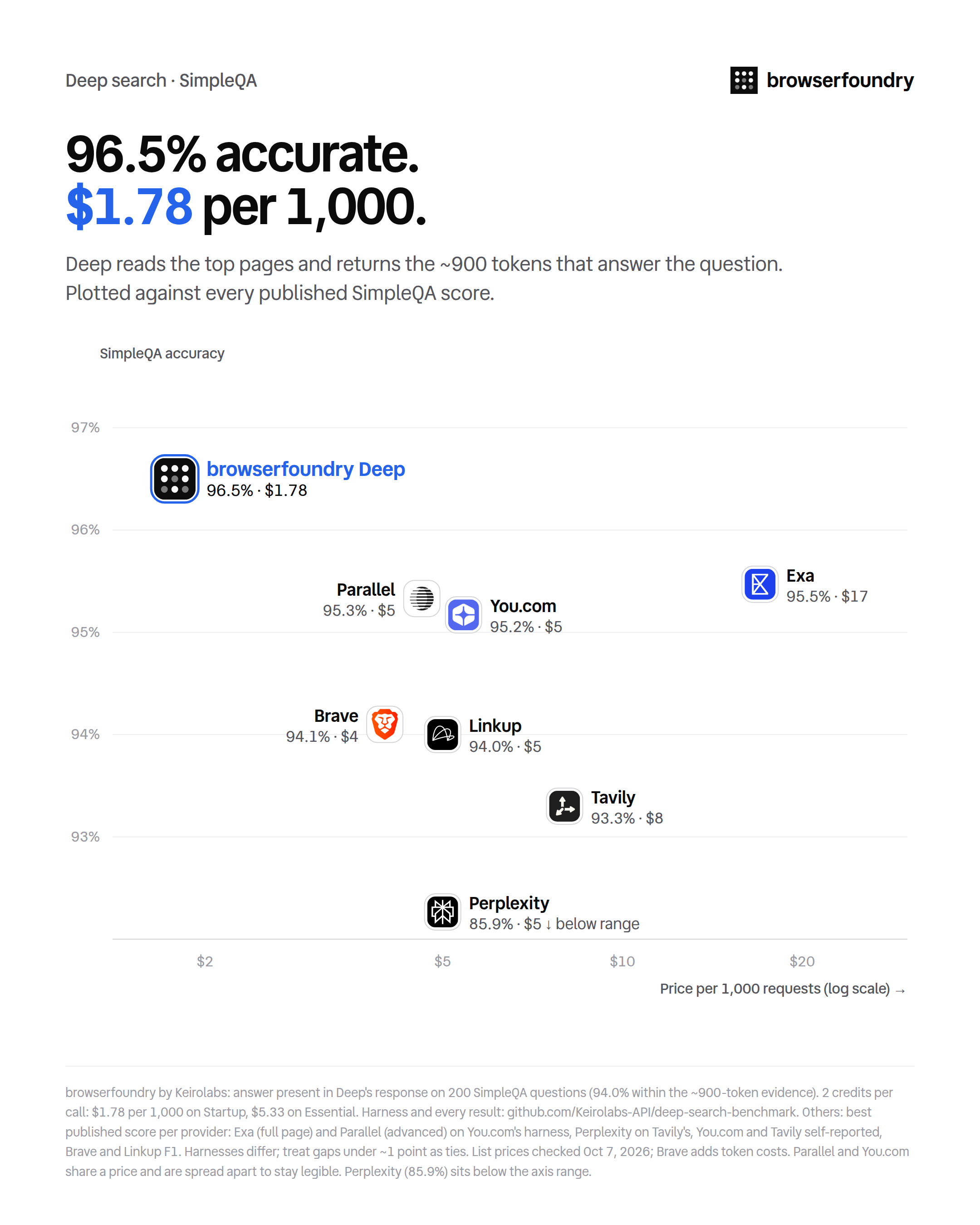
SimpleQA is OpenAI's set of short factual questions with one verifiable answer each. Most search API vendors now publish a score on it, so it is the closest thing to a shared yardstick. A higher score means the answer is more often inside what the API returns.
| Provider | SimpleQA | Price per 1,000 | Page text in the response | Free tier |
|---|---|---|---|---|
| browserfoundry by Keirolabs (deep) | 96.5% | $1.78 (Startup) / $5.33 (Essential) | Yes, plus ~900-token evidence | 750 credits at signup, no card |
| Exa (full page) | 95.47% | ~$17 | Yes (contents billed extra) | Signup and monthly credits |
| Parallel (advanced) | 95.33% | $5 | Excerpts | $5 a month with a card on file |
| You.com (Highlights) | 95.17% | $5 | Excerpts | Trial credits |
| Brave AI Grounding | 94.1% (F1) | $4 + tokens | Grounded answer | $5 monthly credit, card required |
| Linkup (fast) | 94% (F1) | $5 | Yes | Signup and monthly credits |
| Tavily | 93.3% | $8 | Yes | 1,000 credits a month |
| Perplexity Search | 85.92% | $5 | Snippets | None |
How to read this table. Treat the top five as a tie: every vendor runs SimpleQA a little differently, and gaps under about a point are inside run-to-run noise. The price column is not noise. At this accuracy, Keirolabs deep is the only option under $5 per 1,000.
Sources: our score is from 200 SimpleQA questions none of which were used to build or tune deep (full write-up). Exa and Parallel are from You.com's harness, Perplexity from Tavily's harness, and the others are each vendor's own published number. Competitor prices are list pay-as-you-go rates, checked on October 7, 2026.
Best web search API for AI agents
An agent does not want ten blue links. It wants the passage that answers the question, a source to cite, and a signal for whether to keep looking. That is what deep returns:
evidence: about 900 tokens of the best passages from the top pages, already de-duplicated across sites, each with its URL.answer_status:found,weakornot_found. When deep saysfound, the answer was in the evidence 97.3% of the time (183 of 188 in our test), so your agent can stop searching and move on.results: the ranked pages, each withanswer_likelihood, an excerpt, and the full page text if you ask for it.
One call costs 2 credits on every plan. Search, page fetching, ranking and evidence packing are all included.
Best search API for minimizing token usage
Token cost usually dwarfs search cost. If your agent reads 10 full pages per question, that is often 30,000+ tokens of input before it writes a word. Here is what the answer rate looks like at different reading budgets, on the same SimpleQA questions:
| What the agent reads | Answer present | Tokens read |
|---|---|---|
| Lite snippets only | 59.4% | ~550 |
| Lite + top 5 pages crawled | 84.6% | ~13,800 |
| Lite + open recipe, top 8 pages crawled | 92.0% | ~37,000 |
| Lite + recipe, then BM25 picks ~900 tokens | 75.6% | ~900 |
| Deep, evidence only | 94.0% | ~900 |
The last two rows read the same ~900 tokens. Picking passages by keyword keeps the answer 75.6% of the time; deep's passage scoring keeps it 94.0%. That gap is the whole argument for an answer-layer API: you pay for one search call instead of 40x the tokens.
Best search API for citation accuracy
Citations fail in two ways: the cited page does not contain the claim, or the claim came from a page you did not cite. Two things reduce both:
- Passage-level sources, not page-level. Deep attaches the URL to each evidence passage, and lists other sites that say the same thing under
sources. Your model cites the passage it actually used. - A "not found" signal. An API that always returns something invites the model to cite a near miss.
answer_status: not_foundtells it there was no supporting passage, so it can say so instead of inventing a citation.
If you need citations from a fixed set of domains, run lite or fast with your own allow-list, then fetch only those pages with extract.
Best search API for low latency and real-time results
Measured end to end from a single client on October 30, 2026, with cold (uncached) queries:
| Keirolabs endpoint | Typical latency | Use it when |
|---|---|---|
search/lite |
2 to 7 s | You need links and snippets, cheaply |
search/fast |
4 to 8 s | You want AI-ranked live results |
search/content |
20 to 26 s | You need full page text for RAG |
deep |
3 to 25 s (stops early once the answer is confirmed) | You need the answer, not the pages |
Repeat queries are served from cache in under a second. If your hard requirement is a sub-second first byte for chat or voice, Parallel's Turbo mode (~200 ms, per its documentation) or Serper (~1 to 2 s) are the honest picks; use deep where accuracy matters more than a few seconds.
All Keirolabs search results are fetched live at query time, so breaking news shows up as soon as search engines index it.
Cheapest web search API
For raw results (title, URL, snippet), Keirolabs lite is the cheapest we know of: $0.10 per 1,000 on Essential, $0.06 on Pro, $0.03 on Startup. Serper is the cheapest Google-specific option at $1.00 per 1,000, falling to $0.30 only after you prepay for 12.5 million queries.
Cheap per request is not the same as cheap per answer. Lite alone has the answer in its snippets 59.4% of the time; to get to 90%+ you add crawling and model tokens. If your agent needs answers, compare deep at $1.78 against lite plus your own crawler plus the tokens to read it all.
Best free web search API
| Provider | What's free | Card required | Refills |
|---|---|---|---|
| Keirolabs | 750 credits at signup, every endpoint | No | One-time |
| Tavily | 1,000 credits a month | No | Monthly |
| Exa | Signup credits plus monthly credits | No | Monthly |
| Firecrawl | 1,000 credits a month, 2 concurrent requests | No | Monthly |
| Serper | 2,500 queries | No | One-time |
| Parallel | Free hosted MCP server, plus $5 a month | For the monthly credit | Monthly |
| Brave | $5 monthly credit (~1,000 searches) | Yes | Monthly |
| Google Custom Search | Closed to new customers; ends January 1, 2027 | n/a | n/a |
Bing's Search API was retired on August 11, 2025, and Google's Custom Search JSON API is closed to new signups, which is why most free search now comes from the providers above.
Every Keirolabs endpoint and what it costs
One API key covers every endpoint. Credits cost $2.67 per 1,000 on Essential ($29.99/month) and $0.89 per 1,000 on Startup ($99.99/month).
| Endpoint | Returns | Credits per call (paid plans) | Essential, per 1,000 | Startup, per 1,000 |
|---|---|---|---|---|
search/lite |
Titles, URLs, snippets | 0.0375 | $0.10 | $0.03 |
search/fast |
AI-ranked live results | 0.5 | $1.33 | $0.44 |
search/content |
Results + clean page markdown | 1.5 | $4.00 | $1.33 |
deep |
Ranked pages + ~900-token evidence + answer_status | 2 | $5.33 | $1.78 |
extract |
Clean markdown from one URL | 2 | $5.33 | $1.78 |
search/google |
Raw Google SERP | 2 | $5.33 | $1.78 |
Full plan details are on the pricing page.
Where Keirolabs is not the best choice
- You need Google's exact ranking. Use Serper or SerpAPI. Our results come from several engines and are re-ranked, so they will not match Google position for position.
- You need sub-second responses. Lite and fast take seconds, not milliseconds. Parallel Turbo or Serper are faster.
- You need semantic "find similar" retrieval. Exa is built for that; we are keyword-and-intent first.
- You need a compliance package on day one. If a SOC 2 report is a hard procurement gate, check which vendors can hand one over today before you shortlist.
- Some sites block all automated readers. Deep marks these pages
blockedinstead of guessing. Medium is a common one.
How to call it
curl
curl -X POST https://api.keirolabs.cloud/api/v2/deep \
  -H "Authorization: Bearer keiro_..." \
  -H "Content-Type: application/json" \
  -d '{"query": "how many moons does neptune have"}'
Python
import requests

r = requests.post(
    "https://api.keirolabs.cloud/api/v2/deep",
    headers={"Authorization": "Bearer keiro_..."},
    json={"query": "how many moons does neptune have"},
    timeout=90,
)
data = r.json()
print(data["answer_status"])             # found / weak / not_found
for e in data["evidence"]:
    print(e["url"], e["text"][:200])
TypeScript
const res = await fetch("https://api.keirolabs.cloud/api/v2/search/lite", {
  method: "POST",
  headers: { Authorization: "Bearer keiro_...", "Content-Type": "application/json" },
  body: JSON.stringify({ query: "best vector database for rag" }),
});
const { results } = await res.json(); // [{ title, url, snippet }, ...]
MCP (Claude, Cursor, any MCP client)
{
  "mcpServers": {
    "keirolabs": { "type": "http", "url": "https://api.keirolabs.cloud/mcp" }
  }
}
Get a key at platform.keirolabs.cloud. Keys start with keiro_, and the free credits work on every endpoint.
How we tested
- Accuracy: 200 questions from OpenAI's SimpleQA set, none used while building deep. A question counts as answered when the reference answer appears in the returned text. The lite numbers use 500 questions and an open harness you can rerun.
- Prices: each provider's public pay-as-you-go page, checked October 7, 2026. Volume discounts and enterprise deals are not included.
- Latency: wall-clock time for cold queries from one client on October 30, 2026. Your numbers will vary with region and query.
We sell one of the APIs on this page. Every competitor number above is either the vendor's own or from a third party's harness, and the sources are named so you can check them.
In plain questions.
What is the best web search API in 2026?
It depends on the job. For AI agents that need answers, browserfoundry by Keirolabs deep scores 96.5% on SimpleQA at $1.78 per 1,000 requests (Startup plan). For the cheapest raw results, Keirolabs lite costs $0.03 to $0.10 per 1,000. Serper is best for raw Google SERP data, Exa for semantic find-similar search, and Brave for an independent index.
What is the best web search API for AI agents?
One that returns the answering passage, a source and a found / not-found signal, not just links. Keirolabs deep returns about 900 tokens of evidence with an answer_status flag; when it says found, the answer was in the evidence 97.3% of the time in our SimpleQA test.
Which search API uses the fewest tokens?
Keirolabs deep's evidence block keeps the answer for 94.0% of SimpleQA questions in about 900 tokens. Crawling the top 8 pages yourself reaches 92.0% but needs about 37,000 tokens, roughly 40 times more.
What is the cheapest web search API?
Keirolabs lite: $0.10 per 1,000 searches on Essential, $0.06 on Pro and $0.03 on Startup. Serper, the cheapest Google-specific API, costs $1.00 per 1,000 and reaches $0.30 only at 12.5 million prepaid queries.
What is the most accurate web search API?
On SimpleQA the leaders are within about a point of each other: Keirolabs deep 96.5%, Exa 95.47%, Parallel 95.33%, You.com 95.17%, Brave 94.1% (F1), Linkup 94% (F1), Tavily 93.3%. Gaps that small are inside run-to-run noise; the price differences are not.
Which web search API has the lowest latency?
Parallel's Turbo mode reports about 200 ms median latency, and Serper returns Google results in about 1 to 2 seconds. Keirolabs lite takes 2 to 7 seconds cold and deep 3 to 25 seconds, with repeat queries served from cache in under a second.
Is there a free web search API?
Yes. Keirolabs gives 750 credits at signup with no card, usable on every endpoint. Tavily gives 1,000 credits a month, Firecrawl 1,000 credits a month, Serper 2,500 one-time queries, and Brave a $5 monthly credit with a card. Google's Custom Search API is closed to new customers and ends on January 1, 2027.
What replaced the Bing Search API?
Microsoft retired the Bing Search API on August 11, 2025. Common replacements are Keirolabs, Brave Search API, Serper, Exa, Tavily and Parallel, depending on whether you need raw results, page text or answers.
Does Keirolabs have an MCP server?
Yes. Add https://api.keirolabs.cloud/mcp as an HTTP MCP server in Claude, Cursor or any MCP client to give an agent web search, page extraction and deep search.
Is browserfoundry the same as Keirolabs?
Yes. browserfoundry is Keirolabs' web data product and runs on the same API, keys and endpoints.