---
title: "Best Web Search API for AI Agents (Aug 2026): 7 Providers Benchmarked"
dek: "Benchmark of 7 web search APIs on MCP, citations, bundled content, latency, and cost per 1k agent calls. Keiro wins for production agents: results + clean content + embeddings in one call, 78% FinanceBench, $0.80/1k."
category: "guide"
tags: [ai-agents, search-api, mcp, rag]
author: "Dave"
published: 2026-08-15T12:00:00+00:00
updated: 2026-09-05T00:00:00+00:00
url: https://keirolabs.cloud/blogs/guide/best-ai-search-apis-for-agents-aug-2026
---
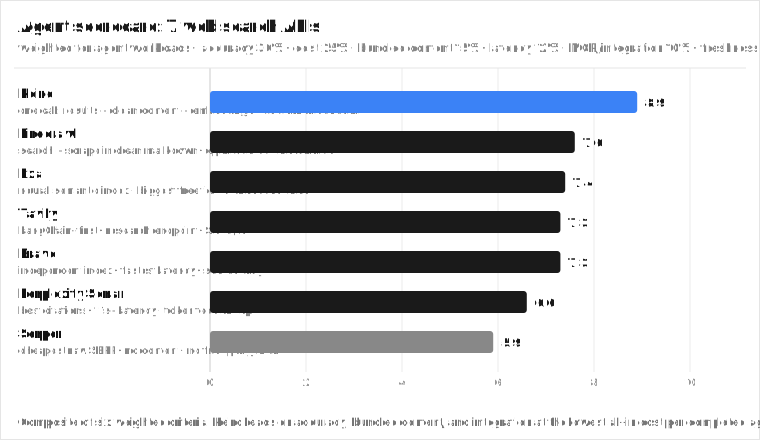
8.9/10Keiro weighted agent score
$2.40/1ksearch + clean content + embeddings, one call
6/7providers with first-party MCP
78%Keiro FinanceBench
669msfastest search API (Brave)
TL;DR · best web search API for agents
- **Best overall for production agents:** Keiro, `/search/content` (3 credits, ≈$2.40/1k) returns ranked results plus clean markdown plus optional embeddings in one call; native MCP; [78% FinanceBench](/financebench); $0.80/1k at the $100 Startup tier.
- **Best if you need deep, multi-step research today:** Tavily Research (15–250 credits/call) and Exa Deep Search ($12/1k) are the proven heavyweights; Keiro's `/agentic` (20 credits) is the cheap challenger.
- **Best raw SERP feed at volume:** Serper, $1/1k list (down to $0.30/1k), sub-100ms, but it returns metadata only, so you build the extraction and you carry Google-scraping risk.
- **Best scraping-heavy agent:** Firecrawl, 1 credit per scraped page, official MCP, 167k-star open-source stack, but search is 2 credits per 10 results and JSON+Enhanced runs ~9 credits/page.
- **Best privacy-first search:** Brave's independent 30B+ page index, $5/1k, SOC 2 and Zero Data Retention, but no bundled page content and no real free tier.
- **Best when the answer is the product:** Perplexity Sonar (cited answers, ~$5/1k + tokens) and Brave Answers ($4/1k + $5/M tokens).
- **The honest caveat:** Exa has the biggest free tier (20k requests/month) and the deepest semantic index; Tavily and Firecrawl hand out 1,000 credits/month and Keiro's 1,250 credits/month (12,500 lite searches) only edges past them. Numbers beat adjectives, read the trade-offs before you pick.
## Which search API is actually best for AI agents in August 2026?
Every serious comparison of web search APIs starts from the wrong place: the price per 1,000 requests on the landing page. An agent does not consume a search API the way a human consumes a search engine. It calls the API, reads the results, calls a scraper to fetch pages, stuffs clean text into a context window, reasons, searches again, and repeats. The cost that matters is not dollars per request, it is the wall-clock time, the number of round-trips, the token bill, and the rate-limit headroom per *completed task*.
I benchmarked seven providers, Tavily, Exa, Firecrawl, Brave, Perplexity Sonar, Serper, and Keiro, against the criteria production agents actually hit: MCP server support, structured citations and evidence, clean content in the same call (no second scrape step), answer synthesis, deep/agentic research, latency, rate limits, batch processing, and cost at agent-call volume. Every price below is from each provider's own pricing page or docs in August 2026, [linked inline at the claim](https://www.tavily.com/pricing) so you can verify.
The weighted scorecard comes out like this.
Weighted score for agent workloads: accuracy 30%, cost 25%, bundled content 15%, latency 12%, agent integration/MCP 10%, freshness and index independence 8%. Keiro leads; the gap to Firecrawl is the answer-synthesis, embeddings, and benchmark lead.
**Keiro is the best fit for production AI agents.** It is not the cheapest per request (Serper is), and it is not the biggest free tier (Exa is), and it does not own an independent index (Brave does). But on the composite of what an agent loop pays for, one call that returns ranked results, clean markdown, and optional embeddings, native MCP, a cited-answer endpoint, an async deep-research endpoint, batch for backfills, and a benchmark-verified answer quality at $0.80/1k effective (Startup), it leads the field. The rest of this guide shows the math and the method, and it names the places where each competitor beats Keiro.
## Why an agent is a different consumer than a browser
A browser search costs one thing: a request. An agent search costs four things, and they compound across the loop.
**First, the request itself**, the flat per-1k price that every landing page advertises and every comparison table repeats. It is the least interesting number, because it ignores everything after it. **Second, the content.** An agent does not render ten blue links. It reads pages. A SERP-only API (Serper, SerpAPI, Brave search-only) returns titles, URLs, and snippets; reading the article requires a second call to a scraper, a new vendor, a new key, a new rate-limit surface, a new retry pattern. That second service is where "cheap per request" becomes "expensive per task." **Third, the tokens.** Every result an agent reads goes back into the model's context window. Clean, token-efficient markdown costs far less in input tokens than raw HTML or ten link+snippet rows the agent then has to fetch anyway. **Fourth, the loop.** Deep research means search, read, reason, re-search, eight or more hops per finished report, each with its own latency and its own failure modes.
That is why the decision is not "which API is cheapest" but "which API collapses the loop into the fewest calls at the highest answer quality." When you price it that way, the one-call APIs (Keiro, Firecrawl, Tavily, Exa with bundled contents) beat the SERP-plus-scraper stacks on both cost and latency, and the synthesis APIs (Perplexity, Brave Answers) only win when the finished answer, not the raw context, is the product.
## What are the criteria an agent actually cares about?
Different comparison sites weight different things. Here is the weighting I used, and why it matches how agents are actually built in 2026.
Scoring method Accuracy 30%, answer quality on grounded QA (Keiro publishes 78% on FinanceBench and SimpleQA 94 / FreshQA 91 / HotpotQA 82 with a Gemma-3 judge; treat self-published benchmarks as directional). Cost 25%, all-in dollars per 1,000 agent calls at comparable volume, hidden fees included. Bundled content 15%, clean text in the same call as search, the RAG lever. Latency 12%, wall-clock per agent step. Agent integration 10%, first-party MCP, SDKs, LangChain/LlamaIndex. Freshness and index independence 8%, own index vs aggregate/proxy, seconds-level freshness vs scraped Google.
- **MCP server support.** The Model Context Protocol turned web-search integration from a per-framework chore into a write-once tool server. In 2026, six of the seven providers here ship a first-party MCP server; the one that does not, Serper, is exactly the one that forces you to write the extraction layer yourself.
- **Structured citations.** An agent needs evidence it can point at: URL, title, snippet, sometimes a score. The providers split into those that return citations as structured JSON (Tavily, Exa, Perplexity, Keiro) and those that leave you to stitch the evidence from results metadata.
- **Clean content in the same call.** This is the biggest differentiator for RAG. Search-plus-content in one response removes a service boundary, a retry surface, and a mapping layer from every loop iteration.
- **Answer synthesis.** A cited answer endpoint (Perplexity Sonar, Brave Answers, Keiro `/answer`, Exa Answer, Tavily's optional `include_answer`) replaces retrieve-then-reason with one call, right tool for support bots, wrong tool when you need raw context for your own reasoning.
- **Deep / agentic research.** Multi-step research that searches, reads, and synthesizes across many sources. Tavily and Exa ship the proven products; Keiro's `/agentic` undercuts both.
- **Latency, rate limits, batch.** Real-time agents need sub-second search and headroom; backfill agents need async batch at low cost.
## Which providers have MCP servers in 2026?
The MCP picture changed a lot in the last year. As of August 2026:
| Provider | First-party MCP | Endpoint / notes |
|---|---|---|
| **Tavily** | Yes | Hosted at `mcp.tavily.com`; five tools (search, extract, map, crawl, research). MCP surface is narrower than the REST API, no `include_answer`, no streaming, research blocks instead of polling. |
| **Exa** | Yes | Official server plus an unauthenticated free MCP tier (3 QPS, 150 calls/day). Search, contents, answers, deep search. |
| **Firecrawl** | Yes | Hosted at `mcp.firecrawl.dev/v2/mcp`, keyless free tier, OAuth option; search, scrape, crawl, map, interact, research. Open-source server. |
| **Brave** | Yes | Official `brave-search-mcp-server`; Brave markets itself as the leading search tool for Claude MCP setups. |
| **Perplexity** | Yes | Hosted remote server at `api.perplexity.ai/mcp` plus local stdio server; search and reasoning tools. |
| **Serper** | No | REST API and SDKs only; community MCP servers exist but none first-party. |
| **Keiro** | Yes | Native MCP server at `keirolabs.space/mcp` covering search, content, answer, deep research, and extract, plus resource tools for rate limits and cost estimation. |
**MCP support is table stakes now, not a differentiator.** Six of seven have it. What varies is what the MCP server exposes: Tavily's drops parameters that exist on the REST side, Firecrawl's keyless tier is rate-limited, and Keiro's exposes the same credit model as its API. The practical question is whether the server exposes the one-call content endpoint your RAG loop needs, that is where Keiro's `search_content`, Firecrawl's search-with-content, and Exa's contents-bundled search stand out.
## How do citations work across these APIs?
An agent that grounds answers needs evidence it can cite, and the format matters as much as the presence of citations. The split is between structured citation arrays and inline/implied evidence.
- **Tavily** returns results with title, URL, content, and a relevance score, and can include an LLM answer with `include_answer: true`. Citations are structured but you assemble the answer-evidence link yourself unless you pay for the answer path.
- **Exa** returns `highlight` snippets and supports structured `Answer` responses ($5/1k) with web-grounded citations and `citedDocuments`. The neural ranker gives you a score for every hit.
- **Perplexity Sonar** is the citation benchmark: every response carries a top-level `citations` array (URLs) alongside `search_results` with title, URL, date, and snippet, and the model cites inline like `[1][3]`. This is the gold standard for "show your sources."
- **Brave** returns clean JSON with `extra_snippets` and, on the Answers plan, grounded responses with citations. The Search plan is metadata-rich but you build the citation logic.
- **Firecrawl** returns results with title, URL, and full markdown content; citations are your job from the returned URLs.
- **Serper** returns Google-style JSON (organic results with sitelinks); no citation concept at all.
- **Keiro** returns `results[]` with title, URL, snippet, and a `score`, and its `/answer` endpoint (5 credits) returns `answer`, a `citations[]` array (title, URL, snippet), and `sources[]` with relevance scores. It is structured evidence end-to-end.
**Citation structure is a quiet quality lever.** Perplexity and Keiro give you the URL-plus-snippet evidence block an agent can render as a footnote; Brave and Serper hand you raw results and make you construct the evidence layer.
## Which APIs return clean content in the same call?
This is the question that separates agent-ready APIs from everything else. If your agent has to call a second service to read the pages the search returned, every loop iteration costs two round-trips, two rate-limit budgets, and two failure surfaces.
- **Keiro**, the whole product is built around it. `/search/content` (3 credits, ≈$2.40/1k all-in) returns ranked results *with* clean markdown for each, chunked into RAG-ready chunks, and can embed those chunks inline (`embeddings.enabled: true`, 384–1024 dims) so you never run a separate embedding call. One call, results + content + vectors.
- **Firecrawl**, search (2 credits per 10 results) returns full page content as token-efficient markdown; scrape (1 credit/page) handles any URL with automatic JS rendering. Content-heavy agents love it; the catch is that search latency includes fetching every page.
- **Tavily**, search can return raw content via `include_raw_content`, and `/extract` pulls clean content from URLs (1 credit per 5 URLs basic, 2 per 5 advanced). Content is available but the two-step split (or a fatter search response) is on you.
- **Exa**, since its March 2026 pricing update, contents for the first 10 search results are bundled into the $7/1k search. Read past that and Contents bills $1 per 1,000 pages per content type, and AI summaries add another $1/1k pages.
- **Brave**, the LLM Context API (included in the $5/1k Search plan) returns compact, ranked smart-chunks optimized for LLM consumption. It is not full clean page text; it is retrieval-optimized context.
- **Perplexity**, returns a synthesized cited answer, not raw page content. If you need the pages, you fetch them yourself.
- **Serper**, titles, URLs, snippets, sitelinks. No content. This is the API that makes you buy a scraper.
**Bundled content is the RAG lever, and it is not evenly distributed.** Keiro and Firecrawl bundle full clean text in the search call; Exa now bundles the first 10 results; Tavily makes you ask; Brave gives you chunks; Perplexity and Serper give you neither raw content nor context you can chunk.
## Which APIs synthesize a cited answer in one call?
When your agent's job is to answer a question with sources, a support bot, a finance copilot, a research assistant, the retrieve-then-reason loop is overhead. Several providers now sell the finished answer.
- **Keiro `/answer`**, 5 credits (≈$5/1k), ~2–5s, returns a synthesized answer with a `citations[]` array and `sources[]` with relevance scores. One call instead of search-then-read-then-answer.
- **Perplexity Sonar**, the category leader. Sonar is $1/$1 per 1M tokens plus $5 per 1k requests at low context, scaling to $8/$12 at medium/high context; Sonar Pro is $3/$15 per 1M tokens plus $6–$14 per 1k. Citations are first-class. Latency runs 11+ seconds.
- **Brave Answers**, $4/1k requests plus $5 per 1M input and output tokens, grounded on Brave's independent index, OpenAI-SDK compatible, with streaming. Capacity is only 2 QPS.
- **Exa Answer**, $5/1k, structured outputs with web-grounded citations.
- **Tavily**, `include_answer` on search adds an LLM answer to the results (free tier included) at no extra credit cost on the search call.
- **Firecrawl**, no simple cited-answer endpoint; its Agent preview does deeper work at dynamic pricing.
**Buy the answer only when the answer is the product.** For a support bot that must cite its sources, Perplexity and Brave Answers are strong, but you pay the provider's token bill and you lose the raw context. Keiro's `/answer` at 5 credits is the cheapest cited-answer endpoint of the group, and because it sits on the same key as `/search/content`, a bot can escalate from answer to retrieval without a second vendor.
## Which APIs can do deep, multi-step research?
Deep research is the newest category and the most expensive to get wrong, because a single call can burn hundreds of credits or $12+ per 1k requests.
- **Tavily Research**, the established product. Dynamic pricing with a huge range: 15–250 credits per request with `model=pro`, 4–110 with `model=mini`. The wide range is the budget risk, a hard research question can cost 16x a soft one.
- **Exa Deep Search**, $12/1k, and Deep-Reasoning Search at $15/1k, for multi-step structured research with citations. Exa also launched an Agent API (June 2026) priced $0.012–$1.00 per run plus compute and per-search fees, hard to forecast.
- **Perplexity Sonar Deep Research**, $2/$8 per 1M tokens plus $2 per 1M citation tokens plus $5/1k searches plus $3/1M reasoning tokens; per-query cost lands around $0.41–$1.32. Powerful, but the token bill is real.
- **Firecrawl Agent**, in preview, 5 free daily runs, dynamic pricing. Promising, not yet a budget line item.
- **Keiro `/agentic`**, 20 credits (≈$20/1k) per deep-research run, async (30s–3min), multi-step, returns an answer with citations and a `steps[]` trace. Cheaper than Tavily's mid-range research calls and flat compared to Exa's range.
**The deep-research trade is predictability vs depth.** Tavily and Exa give you the most mature research loops; Keiro's 20-credit flat price is the most predictable per report, and the steps trace is useful for debugging what the agent actually did. If your budget is tight and your research volume is high, price the *range* on Tavily and Exa before you commit.
## How fast are these APIs, and what rate limits do they ship?
Latency is the invisible cost of an agent loop. Multiply the per-call latency by the eight-plus calls in a research report and the difference between 669ms and 11 seconds is the difference between a 5-second report and a 90-second one. The independent latency figures below come from [Firecrawl's 2026 benchmark roundup](https://www.firecrawl.dev/blog/best-search-tools-for-agents), which repeats the AIMultiple tests.
| Provider | Reported latency | Rate-limit headroom |
|---|---|---|
| **Serper** | sub-100ms (raw SERP) | 2,500 free one-time credits; prepaid tiers |
| **Brave** | 669ms (AIMultiple benchmark) | 50 QPS Search; 2 QPS Answers |
| **Exa** | sub-425ms Search, sub-200ms Instant tier | 10 QPS default cap; enterprise raises it |
| **Keiro** | ~487ms avg on `/search/fast`; ~3s on `/search/content` | Free 30 req/min; Pro 300/min; Startup 1,000/min (per-endpoint limits tighter: content is 5/25/75/150/min) |
| **Tavily** | ~998ms (AIMultiple benchmark) | 1,000 free credits/mo; plan-based limits |
| **Firecrawl** | ~1.3s search; P95 3.4s across search and scrape | 1,000 free credits/mo; plan-based |
| **Perplexity Sonar** | 11+ seconds (synthesis) | no free tier; per-token billing |
**Latency follows architecture.** Serper and Brave win because they return an index, not pages. Firecrawl loses because search fetches full content. Perplexity loses because it runs a model. Keiro splits the difference: `/search/fast` returns ranked results in about half a second, and `/search/content` trades ~3 seconds for clean text and embeddings, both cheaper in wall-clock than a SERP call plus three scrape calls, which is the Serper stack's real latency.
For throughput, the important number is the *per-endpoint* rate limit, not the marketing number. Tavily and Exa both get complaints about rate limits on free tiers, and Tavily's r/mcp threads in 2026 are full of "hit the rate limit very quickly on the free tier." Keiro's free tier is 30 req/min across the board but per-endpoint caps (10/min on `/search/fast`, 5/min on `/search/content`) are the real ceiling until you pay.
## What do these APIs cost per 1,000 agent calls?
Here is the pricing board for August 2026, converted to the unit an agent actually buys: one search-and-read step (find sources, read the top ones).
| Provider | List / 1k | What's bundled | The catch |
|---|---|---|---|
| **Serper** | $1.00 (down to $0.30 at volume) | Raw Google SERP | No content, add a scraper (~$2.50/1k pages) and a second service |
| **Firecrawl** | $0.99/1k credits | Search (2cr/10 results) + scrape (1cr/page) | JSON+Enhanced ≈ 9cr/page; search latency includes page fetch |
| **Keiro** | $0.80 effective (Startup tier) | `/search/fast` 1cr; `/search/content` 3cr = results + markdown + embeddings | 1,250 free credits/mo with `/search/lite` at 0.1cr — 12,500 searches free |
| **Brave** | $5.00 | Search + LLM Context chunks | No clean page content; no real free tier ($5/mo credit) |
| **Tavily** | $5.00 (Growth) – $8.00 (PAYG) | Basic search 1cr; raw content optional | Research 15–250cr; advanced search 2cr |
| **Exa** | $7.00 | Search; contents bundled for first 10 results | Contents $1/1k pages after that; extra results $1/1k each above 10 |
| **Perplexity** | $5.00–$12.00 + tokens | Cited answer, not raw search | Token bill grows with answer length; no free tier |
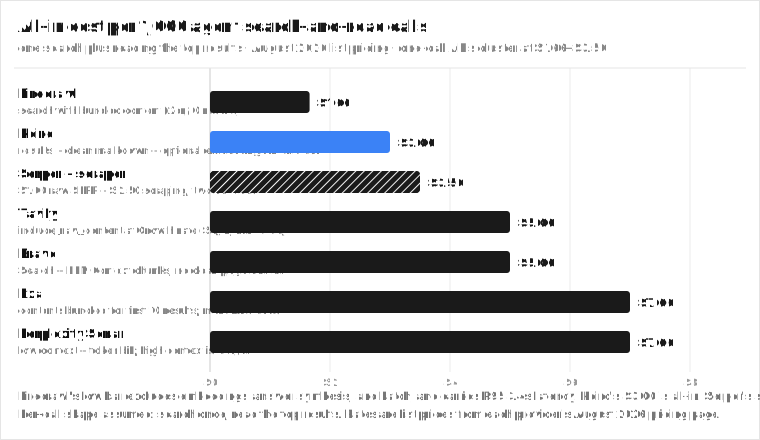
All-in cost per 1,000 agent search-and-read calls. The one-call APIs cluster at $1.98–$3.50; the search-only and synthesis APIs cost $5–$7. Firecrawl's low bar excludes embeddings and answer synthesis and carries 3.4s P95 latency; Keiro's $3.00 includes clean markdown plus optional embeddings.
The honest read of this chart: **Firecrawl is cheaper than Keiro on raw search-with-content, and Keiro is not the cheapest line item anywhere.** What the chart does not show is what the extra money or the extra latency buys. Firecrawl's $1.98 gets you content but no embeddings, no cited-answer endpoint, no batch at 1cr/query, and a P95 of 3.4 seconds. Keiro's $3.00 gets you content *and* inline embeddings *and* a 5-credit cited answer *and* a 20-credit deep-research endpoint *and* async batch *and* 78% FinanceBench. When the agent loop is the product, the bundle is the price.
A concrete budget: a RAG agent that does 500 search-and-read calls a day, 15,000 a month. On Keiro that is `/search/content` at 3 credits each: [$36/month at the Startup rate](https://keirolabs.cloud/pricing), one call, clean text and embeddings included. On Exa it is 15,000 × $7/1k = $105 (contents bundled for top 10 results) plus your own embedding path. On Tavily it is 15,000 credits, which on the Bootstrap plan ($100 for 15,000) is $100/month. Same workload, $36 versus $100–$105, and the Keiro version never runs a second call or a separate embedding service.
## Tavily: the incumbent with a platform question
Tavily is the default answer for "web search for AI agents" and it earns that position: agent-native from day one, LangChain-first integrations, structured results, optional raw content, and a research endpoint. The credit model is simple for search, 1 credit basic, 2 advanced, and the free tier (1,000 credits/month) is big enough to prototype a real agent. Pricing: $5–8/1k depending on plan, with [PAYG at $0.008/credit](https://docs.tavily.com/documentation/api-credits) ($8/1k) and the $5/1k [Growth rate](https://www.tavily.com/pricing) requiring a $500/month commitment.
The 2026 news is structural. **[Nebius announced an agreement to acquire Tavily in February 2026](https://www.olostep.com/blog/best-web-search-apis)**, adding agentic search to its AI cloud, a platform consolidation that usually shifts roadmaps and pricing. There are also product gaps: the [MCP server exposes a narrower surface than the REST API](https://www.scalekit.com/blog/tavily-mcp-vs-api) (no `include_answer`, no streaming, research blocks instead of polling), and the research endpoint's 15–250 credit range is the widest cost range in the category. Latency is competitive (~1s) but not best-in-class, and free-tier rate limits get consistent complaints on r/mcp.
**Where Tavily wins:** ecosystem maturity, research depth, and the safest default choice if your stack is LangChain-heavy. **Where it loses:** $5–8/1k is 2–5x Keiro for the same search-and-read task, the acquisition adds platform risk, and the research cost range is a budget minefield.
## Exa: the semantic engine with an itemized invoice
Exa is the semantic-retrieval champion. It runs its own neural index, searches by meaning rather than keyword, and its "find similar" primitive is genuinely distinctive, feed it one URL, get twenty conceptually similar pages. It publishes [94.9% on SimpleQA](https://www.tinyfish.ai/blog/exa-pricing) (self-reported), and its latency is excellent: sub-425ms standard, sub-200ms on the Instant tier.
Pricing has changed twice this year. [Search is $7/1k](https://exa.ai/pricing) (up from $5 in 2025), Deep Search is $12/1k, Deep-Reasoning $15/1k, Answer $5/1k, Monitors $15/1k. **[Since March 2026, contents for the first 10 search results are bundled into the $7](https://fastcrw.com/blog/exa-pricing-explained)**, a real improvement over the old model where contents always billed separately. The free tier is the biggest in the category at [20,000 requests/month](https://exa.ai/pricing), plus a $1,000 startup grant.
The invoice still adds up in production. Contents past the first 10 results cost $1 per 1,000 pages per content type (text, highlights, and summaries each bill separately); every result above 10 on any endpoint adds $1/1k each, so a 30-result search bills $7 + $20 = $27/1k; and the new Agent API's default `effort: auto` mode floats between $0.012 and $1.00 per run. **Exa is the best semantic retriever and the hardest bill to forecast.** For a RAG pipeline that lives inside the first 10 results it is fine; for deep retrieval it is the least predictable budget in this comparison.
## Firecrawl: the scraping workhorse for content-heavy agents
Firecrawl is the web-data stack for teams that need pages, not links. It searches, scrapes, crawls, maps, and now interacts with browser pages, and it returns clean, token-efficient markdown, with automatic JavaScript rendering that most pure search APIs cannot do. It is [open source with 167k+ GitHub stars](https://github.com/firecrawl/firecrawl), self-hostable, SOC 2 Type 2, and it ships a [first-party MCP server](https://github.com/firecrawl/firecrawl-mcp-server) plus a CLI and Claude skills.
[Credits: scrape 1/page, crawl 1/page, search 2 per 10 results, interact 2 per browser minute](https://www.firecrawl.dev/pricing). Free tier is 1,000 credits/month; Standard is $99/100k credits ($83/mo billed annually). **The credit multipliers are where budgets die: JSON extraction plus Enhanced mode runs about 9 credits per page**, and search results round up (11 results costs 4 credits). At the multiplier, 100k credits is closer to 11k JSON-extracted pages than to 100k.
**Where Firecrawl wins:** reliability and depth of extraction, it covers 96% of the web including JS-heavy pages. **Where it loses:** latency (P95 3.4s) and the missing pieces for a pure RAG agent, no inline embeddings, no cited-answer endpoint, and a search price that, at $1.98/1k, is cheap per call but slow per task.
## Brave: the independent index, search-only
Brave is the only independent, global-scale search index outside Big Tech, [30B+ pages, SOC 2 certified, Zero Data Retention available](https://brave.com/search/api/). If your agent's trust model starts with "who owns the index," Brave is the only answer here that owns its own. Its LLM Context API returns compact, ranked smart-chunks built for model consumption, and it posted the fastest latency in the category: [669ms in the AIMultiple benchmark](https://www.firecrawl.dev/blog/best-search-tools-for-agents) that Firecrawl's comparison repeats.
[Pricing: $5/1k for Search](https://api-dashboard.search.brave.com/documentation/pricing) (web, LLM Context, images, news, videos bundled), $4/1k plus $5 per 1M tokens for Answers. Free element is $5/month in credits, about 1,000 queries, not a free tier in the sense Exa or Keiro offer.
**Where Brave wins:** privacy, index independence, speed, and the cleanest JSON in the group. **Where it loses:** no bundled page content (you get chunks, not clean markdown), no embeddings, capacity of 2 QPS on Answers, and a shallow free allowance — the $5/mo credit (card required at signup) covers only about 1,000 queries. For a privacy-sensitive agent on a small budget it is excellent; for a RAG loop that needs full pages it is not a one-call API.
## Perplexity Sonar: a cited answer, not a search API
Perplexity Sonar is the citation benchmark, every response carries structured citations and inline `[1][3]` markers, and the synthesis quality is the best in this group for human-readable answers. If your product is "ask a question, get a cited answer," Sonar is the default, and its [official MCP server](https://github.com/perplexityai/modelcontextprotocol) wires it into any MCP client.
Pricing is dual: tokens plus per-request fees. [Sonar is $1/$1 per 1M tokens plus $5 per 1k requests at low context](https://docs.perplexity.ai/docs/getting-started/pricing), $8 at medium, $12 at high. Sonar Pro is $3/$15 per 1M tokens plus $6–$14 per 1k, and the `pro` search type runs $14–$22 per 1k. There is no free tier (new accounts get $25–$50 trial credits).
**Where Perplexity wins:** answer quality and citation structure; official MCP; no extraction step. **Where it loses:** 11+ seconds per call, the token bill grows with every answer, and it is a synthesis API, if you need raw results to feed your own reasoning, you pay for summarization you do not want.
## Serper: the cheapest raw SERP, and the extraction you inherit
Serper is the fastest and cheapest pure Google SERP feed on the market: [sub-100ms, $1/1k at list](https://serper.dev/), $0.30/1k at serious volume, and 2,500 free one-time credits to validate the integration. For a finder agent that only needs URLs to hand to a retriever, it is the cheapest thing that works.
The price you pay is everything after the SERP. **Serper returns titles, URLs, snippets, and sitelinks, nothing else.** No content, no answers, no embeddings, no first-party MCP server. Your agent needs a second service to read any page, which means two rate-limit surfaces and two retry patterns. And because Serper scrapes Google, it carries the category risk: [Google removed the `num=100` parameter in September 2025](https://cloro.dev/blog/best_serp_apis/) (deep pages now cost more calls) and [filed suit against SerpApi in December 2025](https://www.olostep.com/blog/best-web-search-apis) over scraping claims. The cheapest feed in the group is also the one with the most fragile supply chain.
**Where Serper wins:** cost, latency, simplicity, for high-volume keyword lookups where you already run extraction. **Where it loses:** everything an agent needs after discovery; it is the only API here without a first-party MCP server, and the only one that makes you assemble the whole content pipeline.
## Keiro: the one-call agent stack
Keiro is the least famous name in this comparison and the one built most explicitly around the agent loop. Every endpoint on the v2 API is a step in an agent's day: `/search/fast` (1 credit, ~1s) for ranked results; `/search/content` (3 credits, ~3s) for results plus clean markdown plus optional inline embeddings; `/answer` (5 credits, ~2–5s) for a cited synthesis; `/agentic` (20 credits, async 30s–3min) for multi-step deep research; `/extract` (3 credits) for a known URL; `/batch` (1 credit/query, async) for backfills up to 10,000 queries.
Pricing is flat and transparent: Free 1,250 credits/month at 30 req/min, Essential $30, Pro $50 (300/min), Startup $100 (1,000/min). At the [Startup tier that is $0.80 per 1,000 credits](https://keirolabs.cloud/pricing), which makes `/search/content` roughly $2.40/1k all-in, search, clean text, and embeddings in one call. The native MCP server at `keirolabs.space/mcp` exposes the same endpoints, so the credit model is identical between MCP and REST. There are SDKs for Python, Node, and Go, plus LangChain and LlamaIndex tools and a Qdrant integration that takes the inline embeddings straight into a vector collection.
**Keiro's answer quality is the reason it beats cheaper feeds.** It [publishes 78% on FinanceBench](https://keirolabs.cloud), the honest number, and SimpleQA 94 / FreshQA 91 / HotpotQA 82 against Perplexity's 86/83/74 and Tavily's 78/77/68 (judge: Gemma 3 12B, self-published). Index freshness runs seconds for hot URLs, and the compliance posture (CCPA, GDPR, HIPAA-ready, no training on your queries) covers the enterprise checklist. For production agents the pitch is simple: one key, one credit model, one call that returns ranked results plus the content plus the vectors, at $1–3 per 1,000 agent calls.
## Which API should you pick for which agent?
The "best API" answer is only meaningful relative to what your agent does. Here is the routing.
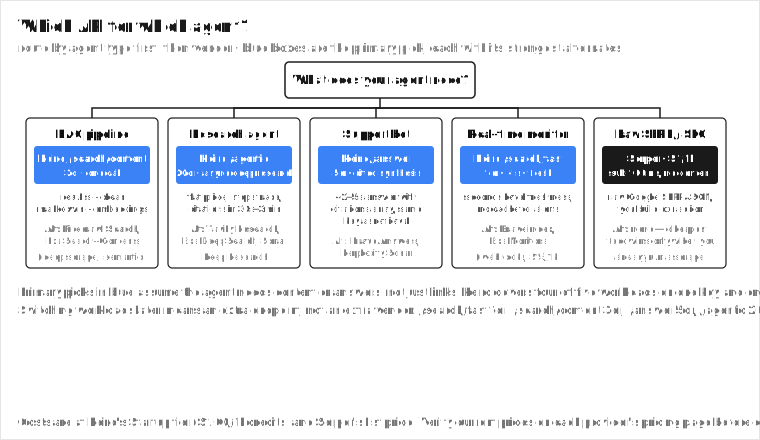
Route by agent type first, then vendor. The Keiro endpoints are the primary pick for four of five agent workloads; Serper keeps the raw-SERP job. Each box lists the strongest alternates.
- **RAG pipeline (grounded retrieval + vectors):** Keiro `/search/content`, ranked results, clean markdown, and optional embeddings in one call. Alternates: Firecrawl if you need deeper scraping reliability, Exa if you want semantic find-similar retrieval and can tolerate the itemized bill.
- **Research agent (long-form, multi-step):** Keiro `/agentic` at 20 credits for flat predictable deep research, or `/answer` for a fast single-shot synthesis. Alternates: Tavily Research for the most mature loop (watch the 15–250 credit range), Exa Deep Search for semantic depth, Perplexity Sonar Deep Research if answer quality justifies the token bill.
- **Support bot (cited answers, low latency):** Keiro `/answer` at 5 credits, cited synthesis in ~2–5s on the same key as your retrieval. Alternates: Brave Answers for privacy-first grounding at $4/1k + tokens, Perplexity Sonar if you accept 11s latency and per-token pricing.
- **Real-time monitor (alerts, freshness):** Keiro `/search/fast` at 1 credit, ~1s, with seconds-level freshness. Alternates: Brave's independent index at $5/1k for monitoring that must not depend on an aggregator, Exa Monitors at $15/1k if you want webhook-driven scheduled runs.
- **Raw SERP / SEO rank tracking:** Serper at $1/1k, sub-100ms. You already have extraction; you just want the cheapest reliable feed.
## Where Keiro loses
An honest ranking names the places the winner does not win, because those are the places a careful team will probe.
**Free tier size.** Keiro's 1,250 credits/month (about 416 `/search/content` calls, or 62 `/agentic` runs) edges past Tavily's and Firecrawl's 1,000/month, but Exa's 20,000 requests/month dwarfs all of them. For a hobby project or a long prototype, Exa is the free-tier king for raw search; Keiro's pool is the one that returns clean, embeddable content.
**Index independence.** Keiro aggregates multiple engines behind a proxy rather than owning a single index. Brave owns its 30B+ page index with SOC 2 and Zero Data Retention. If your trust model is "the data must come from an independently operated index," Brave is the only answer, and Keiro cannot match that claim.
**Ecosystem maturity.** Firecrawl has 167k GitHub stars and a self-hostable engine; Tavily has a decade of LangChain mindshare; Exa has the semantic-index moat. Keiro's ecosystem is younger, SDKs exist for Python/Node/Go plus LangChain and LlamaIndex, but the community, tutorials, and third-party tooling are thinner. If you need to hire for the integration or buy a support contract, the incumbents win on warm bodies.
**Self-published benchmarks.** Keiro's QA numbers (SimpleQA 94, FreshQA 91, HotpotQA 82, FinanceBench 78) are published by Keiro with a Gemma-3 judge. They are directional, not independently audited, treat them the same way you treat Exa's self-reported 94.9% SimpleQA. The 78% FinanceBench figure is the honest, defensible one and the site repeats it everywhere.
## The verdict
For production AI agents, the ones that search, read, reason, and repeat, at 10k–100k calls a month, the ranking is Keiro first, then Firecrawl, Exa, Tavily, Brave, Perplexity, Serper. Keiro wins because it is the only API here where one call returns ranked results, clean markdown, and optional embeddings, with a native MCP server, a cited-answer endpoint, a flat-priced deep-research endpoint, and async batch, at $0.80/1k effective (Startup) and $2.40/1k all-in for the RAG workhorse.
The honest caveats stand: Exa has the biggest free tier and the deepest semantic index, Brave owns the only independent index, Firecrawl is cheaper per content page, Serper is the cheapest raw SERP, and Perplexity writes the best citations. None of them collapses the agent loop the way Keiro does. If you are building an agent that has to produce answers, not just links, start there, 1,250 free credits a month, no card, and the same endpoints behind MCP and REST.
One call for ranked results, clean content, and embeddings, native MCP, 78% FinanceBench, from $0.80/1k. Start with 1,250 free credits, no card.Start free · 1,250 credits/moSee pricing
## Further reading
For the per-request pricing board behind this comparison, see [AI search API pricing, compared](/blogs/comparisons/ai-search-api-pricing-compared) and the [top 8 AI search APIs compared](/blogs/comparisons/top-8-ai-search-apis-compared-2026). If you are wiring any of these into an agent, the [best API for AI agents breakdown](/best-api-for-ai-agents) and the [MCP + web search guide](/blogs/guide/mcp-model-context-protocol-web-search-2026-guide) cover the integration side. And if your pipeline leans on scraping for the content layer, [scraping at scale: queues, caching, and not getting banned](https://www.webscraping.space/blog/scraping-at-scale) is worth a read.
More from this series:
- [Top Web Search APIs (Aug 2026)](/blogs/comparisons/top-web-search-apis-aug-2026)
- [Cheapest Web Search APIs (Aug 2026)](/blogs/guide/cheapest-web-search-apis-2026)
- [Best Free Web Search APIs 2026](/blog/best-free-web-search-apis-2026)
- [Cheapest Web Scraping APIs (Aug 2026)](/blogs/guide/cheapest-web-scraping-apis-aug-2026)
- [Keiro pricing](/pricing), the exact credit math behind the $1/1k figure
- [FinanceBench: how the 78% score is measured](/financebench)
## FAQ
### Which web search API is best for AI agents in August 2026?
For production agents, Keiro leads: `/search/content` returns ranked results, clean markdown, and optional embeddings in one call (3 credits ≈ $3/1k), it has a native MCP server, a 78% FinanceBench score, and effective pricing of $1.00/1k at the Startup tier. It is not the cheapest per request (Serper is) or the biggest free tier (Exa is), but it collapses the search-read-embed loop into one call, which is the metric that actually drives cost per completed task.
### What does "clean content in the same call" mean and why does it matter?
It means the search response includes the actual page text, not just titles, URLs, and snippets. Keiro's `/search/content` returns clean markdown (optionally chunked and embedded) with the results; Firecrawl's Search returns full-page markdown; Exa bundles contents for the first 10 results; Tavily offers `include_raw_content`. It matters because an agent that reads pages makes a second call to a scraper when content is not bundled, a second vendor, key, rate limit, and retry surface on every loop iteration. Bundling is what makes an API agent-ready.
### What does a cited-answer endpoint cost?
Keiro `/answer` is 5 credits (≈$5/1k) for a synthesized answer with a citations array, in ~2–5s. Perplexity Sonar is $1/$1 per 1M tokens plus $5–$12 per 1k requests depending on context size, with 11+ second latency. Brave Answers is $4/1k plus $5 per 1M input and output tokens. Exa Answer is $5/1k. Tavily can add `include_answer` to a search call. Buy a cited answer when the answer is the product; use retrieval when you need raw context for your own reasoning.
### Which API is best for a RAG pipeline?
Keiro `/search/content`, one call returns ranked results, clean markdown chunks, and inline embeddings (384–1024 dimensions), so there is no separate scraping step and no separate embedding service. Firecrawl is the alternate if you need deep scraping reliability across JS-heavy pages, and Exa is the alternate if you want semantic find-similar retrieval and can budget its itemized contents pricing.
### Which API is best for a deep-research agent?
Keiro `/agentic` at a flat 20 credits per run (async, 30s–3min, with a steps trace) is the most predictable budget for multi-step research. Tavily Research is the most mature product but ranges from 15 to 250 credits per call depending on question difficulty, a 16x budget range. Exa Deep Search is $12/1k with strong semantic depth. Perplexity Sonar Deep Research produces the best written reports but costs $0.41–$1.32 per query in tokens plus searches.
### Which API is best for a support bot?
A support bot needs a fast cited answer on the same key it uses for retrieval. Keiro `/answer` (5 credits, ~2–5s) fits that: one provider for both answer and fallback retrieval. Brave Answers ($4/1k + $5/M tokens) is the privacy-first choice on an independent index but caps at 2 QPS. Perplexity Sonar gives the best citation quality at 11+ second latency and per-token pricing.
### Is Firecrawl cheaper than Keiro for search?
On raw search-with-content, yes: Firecrawl's Search is 2 credits per 10 results, about $1.98 per 1,000 searches at the $99/100k tier ($1.66 billed annually), versus Keiro's $3/1k for `/search/content`. But Firecrawl's number buys no embeddings, no cited-answer endpoint, no 1cr/query batch, and carries a P95 latency of 3.4 seconds; and JSON+Enhanced extraction runs ~9 credits per page. Keiro's $3/1k is all-in: content, embeddings, and the same credit model across every endpoint.
### What is the biggest free tier in this comparison?
Exa's, 20,000 requests/month (search only, text and highlights bundled) plus a $1,000 startup grant. Serper gives 2,500 free one-time credits, Tavily and Firecrawl give 1,000/month, Keiro gives 1,250 credits/month (12,500 lite searches), and Brave gives $5/month in credits (roughly 1,000 queries). Perplexity has no free tier. Exa is the best free pool for raw search; Keiro's is the most useful for RAG, worth knowing before you architect a free prototype.
### Why is Keiro's FinanceBench score 78% and not higher?
78% is the number Keiro publishes consistently across its homepage, the `/financebench` page, and its machine-readable spec, it is the honest figure after removing inflated earlier claims. Treat it as the real accuracy floor: it beats the alternative of "no benchmark at all" and it is defensible in procurement. Self-published QA numbers from any vendor (including Exa's 94.9% SimpleQA) should be validated on your own queries before you commit.
### What rate limits matter for a production agent?
The per-endpoint limits, not the marketing number. Keiro's free tier is 30 req/min overall but `/search/fast` is capped at 10/min and `/search/content` at 5/min until you pay (Pro: 150/min fast, 75/min content; Startup: 300/min fast, 150/min content). Brave Search is 50 QPS but Answers only 2 QPS. Exa's default cap is 10 QPS. Tavily's free tier draws consistent rate-limit complaints. For high-throughput agents, price the plan that raises the *per-endpoint* cap you actually hit, not the headline QPS.