---
title: "What Is the Best API for News Aggregation in 2026?"
dek: "Most news APIs sell yesterday's licensed headlines as a monthly subscription, and the price is a cliff. NewsAPI.org jumps from a localhost-only free tier straight to $449/mo with no plan in between. If you want what is happening NOW, you want a fast web index. A real comparison of Keiro, GDELT, NewsData, Perigon, NewsAPI, Mediastack, and Currents."
category: "comparisons"
tags: [news, comparison, api, aggregation, keiro, ai-agents]
author: "Manny"
published: 2026-01-11T09:00:00+00:00
updated: 2026-09-21T00:00:00+00:00
url: https://keirolabs.cloud/blogs/comparisons/what-is-the-best-api-for-news-aggregation
---
The contrarian half is above. The honest half is that structured news databases do something a web index does not. They give you clean source metadata, years of history, sentiment, entities, and deduplication. So the real answer is two tools, not one. This guide compares the seven that matter, with real prices and an honest read on when you want a news database versus when you want live web news search.
$449NewsAPI cliff, free to paid
~100msKeiro indexed news
1979GDELT history
15 minGDELT update cadence
7tools compared
## TL;DR
TL;DR · the 7 category winners
- **Live breaking news + clean article text for agents:** Keiro. 50B+ index, ~100ms indexed, $1/1k, free 500/mo, commercial use allowed. Not a subscription.
- **Free, full-stop:** GDELT. Free forever, 100+ countries, data back to 1979, sentiment and themes, a free community MCP server.
- **Structured feed for broad coverage:** NewsData.io. 97K+ sources, 206 countries, 10-year archive, commercial use allowed on the free tier.
- **Purpose-built for AI agents:** Perigon. 200K+ sources, native MCP, 25+ enrichment signals, entity graph, bias and paywall labels.
- **Cheap and simple:** Mediastack. $9.99/mo, single endpoint, 7,500 sources.
- **Known, worst value:** NewsAPI.org. Great docs, 150K+ sources, but the $449/mo cliff and no article text on public plans.
- **Generous free tier for side projects:** Currents API. 600 requests a day, no card.
## What is news aggregation?
News aggregation is the programmatic collection of news articles and their metadata, source, author, date, category, sentiment, entities, into a feed your application can consume. You use it to monitor brands, track competitors, power finance signals, feed RAG over current events, run sentiment analysis, and build "what happened today" agents.
What people use it for:
- **Brand and competitor monitoring** across thousands of queries a day.
- **Finance and trading signals** from news events and sentiment.
- **RAG over current events** so an agent answers with this week's context, not its training cutoff.
- **Risk and intelligence** monitoring for security, compliance, and reputation teams.
- **Research and analysis** over months or years of coverage.
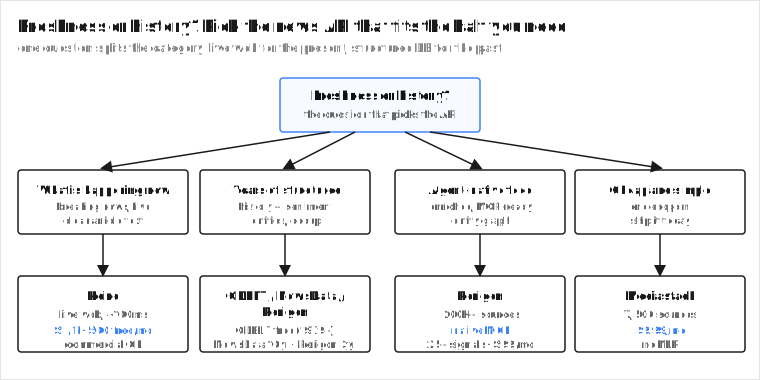
The market splits in two, and the best API depends on which half you need. **Structured news databases** (NewsAPI, NewsData, GDELT, Perigon, Mediastack, Currents) give you clean records from licensed or crawled sources, with history, sentiment, and entities. **Live web news search** (Keiro) finds breaking articles on the open web and returns their clean text, usually before any news database has them indexed. Structured data is clean and historical but lags. Live web search is fresh and catches everything, but you shape it yourself.
The one question that splits the category. Live web for the present, structured database for the past.
## How the freshness lag actually works
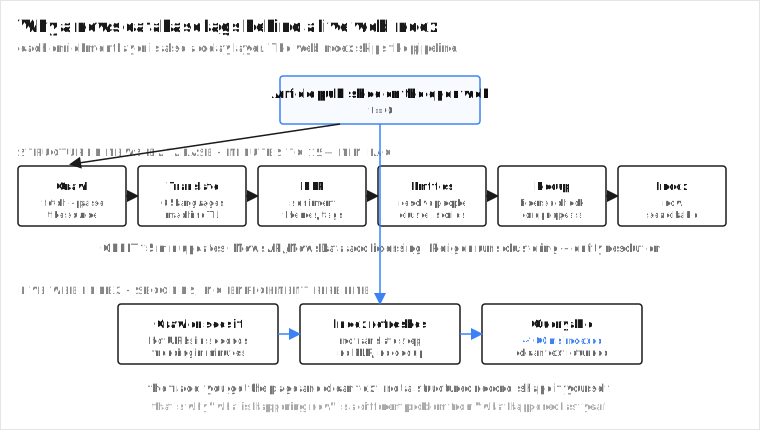
A news article does not appear in a structured database the instant it is published. It has to be crawled, downloaded, parsed, translated, classified, enriched, deduplicated, and indexed. Each of those steps is a layer of compute, and each layer of enrichment is also a layer of delay.
GDELT, one of the faster ones, updates roughly every 15 minutes. Its DOC API translates across 65 languages and runs the GCAM sentiment suite, 2,300+ emotions and themes scored per article, before an article is searchable. NewsAPI and NewsData add licensing and deduplication on top. Perigon runs clustering, entity resolution, and story-velocity scoring. None of this is free. It is the work that produces a clean structured record, and it is also the reason the record lags.
A web index does not have that pipeline. The article goes live on the open web, a crawler sees it, the index refreshes. Keiro's hot URLs refresh in seconds and trending topics in minutes, and an indexed query returns in about 100ms. Breaking news shows up on the open web before it lands in any licensed news database, and a web index sees it first.
The pipeline tax. Every enrichment layer is also a delay layer. The web index skips it.
The trade is that the web index returns a page and clean text, not a structured record. There is no licensed source list, no sentiment label, no entity graph. You get the article and you shape it. For an agent that reads the news and answers questions, that is usually what you want. For a dashboard that plots sentiment over 10 years, it is not.
## A comparison of the 7
| API | Free tier | Starting paid | Sources | History | Best for |
| --- | --- | --- | --- | --- | --- |
| **Keiro** | 500 credits/mo (commercial OK) | $1/1k (usage) | live web (50B+ index) | live | Breaking news + clean article text for agents |
| **GDELT** | free forever | free | 100+ countries, 100+ langs | 1979 onward | Academic research, sentiment, events |
| **NewsData.io** | 200 credits/day, 12h delay, commercial OK | $199.99/mo | 97K+, 206 countries | 10 years | Broad international coverage |
| **Perigon** | 50 req/day trial | $99/mo | 200K+ | 3 years | AI agents (native MCP, enrichment) |
| **Currents API** | 600 req/day, no card | custom | 22K+ | none | Side projects, generous free |
| **Mediastack** | 500 req/mo | $9.99/mo | 7,500 | limited | Cheap and simple |
| **NewsAPI.org** | 100 req/day, localhost only | $449/mo | 150K+ | 1 mo (5 yr paid) | Prototyping; great docs |
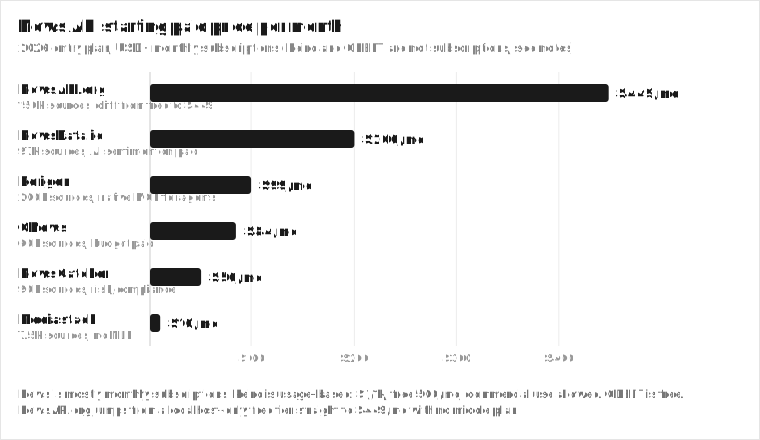
Pricing is 2026 list. Keiro and GDELT are not monthly subscriptions (usage-based and free, respectively), so they sit outside the subscription chart below. Verify on each provider's site.
News is mostly monthly subscriptions. NewsAPI.org jumps from a localhost-only free tier straight to $449/mo with no middle plan. Keiro is usage-based, GDELT is free.
## The $449 cliff, up close
The NewsAPI.org pricing ladder is the thing to understand before you architect around it. The free Developer tier is 100 requests a day, articles have a 24-hour delay, 1-month archive, no uptime SLA, and CORS only works on localhost. The terms are explicit: "If the Service has been integrated outside of a development environment, license to use the Developer plan will be revoked and a paid subscription will be required."
There is no middle plan. The next step is Business at $449/mo for 250,000 requests, real-time articles, 5-year archive, and CORS for all origins. The step above that is Advanced at $1,749/mo for 2M requests and a 99.95% SLA. Enrichment, story clustering, and custom tagging are Enterprise only.
And you still do not get full article text on any public plan. Business and Advanced return headlines, descriptions, and URLs. Your agent then has to scrape the URL anyway. You are paying $449/mo to read headlines you scrape.
The cliff free $0 (localhost, no commercial) to $449/mo (Business), no plan in between. Advanced is $1,749/mo. Enrichment is Enterprise.
What you get at $449 250k requests, real-time, 5-year archive, CORS for all origins. Still no full article text.
What it costs you the scrape step you were going to do anyway, plus a $449/mo headline bill on top.
## A concrete monitoring scenario
You are monitoring breaking news for a portfolio of 50 public companies. You want to know the moment a rate decision, earnings surprise, or regulatory action hits, and you want the article text so your agent can summarize and route it.
**With NewsAPI.org**, you prototype on the free tier (100 requests a day, localhost only, no commercial use). The moment you deploy to a real domain, CORS blocks browser requests and the license forbids production. To go live you jump to $449/mo for 250,000 requests, and you still do not get full article text on the Business plan, only headlines, descriptions, and URLs. Your agent then has to scrape the URL anyway. You are paying $449/mo to read headlines you scrape.
**With Keiro**, 50 companies checked once a minute is 50 * 60 * 24 = 72,000 queries a day. At $1/1k that is about $72/day, roughly $2,160/month at the naive volume. Real monitoring is bursty and deduped, so the actual bill is lower, and the first 500 credits a month are free with commercial use allowed. `/api/v2/search/content` returns the ranked pages plus clean article text plus optional embeddings in one call, so the agent gets the article and the body without a separate scrape step. For most teams the cost is a fraction of the $449 cliff, and you get the article text you were going to scrape anyway.
```bash
curl -X POST https://api.keirolabs.cloud/api/v2/search/content \
-H "Authorization: Bearer keiro_your_api_key_here" \
-H "Content-Type: application/json" \
-d '{"query": "Fed rate decision March 2026", "maxResults": 5, "mode": "ai"}'
```
**The structured half still matters.** The same portfolio wants a 10-year sentiment trend on each holding. That is NewsData (10-year archive, 206 countries) or GDELT (free, 1979 onward, sentiment and themes) for the history, plus Keiro for the live wire. Structured for the past, live web for the present. That is the stack.
## The 7, head to head
Keiro the live web layer
This is our product. The reason it is first for news is freshness and price.
Breaking news shows up on the open web minutes before it lands in any licensed news database, and a web index sees it first. Keiro's index refreshes hot URLs in seconds and trending topics in minutes, and indexed queries return in about 100ms. `/api/v2/search/content` returns ranked news pages plus their clean article text and optional chunked embeddings in one call, so a news-RAG agent gets the article and the clean body without a separate scrape step. $1/1k, 500 free credits a month, no card, commercial use allowed on the free tier.
That returns ranked pages and their clean text in one call. For an agent monitoring breaking news, that is the whole pipeline.
Best for live breaking news plus clean article text for an agent, in one call, before any news database has it.
Price $1/1k usage, 500 free credits/mo, no card, commercial use allowed on free.
The catch not a structured news database. No licensed source metadata, no sentiment labels, no years of clean history. Pair it with GDELT or NewsData.
Why it is here it is the only tool that returns what is happening now as clean text, at $1/1k, with commercial use on the free tier.
Pros
Breaking news before any news database, ~100ms indexed, clean article text in one call.
$1/1k, 500 free credits/mo, commercial use allowed. No $449/mo cliff.
Leads the public QA benchmarks (SimpleQA 94, FreshQA 91, HotpotQA 82), so agents reading the news answer more accurately.
/search/content returns clean text plus optional embeddings, no separate scrape.
Cons
Not a structured news database. No licensed source metadata, no sentiment or entity labels, no years of clean history.
Index-based, so it returns pages the index has. For a tiny outlet not yet indexed, it lags.
Newer than the incumbents, so the news-specific SDK ecosystem is smaller so far.
G GDELT the free research dataset
The free, academic, everything-forever pick.
GDELT is the Global Database of Events, Language, and Tone, and it is unconditionally free. 100+ countries, 100+ languages, data back to 1979, 15-minute updates on GDELT 2.0, with geolocation, the GCAM sentiment suite (2,300+ emotions and themes across 24 measurement packages), CAMEO event coding with 300+ categories, and a Mentions table that tracks how stories flow through global media over time. Queryable on BigQuery with live 15-minute updates.
The DOC API is the part agents actually call. It searches a rolling 3-month window by default via `TIMESPAN`, but timeline modes (`timelinevol`, `timelinetone`, `timelinesourcecountry`, and friends) accept absolute `STARTDATETIME`/`ENDDATETIME` back to January 1, 2017. Non-timeline output (ArticleList, ToneChart) stays capped at the last 3 months. There is a free community MCP server (`cyanheads/gdelt-mcp-server`, Apache 2.0, 9 tools, 1 req/5s) exposing the DOC API (global news, 65 languages, last 3 months) and the TV API (US television transcripts back to 2009).
The catch is the learning curve. GDELT's schema is complex and proprietary, the DOC API has that 3-month window on non-timeline output, and you do significant data engineering to make it useful. For research, sentiment, and large-scale analysis at zero cost, nothing beats it. For a clean production news feed, it is a lot of work.
Best for academic and large-scale research, sentiment and event analysis, at zero cost.
Price free forever, no key.
The catch complex proprietary schema, heavy preprocessing, DOC API non-timeline output limited to a 3-month rolling window.
Why it is here it is the only unconditionally free, 45-year, global, enriched news dataset. Nothing else is close on price or history.
Pros
Free forever, no key, 45+ years of data, 100+ countries and languages.
Timeline modes reach back to Jan 1, 2017 via absolute dates.
Free community MCP server for agents.
Cons
Complex proprietary schema and heavy preprocessing required.
DOC API non-timeline output limited to a 3-month rolling window.
Not a clean production feed; it is a research dataset.
N NewsData.io broad international coverage
The broad-coverage structured pick on a budget.
NewsData.io covers 97,000+ sources across 206 countries and 89 languages, with a 10-year archive, and AI sentiment and tagging on paid plans. The free tier is 200 credits a day (about 2,000 articles) with a 12-hour delay, and importantly commercial use is allowed on the free tier. Paid starts at $199.99/mo. Crypto and market news endpoints are included.
The catch is the 12-hour free-tier delay and that enrichment depth trails Perigon. Best for broad international coverage where commercial use on the free tier matters and you want a real 10-year archive without the GDELT schema pain.
Best for broad international coverage with a 10-year archive and commercial use on the free tier.
The catch 12-hour delay on the free tier, enrichment depth not as advanced as Perigon.
Why it is here 97K+ sources across 206 countries plus a 10-year archive is the best structured coverage for the price, and you can ship on the free tier.
Commercial use allowed on the free tier (200 credits/day).
AI sentiment, tags, and custom tagging on paid plans.
Cons
12-hour delay on the free tier.
Enrichment depth not as advanced as Perigon.
$199.99/mo entry to paid.
P Perigon agent-native enriched feed
The purpose-built-for-AI-agents pick.
Perigon is the news API most explicitly built for AI agents in 2026. 200,000+ sources, an official native MCP server at `mcp.perigon.io` (Streamable HTTP at `/v1/mcp`, Bearer auth, tool scoping via `?tools=`), 25+ enrichment signals, an entity knowledge graph that canonicalizes people and companies across articles, and bias, opinion, and paywall labels. Structured output, summaries, sentiment, topic classification, story clustering into narratives with story velocity, and deduplication. 3-year archive. Free trial at 50 requests a day, paid from $99/mo.
The entity graph is the part agents actually benefit from. Searching for "Jensen Huang" returns articles where he is a named, resolved entity, not a string match. That removes a whole class of reasoning errors that compound when an agent tries to disambiguate people and companies across thousands of raw articles.
The catch is price. It is the best agent-native news API, but $99/mo entry and $550/mo Plus put it above the budget options. Best when your agent needs enriched, deduplicated, structured news and you want MCP out of the box.
Best for AI agents that reason over structured, enriched, deduplicated news with native MCP.
Price 50 req/day free trial, paid from $99/mo, Plus $550/mo.
The catch $99/mo entry is above the budget options, and the 50 req/day trial is small.
Why it is here the only news API with a native MCP server, a real entity graph, and bias and paywall labels built for agents.
Bias, opinion, and paywall labels, deduplication, story clustering, summaries.
Purpose-built structured output for agents.
Cons
$99/mo entry, $550/mo Plus.
50 req/day free trial is small.
3-year archive is shorter than GDELT or NewsData.
N NewsAPI.org known, documented, expensive
The known, well-documented, expensive pick.
NewsAPI.org is the one everyone knows. Excellent documentation, a simple REST API, sub-200ms responses, 150,000+ sources. The free Developer tier is 100 requests a day, localhost only (CORS only works on localhost), no commercial use, 24-hour article delay, 1-month archive, no uptime SLA. The moment you deploy to a real domain, browser requests are blocked by CORS and the terms forbid production. The catch is the cliff: the first paid tier (Business) is $449/mo for 250,000 requests, with no plan in between, and no full article text on any public plan. Enrichment is only on Enterprise. The next tier above Business is Advanced at $1,749/mo.
It is great for prototyping on localhost and rough on production budgeting. The community gotcha is real: a lot of teams prototype on the free tier, ship, and discover the restriction only after deploy.
The catch free tier is localhost-only and forbids commercial use, $449/mo cliff to first paid with no middle plan, no full article text on public plans.
Why it is here the default everyone already knows, with the best docs in the category. The reference point for the cliff.
Pros
Best documentation in the category, simple REST, fast.
150K+ sources, 5-year history on paid.
The default everyone already knows.
Cons
Free tier is localhost-only, no commercial use, 100 req/day.
$449/mo cliff to the first paid tier, no middle plan.
No full article text on public plans, enrichment only on Enterprise.
M Mediastack cheap and simple
The cheap and simple pick.
Mediastack is a single-endpoint REST API that returns news from 7,500 sources across 50+ countries and 13 languages, near real-time, starting at $9.99/mo (free tier 500 requests a month). It is the cheapest paid option here and the easiest to wire up.
The catch is what you give up for the price. Only 7,500 sources, no NLP or enrichment, HTTPS only on paid, and limited historical data. Best for a lightweight app where cheap and simple beats coverage and intelligence.
Best for a lightweight app where cheap and simple beats coverage and intelligence.
Price free 500 req/mo, paid $9.99/mo, the cheapest paid plan here.
The catch only 7,500 sources, no NLP or enrichment, HTTPS only on paid, limited history.
Why it is here the cheapest paid option and the easiest to wire up, for when you just need a feed.
Pros
$9.99/mo, the cheapest paid plan here.
Single-endpoint REST, near real-time, easy to wire up.
Cons
7,500 sources, no NLP or enrichment.
HTTPS only on paid, limited history.
Not for AI workloads that need structured enrichment.
C Currents API generous free tier for side projects
The generous-free-tier pick for side projects.
Currents API gives 600 requests a day free with no credit card, across 22,000+ sources. Simple API, real-time global news. The catch is no historical archive, thin documentation, and inconsistent data quality. Best for side projects and prototyping where the 600/day free tier is the whole point.
Best for side projects and prototyping where the 600/day free tier is the whole point.
Price free 600 req/day, no card. Custom paid.
The catch no historical archive, thin docs, inconsistent data quality, no AI enrichment.
Why it is here the most generous no-card free tier if you just need a real-time feed for a hobby project.
Pros
600 requests a day free, no card, 22K+ sources.
Simple, real-time.
Cons
No historical archive.
Thin docs, inconsistent data quality.
No AI enrichment.
## The recommended stack
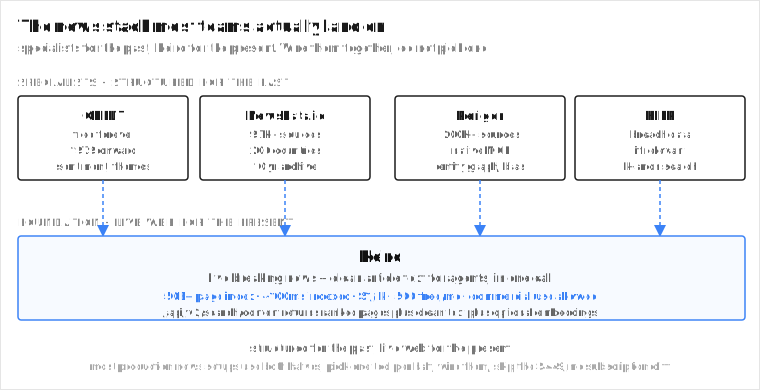
Most production news setups use both halves. A structured database for history and enrichment, plus Keiro for live breaking news and clean article text. You do not pick one tool, you wire them.
Specialists for the past, Keiro for the present. Most teams land on a stack, not a single API.
The foundation is Keiro, because "what is happening now, as clean text" is the part every news product needs and the part every news database makes you scrape separately. The specialists layer on top:
- **GDELT** for free history and sentiment at research scale.
- **NewsData** for broad international coverage and a 10-year archive.
- **Perigon** for agent-native enrichment, the entity graph, and MCP.
- **HIBP** for breach data when your news monitoring touches security or reputation. It is not strictly news, but it belongs in the stack when your use case does.
## The commercial-use-on-free trap
This is the single most common gotcha in the category. Teams prototype on NewsAPI's free tier because the docs are good and the API is simple, ship to production, and discover CORS is blocking browser requests and the license forbids commercial use. There is no middle plan, just the $449 cliff.
If commercial use on a free tier matters, Keiro and NewsData are the two that allow it, and GDELT is free for any use. That is the short version of the whole license section.
## How to choose a news API
**Freshness or history?** If you need what is happening now, Keiro's live web index beats a licensed feed on freshness and price. If you need years of clean, structured history, GDELT (free) or NewsData (10 years) or Perigon (3 years, enriched).
**Structured or raw?** If your agent needs sentiment, entities, deduplication, and source labels, Perigon or NewsData. If it needs clean article text to read and answer, Keiro `/search/content` or GDELT's DOC API.
**Budget.** Free-forever research: GDELT. Free with commercial use: Keiro (500/mo) and NewsData (200 credits/day). Cheap paid: Mediastack ($9.99). Agent-native paid: Perigon ($99). Avoid NewsAPI's $449 cliff unless you specifically need its source set and can absorb the cost.
**Commercial use on free.** This is the trap above. NewsAPI's free tier is localhost-only and forbids commercial use. Keiro and NewsData allow commercial use on free. GDELT is free for any use. Read the free-tier terms before you build on it.
**Agent-native?** If your agent talks MCP natively, Perigon is the news API with an official MCP server and an entity graph. Keiro's clean text plus embeddings is the other half, and a community MCP server exists for GDELT.
**The hybrid most teams land on.** A structured database for history and enrichment (GDELT or NewsData or Perigon) plus Keiro for live breaking news and clean article text. Structured for the past, live web for the present. That is the stack in the diagram above.
## Takeaways
There is no single best news API because news has two halves. For history, structure, and enrichment, GDELT is free and unmatched for research, NewsData for broad coverage and a 10-year archive, Perigon for agent-native enrichment with a real entity graph and native MCP. For live breaking news and clean article text into an agent, Keiro finds it first at $1/1k with 500 free credits a month and commercial use allowed, and you skip the $449/mo subscription cliff.
If you are paying a news API $449/mo to read headlines your agent then has to scrape anyway, that is the bill to cut. Start free with 500 Keiro credits on the [pricing page](/pricing), or see the [best AI search API guide](/best-ai-search-api) and the [Exa alternatives breakdown](/blog/exa-alternatives-2026).
## FAQ
### Do I need a news API or a search API for news?
Often a search API. If you want breaking news as clean article text for an agent, Keiro's live web index finds it in ~100ms at $1/1k, before any news database has it. You need a news API (NewsData, Perigon, GDELT) when you want structured metadata, years of history, sentiment, and entities, not just current articles. Most production setups use both: structured for the past, live web for the present.
### What is the best free news API?
GDELT, unconditionally. Free forever, 100+ countries, data back to 1979, sentiment and themes, a free community MCP server. The trade is a complex schema and heavy preprocessing. For a free tier you can ship in a commercial product, Keiro (500 credits/mo, commercial allowed) and NewsData (200 credits/day, commercial allowed) beat NewsAPI's localhost-only free tier.
### Why is NewsAPI.org so expensive?
You are paying for 150,000+ licensed sources, great documentation, and a polished API, and for the fact that it is the default everyone knows. The free tier is localhost-only (CORS only works on localhost) and forbids commercial use, and the first paid tier is $449/mo with no middle plan. The next tier is $1,749/mo. No full article text on public plans, enrichment only on Enterprise. It is good for prototyping and rough on production budgets.
### Which news API is best for AI agents?
Perigon for enriched, structured, agent-native news with an official native MCP server and an entity graph. Keiro for live breaking news plus clean article text and embeddings in one call. GDELT for free research-scale event and sentiment data via a community MCP server. The agent-native answer depends on whether your agent reads live articles (Keiro) or reasons over structured signals (Perigon, GDELT).
### How fresh is Keiro for news?
Hot URLs refresh in seconds, trending topics in minutes, and indexed queries return in about 100ms. Breaking news shows up on the open web before it lands in licensed news databases, and a web index sees it first. `/search/content` returns the ranked pages and their clean article text in one call, with optional embeddings.
### Can I use a free news API in a commercial product?
It depends on the license. NewsAPI's free tier is localhost-only and forbids commercial use. Keiro's free tier (500 credits/mo) and NewsData's free tier (200 credits/day) allow commercial use. GDELT is free for any use. Read the free-tier terms before you architect around them, because the "free" news API you prototyped on may become a $449/mo bill the day you deploy.
### Which news API has the most sources?
Perigon (200,000+), NewsAPI (150,000+), NewsData (97,000+). Keiro does not have a fixed source count because it indexes the open web (50B+ pages) rather than licensing a source list, which is why it catches sources the licensed databases do not.
### How much does a news pipeline cost at scale?
It depends on the model. Subscription news APIs run $10 (Mediastack) to $449/mo (NewsAPI) to $550/mo (Perigon Plus). Keiro is usage-based: 100k news queries a month is about $100, 1M is about $1,000, with 500 free a month. GDELT is free but engineering-heavy. Model your real query volume against the model, not just the headline price.
### How does the freshness lag in a news database actually work?
A news article has to be crawled, downloaded, parsed, translated, classified, enriched, deduplicated, and indexed before it is searchable in a structured database. GDELT, one of the faster ones, updates roughly every 15 minutes and needs to translate across 65 languages and run the GCAM sentiment suite. NewsAPI and NewsData add licensing and deduplication steps. Perigon runs clustering and entity resolution. Each enrichment layer is also a delay layer. A web index skips that pipeline: the article goes live, the crawler sees it, the index refreshes. That is why "what is happening now" is a different problem from "what happened last year."
### Does GDELT really go back to 1979?
Yes. GDELT 1.0 covers January 1, 1979 onward in the older format. GDELT 2.0, which adds 15-minute updates, 65-language translation, and the GCAM sentiment suite, begins February 19, 2015. The DOC API timeline modes reach back to January 1, 2017 via absolute `STARTDATETIME`/`ENDDATETIME`, while non-timeline output (ArticleList, ToneChart) is capped at the last 3 months. For the full 45+ year record, query the Event Database or GKG on BigQuery.
 Keiro the live web layer