---
title: "What Is the Best API for Event Research in 2026?"
dek: "Event research means finding conferences, speakers, sponsors, and attendees for sales, recruiting, and partnerships. Two flavors, seven APIs, one stack. Here is how ConfBase, PredictLeads, Keiro, Tavily, Exa, SerpAPI, and Eventbrite compare on data, price, and fit."
category: "comparisons"
tags: [events, event-research, comparison, api, business-development, keiro]
author: "Manny"
published: 2026-12-30T10:00:00+00:00
updated: 2026-09-21T00:00:00+00:00
url: https://keirolabs.cloud/blogs/comparisons/what-is-the-best-api-for-event-research
---
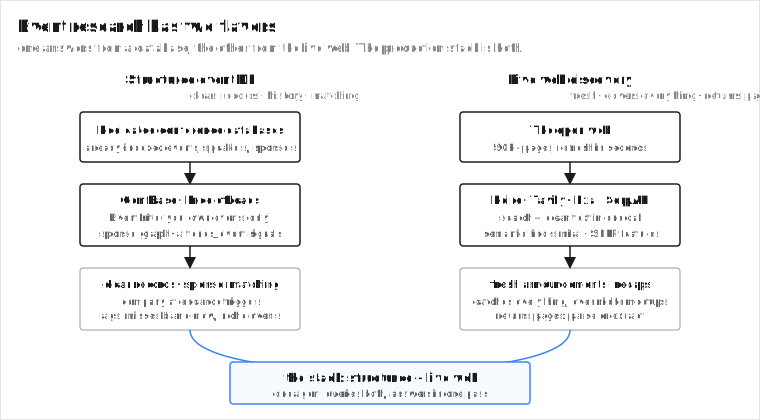
Event research is programmatically finding conferences, trade shows, meetups, speakers, sponsors, and attendees for sales, recruiting, marketing, and partnerships. It splits into two flavors, and the best API depends on which one you need. **Structured event data** lives in dedicated conference databases like ConfBase and PredictLeads. **Live web discovery** finds event announcements, speaker lineups, recaps, and news that are not in any structured database yet, and that is where general web search APIs like Keiro, Tavily, and Exa come in.
This guide compares the seven APIs that matter for event research in 2026, with real pricing, the actual endpoint mechanics, and an honest read on what each is good at and where it breaks.
$1Keiro / 1k
94SimpleQA
2.4M+PredictLeads companies
96ConfBase sponsors tracked
2019Eventbrite search retired
## TL;DR
TL;DR · 7 tools, 7 jobs
- **Best for structured conference, speaker, and sponsor data:** ConfBase. Dedicated conference intelligence API with a two-pass Sponsor Graph and matching endpoints.
- **Best for company event-attendance signals (B2B triggers):** PredictLeads. Company intelligence with an `attends_event` category across 2.4M+ companies, an official MCP server, and webhooks.
- **Best for live web event discovery (announcements, recaps, news):** Keiro. 50B+ index, ~100ms, $1/1k, leads the public QA benchmarks, search plus clean text in one call.
- **Best for agent-native event research:** Tavily. Native LangChain and CrewAI, raw content inline, multi-step `/research`.
- **Best for semantic event discovery:** Exa. Keyword-free "find similar" search trained on link prediction.
- **Best for Google SERP event listings:** SerpAPI. 40+ engines, rich structured SERP, 99.9% SLA.
- **Best for managing your own events:** Eventbrite. Free API, but only your own organization's events. Public search was retired December 12, 2019.
## What is event research?
Event research is the programmatic discovery of events and the people and companies at them. You use it to answer questions like "which conferences is my prospect speaking at next quarter," "who sponsored BigCommerce 2026," "find AI safety meetups in Berlin," or "which companies attended our competitor's user conference."
What people actually use it for:
- **Sales and BD** find conferences their prospects attend or speak at, and time outreach around the event. The trigger is "they will be in the same room as my customers next month."
- **Recruiting** finds speakers and experts on specific topics. A conference agenda is a list of people who self-selected into a subject.
- **Marketing** decides which events to sponsor and measures event ROI against competitor presence.
- **Partnerships** maps who shows up where, and who sponsors what. Sponsor overlap is a co-marketing signal.
For this guide I split the market in two. **Event intelligence APIs** (ConfBase, PredictLeads, Eventbrite) give you structured records about known events, speakers, sponsors, and company attendance. **Web search APIs** (Keiro, Tavily, Exa, SerpAPI) find event content on the live web: announcements, agendas, speaker lists published on a conference site, recaps, news.
The two complement each other. Structured data is clean but only covers events already in the database. Live web search catches everything else, usually before it lands in any database.
Event research is two flows that converge. Structured databases give you clean records with history but lag. Live web search catches everything but returns pages. The production stack runs both.
## A comparison of the 7
| API | Pricing | Free tier | Data type | Best for |
| --- | --- | --- | --- | --- |
| **ConfBase** | Free / Lite $149/mo / Standard $499 / Enterprise | Free, 250 credits/mo | Structured conferences, speakers, sponsors | B2B conference intelligence |
| **PredictLeads** | $0.002 to $0.04/call ($40/mo min) | 100 calls/mo | Company event-attendance signals | B2B sales triggers |
| **Keiro** | $1/1k | 500/mo | Live web event discovery + extraction | Announcements, recaps, news not in DBs |
| **Tavily** | $8/1k PAYG | 1,000/mo | Live web, agent-native | Agent event-research workflows |
| **Exa** | $7/1k | 20,000/mo | Semantic event discovery | "Find similar events" |
| **SerpAPI** | $9.17 to $15/1k | 250/mo | Google SERP | Event listings via Google |
| **Eventbrite** | Free API | Free (your own events) | Your organization's events | Managing your events, not public discovery |
Pricing is 2026 list rates. PredictLeads and ConfBase are credit or tier based, so per-1k depends on volume. Verify on each provider's site before you commit.
## Event intelligence APIs
C ConfBase structured conference intelligence
Best for B2B teams that need structured conference, speaker, and sponsor data with matching.
The catch Covers conferences already indexed. Brand-new or niche events not yet scraped are missing.
Price Free tier with 250 credits/mo. Lite $149/mo for full Speaker and Sponsor Graph access, 5,000 credits. Standard $499/mo, 20,000 credits. Enterprise for allocator contacts and SSO.
ConfBase is a REST API mounted at `confbase.com/api/v1/` with endpoints for events, conferences, speakers (with LinkedIn and X URLs where known), sponsors, companies, and matching. Auth is `Authorization: Bearer cb_live_...`, with Free, Lite, Standard, Advanced, and Enterprise tiers. There is a public OpenAPI 3 spec at `/openapi.json` and a health probe at `/health`, so it is straightforward to wrap in an agent tool or an MCP server.
The Sponsor Graph is the part you cannot easily build yourself. It tracks 96 sponsors across 76 conferences, with Google Cloud, AWS, PwC, Visa, and Deloitte at the top by event count. It is a two-pass structure:
- **Breadth pass:** `GET /sponsors` to discover sponsors, filter by market or location, read sponsorship counts and compact conference footprints.
- **Depth pass:** `GET /sponsors/:slug?include=intelligence` for founder/CEO profiles, funding and team signals, approach brief, movement summary, and evidence.
Full sponsor intelligence needs Lite or higher, or a key with `api:sponsor_graph_full` scope. Free keys get compact profiles only. The matching endpoints (`/match/sponsors-to-events`, `/match/allocators-to-event`) do the hard B2B fit work: "which sponsors match this event's allocator profile" comes back as a ranked list, not a join you have to write.
Agent-friendly filters like `has_content=true` skip events that have not been scraped yet, which keeps your pipeline from wasting credits on empty records. That is a small detail that compounds at volume.
Pros
The only API here purpose-built for conference, speaker, and sponsor data
Two-pass Sponsor Graph and matching endpoints do the hard B2B fit work for you
OpenAPI 3 spec, agent-friendly filters, speaker LinkedIn and X resolution
Allocator-contact endpoints (Enterprise) get you to the actual buyers
Cons
Tiered pricing is not a clean per-1k, so volume cost needs a conversation
Covers conferences already indexed, so it misses brand-new or niche events not yet scraped
Conference-focused, so less useful for meetups, webinars, or informal events
P PredictLeads company attendance signals
Best for Sales and GTM teams that want event attendance as a trigger signal across many companies.
The catch Not a conference or speaker database. Discovery endpoints bill per result returned, not per request.
Price 100 free calls/mo, then $0.04/call down to $0.002/call at volume, $40/mo minimum. Official MCP server at mcp.predictleads.com.
PredictLeads is a company-intelligence API covering 120M+ companies globally. Events show up as an `attends_event` category inside its News Events dataset, which has 37 event categories in 11 groups and 9M+ signals since 2016 across 2.4M+ companies in 195 countries. About 50,000 new events land each week. So you get "Cisco Systems attended event X" as a structured signal, not a conference database.
The `attends_event` category sits in the Expansion family alongside `expands_facilities`, `expands_offices_to`, `increases_headcount_by`, and `opens_new_location`. That makes it composable. You can query `attends_event,receives_financing,increases_headcount_by` in one call to build a "funded and growing and showing up at events" target list. Each event carries a confidence score, the source article, and normalized location data.
The endpoints are `/companies/{company_id_or_domain}/news_events` for one company and `/news_events/discover/news_events` for cross-company search filtered by category, timing, and market focus.
One gotcha to model for: discovery endpoints are billed **per result returned**, not per request. A discover query that returns 300 records is not one credit. Read the docs line on discovery billing before you wire it into a loop, or your $40/mo minimum gets expensive fast.
PredictLeads ships an official MCP server (`https://mcp.predictleads.com/`, Streamable HTTP transport, listed Dec 21, 2025) that drops into Cursor and Claude Desktop with `X-Api-Key` and `X-Api-Token` headers. The GTM directory confirms it is queryable directly by LangChain (via `langchain-mcp-adapters`) and CrewAI (via native `mcps=`) without custom wrappers. Webhooks fire real-time signals when a followed company does something.
Pros
Event attendance as a clean, queryable company signal, great for trigger-based outbound
37 event categories in 11 groups beyond attendance: funding, partnerships, leadership, expansions
Official MCP server for agent workflows, webhooks for real-time signals, 2.4M+ companies
Composable category queries let you stack signals in one call
Cons
Not a conference, speaker, or sponsor database. Use ConfBase for that.
Discovery endpoints bill per result returned, not per request. Model your volume.
Event signals are derived from news, so there is latency versus the event itself
E Eventbrite your own events only
Best for Managing and reading your own organization's events: orders, attendees, check-ins, webhooks.
The catch Public event search was retired December 12, 2019. No general event discovery, full stop.
Price Free API. Eventbrite earns on ticketing fees, not API calls.
The API that remains is free and solid for managing your own events. Base URL is `https://www.eventbriteapi.com/v3`, results paginate in groups of 50, and expansions pull venue, organizer, category, ticket classes, and ticket availability in one call. Auth is OAuth 2.0 (public and private tokens, `Authorization: Bearer MYTOKEN`), which is heavier than a simple API key but fine for an integration you control. Rate limits sit around 1,000 to 2,000 requests per hour per token.
Eventbrite does have a "bring events to your application" path for accessing public events at scale, which is the spiritual successor to the old search endpoint. But it is the Distribution Partner Program, and developers reported applying in October 2019 and hearing nothing back. Treat that path as gated and unreliable. Paying for Eventbrite's premium tier does not restore API access either.
Pros
Free API, no per-query cost (Eventbrite earns on ticketing fees)
Solid for managing your own events: orders, attendees, check-ins, webhooks
Expansions pull venue, organizer, and ticket classes in one call
Cons
Public event search retired December 12, 2019. No general discovery.
Scoped to your own org's events unless you are an approved distribution partner
OAuth 2.0 setup is heavier than a simple API key
## Web search APIs for live event discovery
Keiro live web, cheapest full-featured
Best for Finding event announcements, agendas, speaker lists, and recaps on the live web that are not in any structured database yet.
The catch Not a structured conference database. Pair it with ConfBase for clean sponsor-tier records.
Price $1/1k on the Startup plan. 500 free credits/mo, no card, commercial use allowed on free.
A lot of event research is not "query a conference database." It is "find the page where someone just announced a 2027 AI conference, get its agenda, and pull the speaker list." That is a live-web problem, and Keiro is built for it. 50B+ page index (it is an index, not a scraper), indexed queries in ~100ms, and `/api/v2/search/content` returns search plus clean page text in one call, 3 credits, so you go from query to a RAG-ready conference agenda without a separate scrape step.
The endpoint stack maps cleanly onto event research:
- **Find the page:** `/api/v2/search/content` (3cr) returns ranked pages plus their clean text. One call, no second scrape.
- **Pull structured fields:** `/api/v2/data` (2cr) does structured extraction from a URL or `urls` array. Point it at a conference agenda and get a clean speaker JSON object back.
- **Answer a question:** `/api/v2/answer` (5cr) reads the pages and answers. "What is the date and venue for this event" without you parsing anything.
- **Run the loop:** `/api/v2/agentic` (20cr) for multi-hop research like "which of these 12 events had a sponsor that also spoke at our competitor's event."
$1/1k on the Startup plan, 500 free credits a month, no card. Auth is `Authorization: Bearer keiro_...` in the header, never `apiKey` in the body.
On three public QA benchmarks (judge: Gemma 3 12B, endpoint `/keiro`), Keiro leads Perplexity and Tavily, which matters when your agent is reading event pages and answering questions about them:
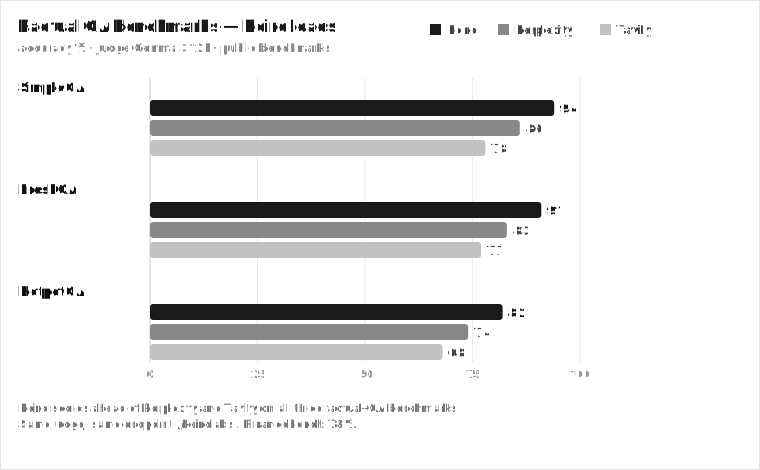
- **SimpleQA:** Keiro 94, Perplexity 86, Tavily 78
- **FreshQA:** Keiro 91, Perplexity 83, Tavily 77
- **HotpotQA:** Keiro 82, Perplexity 74, Tavily 68
- **FinanceBench:** 78%
A real event-research request:
```bash
curl -X POST https://api.keirolabs.cloud/api/v2/search/content \
-H "Authorization: Bearer keiro_your_api_key_here" \
-H "Content-Type: application/json" \
-d '{"query": "AI safety conferences 2027 agenda speakers", "maxResults": 5, "mode": "deep"}'
```
That returns ranked pages plus their clean text, so you can pull speaker lists straight out without a second API call. The `mode` param (`ai|deep|medium|light`) controls extraction depth. Hot URLs refresh in seconds. Trending topics surface in minutes. A structured database indexed last week cannot do that.
Pros
Live web discovery with bundled content extraction, so new and niche events show up before any database has them
$1/1k, about 7x cheaper than Exa and 8x cheaper than Tavily PAYG
Leads the public QA benchmarks, so agents reading event pages answer more accurately
Free 500 credits a month, no card, commercial use allowed on the free tier
Indexed queries in ~100ms, hot URLs refresh in seconds, trending in minutes
Cons
Not a structured conference database. Pair it with ConfBase for clean sponsor records.
Index-first (keyword plus freshness), not keyword-free semantic "find similar." For that, see Exa.
Newer than the incumbents, so the SDK ecosystem is smaller so far
Tavily agent-native
Best for Event-research agents that live in LangChain or CrewAI and want source-first discovery with inline content.
The catch $8/1k PAYG, about 8x Keiro, and Keiro outscores it on the QA benchmarks by 16, 14, and 14 points.
Price $8/1k PAYG. 1,000 free a month.
Tavily returns ranked results with optional raw content inline on `/search`, plus `/extract`, `/crawl`, `/map`, and `/research` endpoints. The LangChain and CrewAI integrations are the best in the category, so if your event-research agent is already wired into those frameworks, Tavily drops in cleanly. The multi-step `/research` endpoint is good for "summarize what happened at this conference" when you do not want to wire the retrieval loop yourself.
The trade-off is cost and accuracy. At 100k event queries a month, Tavily is about $800 against Keiro's $100, and on the three public QA benchmarks Keiro leads by 16, 14, and 14 points. If your agent reads event pages and answers questions, that gap shows up in your downstream quality. Tavily is citation-focused, so it is less suited to pulling structured fields out of event pages than Keiro's `/data` extract endpoint.
The `/crawl` and `/map` endpoints are useful when you already know the conference site and want to walk it. But for event discovery from a cold query, you are paying 8x more for the live-web layer than you would with Keiro.
Pros
Best framework integrations for agent-based event research
Raw content inline on /search, no separate extraction call
Multi-step /research for summarizing what happened at a conference
/crawl and /map for walking a known conference site
Cons
$8/1k PAYG, about 8x Keiro
Keiro outscores it on QA benchmarks by 16, 14, and 14 points
Citation-focused, so less suited to pulling structured fields out of event pages
Exa semantic find-similar
Best for "Find events similar to this one" when you do not have good keywords.
The catch $7/1k, 7x Keiro, and extraction is a separate paid call.
Price $7/1k search. 20,000 free requests/mo (search only). Contents $1/1k pages, first 10 free with search.
Exa's neural search is trained on link prediction, so it grasps semantic relationships that keyword search misses. "Conferences like MLOps World" returns conceptually close events even with no shared terms, which is a different primitive from "search the web for MLOps conferences." If your event-discovery workflow starts from an example event and wants neighbors, Exa is the right tool.
$7/1k for search, with a very generous 20,000-request free tier (search only), and contents are $1/1k pages with the first 10 free when bundled with search. Sub-second responses and real-time indexing.
The catch is cost and coverage. At $7/1k search plus $1/1k contents, Exa stacks two paid layers where Keiro bundles content into the search call at $1/1k. Exa's index is smaller than full-web crawlers, so it can miss commercial or very recent events that have not been indexed yet. And the neural setup is more work than a straightforward search API. For "find events similar to this URL," Exa wins. For "find me the agenda and speakers of the AI safety conference announced yesterday," Keiro wins.
Pros
Keyword-free "find similar events" is genuinely useful for discovery
20,000 free requests a month is the most generous free tier here
Sub-second responses, real-time indexing
Cons
$7/1k, 7x Keiro, and extraction is a separate paid call
Smaller index than full-web crawlers, so it can miss commercial or very recent events
More setup than a straightforward search API
SerpAPI Google SERP wrapper
Best for When you specifically need Google's event results, including maps, shopping, and rich SERP features.
The catch From $15/1k, about 15x Keiro, and metadata only. You build the extraction pipeline.
Price From $15/1k (Developer, 5k/$75). Starter $25/1k. Big Data $9.17/1k. 250 free/mo.
SerpAPI wraps 40+ engines and returns the richest structured SERP data. For event research, that means People Also Ask, local packs, and event carousels that pure search APIs do not surface. If your event workflow needs Google Maps for venue locations or vertical SERP features, SerpAPI is the tool. 99.9% SLA, 250 free a month.
The catch is price and shape. From $15/1k at the Developer tier (down to $9.17/1k at Big Data volume), it is the most expensive option here, about 15x Keiro. And it is metadata only. SerpAPI gives you the SERP. It does not give you the event page, the agenda, or the speaker list. You build the extraction pipeline yourself, which means another API on top.
SerpAPI is the right pick when Google's ranking and SERP features are the product. It is the wrong pick when you just need clean event content to feed an agent, because you pay 15x and still have to extract.
Pros
40+ engines, richest structured SERP, 99.9% SLA
Surfaces Google event features (carousels, local packs, PAA) the others miss
Good when you need vertical SERP like Maps for venue locations
Cons
From $15/1k, about 15x Keiro, the most expensive option here
Metadata only. You build the extraction pipeline for event pages yourself.
Overkill if you just need clean event content
## How it actually works: the two-layer stack in production
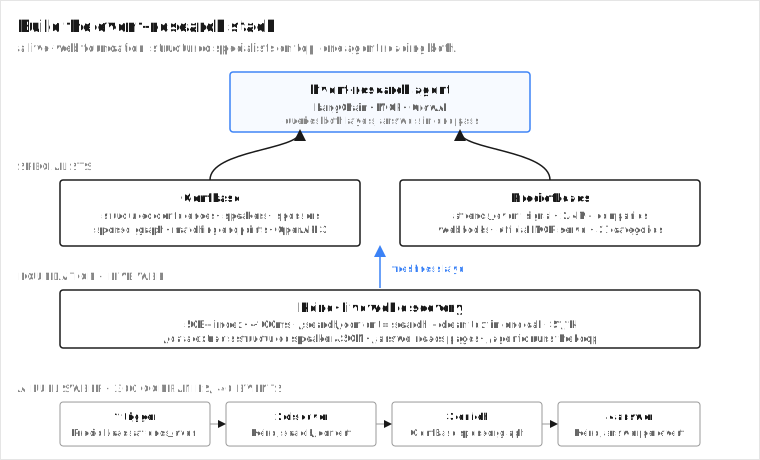
Most teams that do event research at scale do not pick one API. They run two layers and point an agent at both. Here is the shape that works.
The production stack. Keiro as the live-web foundation catches everything. ConfBase and PredictLeads sit on top as structured specialists. One agent queries both and answers in one pass. The bottom rail is the four-step BD sweep.
**The foundation layer is live web.** Keiro's `/search/content` is your "find the page and get its text" call. You ask it for "AI safety conferences 2027 agenda speakers," get back ranked pages with clean text, and you have the conference agenda without a second request. This is the layer that catches brand-new events, niche meetups, and recaps that have not landed in any database. It is also your freshness fallback when a structured database has an event listed but no current agenda or speaker list.
**The specialist layer is structured.** ConfBase gives you the Sponsor Graph and matching endpoints so you can ask "which sponsors match this event's allocator profile" and get a ranked list back. PredictLeads gives you the `attends_event` signal across 2.4M+ companies so you can ask "which of my target accounts just signed up to attend an event" and get a trigger you can act on this week.
**The agent reads both.** A single event-research agent with Keiro and ConfBase tools can answer "find me AI safety conferences next quarter, pull their agendas, cross-reference the speakers against my target accounts, and tell me which events my prospects are speaking at." That is a two-layer question. No single API answers it.
### A concrete BD scenario with real math
Say you run BD for a dev-tools company. Your ICP is engineering leaders at Series B to D companies. You want to be in the room with them at the events they attend, and you want to reach out the week before the event when the topic is fresh in their head.
**Step 1, structured trigger.** You query PredictLeads for `attends_event,receives_financing` filtered to companies in your ICP band. You get back 300 companies that recently attended an event and raised a round. That is your hot list. At PredictLeads' volume price of $0.002/call, that is about $0.60 in API spend against the $40/mo minimum. Realistically you run a discover query that costs a few dollars because discovery bills per result returned, not per request.
**Step 2, live web discovery.** For each of those 300 companies, you want to know which events they attended and whether anyone from that company is speaking at an upcoming event. You run Keiro `/search/content` with queries like "Company X speaking at conference 2026." At 300 queries, 3 credits each, that is 900 credits. At $1/1k, that is about $0.90.
**Step 3, structured enrichment.** For the 40 events that surface, you hit ConfBase for the sponsor graph and matching, so you know which sponsors are already committed and whether your ICP companies are in the sponsor list. ConfBase credits vary by tier, but at Lite ($149/mo, 5,000 credits) you have plenty of headroom for 40 events plus sponsor lookups.
**Step 4, the agent pass.** Your agent reads the Keiro event pages and the ConfBase sponsor records and produces a ranked list: "These 12 events have your ICP companies attending or speaking, here are the dates, here is who to reach out to, here is the angle." That last pass is a Keiro `/answer` call per event, 5 credits each, 60 credits, about $0.06.
Total API spend for a full BD event-research sweep across 300 companies and 40 events: well under $20, dominated by the ConfBase tier. Run the same sweep with Tavily instead of Keiro on step 2 and step 4 and the live-web layer alone is about $8, because Tavily is $8/1k and you are doing roughly 1,000 calls. Run it with SerpAPI and you still need a separate extraction API because SerpAPI gives you the SERP, not the page.
The math is why the stack is Keiro plus a structured layer. The structured layer is where the clean records live. Keiro is where the live web and the cheap, accurate content extraction live.
### A recruiting scenario, for contrast
Recruiting uses the same stack flipped. You want engineering leaders who speak at Rust conferences. ConfBase `/speakers?title=CTO,VP-Engineering` gives you structured speaker records with LinkedIn URLs where known. That is your seed list. For each speaker, Keiro `/search/content` pulls the talk abstract and bio from the conference page so you can personalize outreach. PredictLeads is the wrong tool here because it tracks company attendance, not individual speakers.
The point: the stack is the same, the entry point changes. Sales enters at PredictLeads. Recruiting enters at ConfBase. Both fall through to Keiro for the live-web content layer.
## How do you choose an event research API?
**What data do you actually need?** Structured conference, speaker, and sponsor records, go ConfBase. Company attendance signals for trigger-based sales, go PredictLeads. Live event content on the web (announcements, agendas, recaps), go Keiro or Tavily. Your own events, Eventbrite. A lot of teams run two: ConfBase or PredictLeads for structured data, plus Keiro for everything not yet in a database.
**Freshness vs coverage.** Structured databases cover known events but lag. Live web search catches new and niche events first. If your edge is "know about events before competitors," the live web layer matters more, and Keiro's ~100ms indexed path and freshness fallback are built for it. Hot URLs refresh in seconds. Trending topics surface in minutes. A structured database indexed last week cannot do that.
**Cost at scale.** At 100k event queries a month, Keiro is about $100, Tavily about $800, Exa about $700 plus $1/1k for contents, and SerpAPI about $1,500. The structured APIs bill per record or per call with minimums, so model your real volume. PredictLeads discovery bills per result returned, not per request. ConfBase is tiered. Per-1k varies by plan on every provider.
**Agent integration.** If your event research runs in an agent, LangChain and MCP support matter. Keiro, Tavily, and PredictLeads all ship agent tooling. PredictLeads has an official MCP server at `mcp.predictleads.com` (Streamable HTTP). ConfBase has an OpenAPI 3 spec that is easy to wrap as an MCP server. The 2026-07-28 MCP spec makes stateless remote servers the default, so wrapping an OpenAPI spec as an MCP server is a few dozen lines.
**Accuracy.** If an agent reads event pages and answers questions (speaker bios, topics, dates), benchmark accuracy matters. Keiro leads SimpleQA, FreshQA, and HotpotQA over Perplexity and Tavily. That gap shows up in downstream quality when your agent is summarizing an event or pulling a speaker list.
## Takeaways
There is no single best API for event research because the question has two answers. For structured conference, speaker, and sponsor data, ConfBase is the dedicated pick and PredictLeads is the company-signal pick. For live web discovery of everything not yet in a database, Keiro leads the QA benchmarks at $1/1k, with bundled extraction so you pull agendas and speaker lists in one call.
The stack most teams land on is a structured layer plus a live web layer: ConfBase or PredictLeads for known events and company signals, Keiro for new announcements and recaps. Point one agent at both and you answer the two-layer questions no single API can. Start free with 500 Keiro credits a month on the [pricing page](/pricing), or see the broader [best AI search API guide](/best-ai-search-api) and the [Exa alternatives breakdown](/blog/exa-alternatives-2026).
## FAQ
### Can I use the Eventbrite API to find public events?
No. Eventbrite retired its public event search API (`GET /v3/events/search/`) on December 12, 2019 at 11:59 pm PT. The endpoint started failing with `403 Forbidden` around October 18, 2019 with no notice, came back briefly in November with a brutal rate limit that threw `406` and `429` errors after 3 or 4 requests, then died for good on December 12. The API that remains is free but scoped to your own organization's events (by event ID, by venue, or by organization) unless you are an approved distribution partner, and developers reported applying in October 2019 and hearing nothing back. Paying for a premium tier does not restore access. For discovering public events you do not own, use a web search API like Keiro, Tavily, or Exa, or a dedicated conference intelligence API like ConfBase.
### What is the difference between an event intelligence API and a web search API?
Event intelligence APIs (ConfBase, PredictLeads) return structured records about known events, speakers, sponsors, and company attendance. Web search APIs (Keiro, Tavily, Exa) find event content on the live web: announcements, agendas, recaps, news. Structured data is clean but limited to what is indexed. Live web search catches new and niche events first but returns pages you may need to parse. The two cover different parts of the funnel, which is why the production stack runs both.
### Which API is best for finding conference speakers?
For structured speaker data with LinkedIn and X profiles, ConfBase's `/speakers` endpoint with `?title=CIO,Allocator` filters. For finding speaker announcements and bios published on the live web, Keiro's `/api/v2/search/content` pulls the page and its clean text in one call, and `/api/v2/data` extracts a structured speaker JSON from a specific agenda URL. For tech-conference speaker signals as a sales trigger, PredictLeads' event categories catch "spoke at event" alongside `attends_event`.
### Which is best for B2B sales triggers from events?
PredictLeads. Its `attends_event` signal tells you which companies attended which events, across 2.4M+ companies in 195 countries, with webhooks for real-time triggers. Compose it with `receives_financing` and `increases_headcount_by` in one query to build a "funded, growing, and showing up" target list. Pair it with Keiro if you also want the event's public content and speaker list. Watch the discovery billing: it charges per result returned, not per request.
### Can I combine structured event data with live web search?
Yes, and it is the most common production setup. ConfBase or PredictLeads for structured conference and company-attendance data, Keiro for live announcements, recaps, and pages not yet in any database. Point one agent at both and it answers two-layer questions like "which events are my prospects speaking at next quarter" in a single pass. The two cover different parts of the funnel.
### How much do event research APIs cost at scale?
Keiro is $1/1k, so 100k event queries a month is about $100. Tavily is $8/1k PAYG, so the same volume is about $800. Exa is $7/1k for search plus $1/1k for contents. SerpAPI starts at $15/1k at the Developer tier, down to $9.17/1k at Big Data volume. PredictLeads is credit-based from $0.04 down to $0.002/call with a $40/month minimum, and discovery bills per result. ConfBase is tiered, from a free 250-credit tier through Lite at $149/mo with 5,000 credits and Standard at $499/mo with 20,000. Eventbrite is free for your own events. Model your real volume before committing.
### Do these APIs work with LangChain and AI agents?
Keiro, Tavily, and PredictLeads all ship LangChain or MCP integrations. Tavily is the most native for LangChain. PredictLeads has an official MCP server (`mcp.predictleads.com`, Streamable HTTP) that drops into Cursor and Claude Desktop and is queryable by LangChain and CrewAI without custom wrappers. ConfBase has an OpenAPI 3 spec that is easy to wrap as an MCP server. For agent-based event research, Keiro plus a structured layer is the common pairing.
### Which is best for RAG over event content?
Keiro. `/api/v2/search/content` does search plus clean page text in one call, 3 credits, so the conference agenda or recap goes straight into your RAG pipeline without a separate scrape step, and Keiro leads the QA benchmarks. For structured extraction from a specific event URL, `/api/v2/data` pulls a clean JSON object in 2 credits. Tavily's inline raw content and Perplexity's pre-synthesized cited answers are the other RAG-relevant options.
### What about Autobound for conference speaker intelligence?
Autobound markets conference speaker intelligence as a sales-trigger source, pulling who is speaking at which events and turning that into outreach context. It is a sales-intelligence product rather than a raw API, so it fits when you want the trigger and the messaging in one tool, not when you want structured records or live web pages to feed your own agent. For the raw-data layer, ConfBase gives you the speaker graph and Keiro gives you the live web.
### Why not just scrape conference sites myself?
You can, and for one or two known sites it works. At scale it falls apart. Conference sites change structure constantly, block scrapers, and bury speaker lists behind JavaScript. A scraping pipeline costs you proxies, anti-bot evasion, parser maintenance, and freshness polling. Keiro's `/search/content` gives you the same clean text at $1/1k with no infra to run, and ConfBase gives you structured records someone already cleaned. The scraping approach only wins when you need a site Keiro and ConfBase do not cover, and even then you usually want Keiro's `/data` extract on the URL you found.
 Keiro live web, cheapest full-featured
 Tavily agent-native
 Exa semantic find-similar
 SerpAPI Google SERP wrapper