---
title: "Top Web Search APIs (Aug 2026): the 8 that matter, ranked"
dek: "An independent, numbers-driven ranking of 8 web search APIs for AI agents, cost per 1k, result quality, latency, MCP support, and why Keiro takes #1 on overall value. No vendor spin."
category: "comparisons"
tags: [search-api, comparison, 2026, ai-agents]
author: "Dave"
published: 2026-08-15T12:00:00+00:00
updated: 2026-09-05T00:00:00+00:00
url: https://keirolabs.cloud/blogs/comparisons/top-web-search-apis-aug-2026
---
Every "best search API" list in 2026 opens with a pricing table and a column of names. The problem is that a price per 1,000 requests is not the same product across vendors. Serper sells a raw Google SERP for $1/1k. Exa sells semantic retrieval for $7/1k. Perplexity sells a finished cited answer for $5/1k plus tokens. These are three different jobs with three different cost structures, and ranking them on the headline number alone is how teams pick the wrong tool.
This page ranks eight web search APIs across seven weighted criteria, cost per 1k, result quality/freshness, bundled content, citations, MCP/agent support, free tier, and latency, with the weights published up front so you can rerun the math. **The short version: on overall value for agent and RAG workloads, Keiro ranks #1, and the reason is that it combines the floor price ($1/1k) with bundled content extraction ($3/1k all-in) that the cheap SERP APIs simply do not sell.** It also loses in specific places, to Brave on independent-index quality and privacy, to Exa on free-tier size and semantic find-similar, to Perplexity on citation polish, to Serper on pure raw-SERP price at volume. Those gaps are real and stated below with the numbers.
8APIs ranked
7weighted criteria
$1.00per 1k at the value leader
15xspread, cheapest to priciest
10x+latency spread, fastest to slowest
TL;DR · ranked by overall value, August 2026
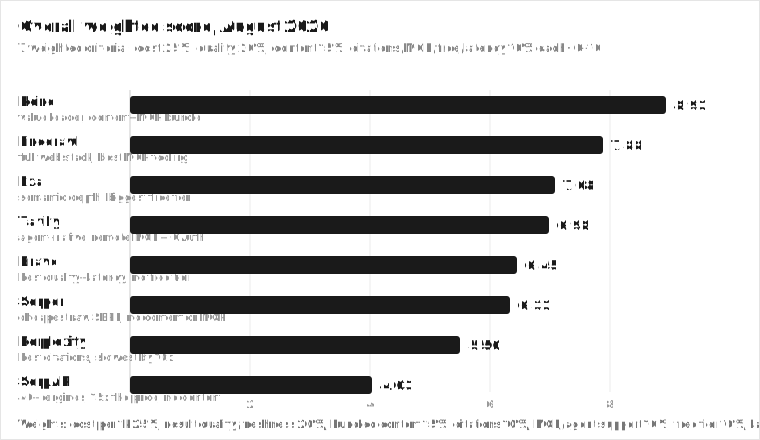
Keiro ranks #1 (8.93). $1/1k on /search/fast, $3/1k all-in for search + clean markdown + embeddings, 500 free credits/mo, [FinanceBench 78%](/financebench), native MCP. It wins because cost and content both count, and no one else scores high on both.
Firecrawl ranks #2 (7.88). The deepest web stack (search, scrape, crawl, map, interact) with the best MCP tooling, at $1.98/1k for search on the Standard tier, but the credit multipliers and scrape-heavy latency hold it back.
Exa ranks #3 (7.08). The biggest free tier (20,000 search/mo) and the only keyword-free semantic index, but $7/1k plus $1/1k page contents is 7x the floor.
Tavily ranks #4 (6.98). Best remote MCP ergonomics (OAuth, hosted server) and solid agent-native output, at $5-8/1k, competitive, but $500/mo to reach the $5 rate.
Brave ranks #5 (6.45). The fastest (669ms) and highest-scoring API in AIMultiple's May 2026 benchmark, on an independent index with zero query retention, but a shallow free tier (a $5/mo credit allowance, card required) and $5/1k.
Serper ranks #6 (6.33). The cheapest raw Google SERP at $1/1k with sub-100ms latency, dragged down by no bundled content and no official MCP server.
Perplexity ranks #7 (5.50). The best citations and the only finished-answer API in the set, but 11+ seconds of latency and $5-12/1k plus tokens make it a batch tool, not an interactive one.
SerpAPI ranks #8 (4.03). 40+ engines and an official MCP, but $15/1k, no content, and the lowest quality score in the benchmark.
## Which web search API is the best in August 2026?
The ranking, in one table, with the full scorecard below it.
| Rank | API | Overall score | $/1k (entry) | Free tier | Bundled content | Best in benchmark |
| --- | --- | --- | --- | --- | --- | --- |
| 1 | **Keiro** | **8.93** | $1.00 / $3.00 all-in RAG | 500/mo | Markdown + embeddings in one call | QA accuracy (SimpleQA 94, FreshQA 91, HotpotQA 82) |
| 2 | **Firecrawl** | **7.88** | $1.98 (Standard) | 1,000 cr/mo | Markdown, structured output, scraping | MCP tooling (14+ tools, remote) |
| 3 | **Exa** | **7.08** | $7.00 | 20,000/mo | Contents $1/1k pages | Semantic find-similar |
| 4 | **Tavily** | **6.98** | $5-8 | 1,000/mo | Inline content + /extract | Remote MCP + OAuth |
| 5 | **Brave** | **6.45** | $5.00 | $5 credit/mo (card required) | LLM Context API | AIMultiple agent score 14.89, 669ms |
| 6 | **Serper** | **6.33** | $1.00 | 2,500 one-time | none | Price and latency ($0.30/1k at volume) |
| 7 | **Perplexity** | **5.50** | $5+ | none | Cited answer | Citations (native) |
| 8 | **SerpAPI** | **4.03** | $15.00 | 250/mo | none | 40+ engines, 99.9% SLA |
Overall weighted score, 0-10. Keiro leads on the combination of cost and bundled content; the three cheapest SERP-only or synthesis-first APIs trail on content or latency.
The headline result is not subtle. **Keiro's 8.93 beats #2 Firecrawl by more than a full point, and the reason is that it is the only API in the set that scores 9.5 or higher on both cost and bundled content.** The next two providers each win one of those two criteria, Serper wins cost (tied at $1/1k) but scores 1.5/10 on content; Exa wins free tier but pays $7/1k. Keiro is the only one that wins both halves of the value equation at once.
That is not the same as saying Keiro is the best search API for everything. It is the best *value*, the best score when cost, quality, content, citations, MCP support, free tier, and latency are weighted together. The section on where Keiro loses lists the three places a different API is genuinely better.
## How did I rank the APIs?
The seven criteria and their weights:
| Criterion | Weight | Why it matters |
| --- | --- | --- |
| Cost per 1k | 25% | The bill at scale dominates every other decision for agent workloads |
| Result quality / freshness | 20% | A cheap API that returns stale or wrong results costs more in agent retries |
| Bundled content | 15% | Search-plus-extraction in one call saves a separate scraping pipeline |
| Citations | 10% | Grounded answers need source URLs, scores, and freshness metadata |
| MCP / agent support | 10% | Native MCP server = hours less integration work per agent |
| Free tier | 10% | Prototyping and evals are free; every dollar here is real |
| Latency | 10% | Interactive agents compound latency across every search in a loop |
Cost gets the highest weight because it compounds. A search API that is $5/1k instead of $1/1k is a $4,000 difference per million queries, before you add the extraction pipeline a SERP-only API forces on you. Quality is second because it is the accuracy ceiling for everything downstream. **The full scorecard is below; every score is a judgment call on published numbers, and the sources are inline in each provider section so you can argue with any single cell.**
Scorecard Full weighted scores, 0-10 per criterion. Cost 25%, quality 20%, content 15%, citations/MCP/free/latency 10% each. Weighted totals: Keiro 8.93, Firecrawl 7.88, Exa 7.08, Tavily 6.98, Brave 6.45, Serper 6.33, Perplexity 5.50, SerpAPI 4.03. If you weight cost at 40% instead of 25%, Serper and Keiro trade places at the top, the ranking is sensitive to weights, which is why the weights are published.
| API | Cost (25%) | Quality (20%) | Content (15%) | Citations (10%) | MCP (10%) | Free (10%) | Latency (10%) | Total |
| --- | --- | --- | --- | --- | --- | --- | --- | --- |
| **Keiro** | 9.5 | 8.5 | 10 | 9.0 | 8.5 | 7.0 | 9.0 | **8.93** |
| **Firecrawl** | 7.5 | 8.0 | 9.0 | 6.5 | 10 | 7.5 | 6.5 | **7.88** |
| **Exa** | 4.0 | 7.5 | 7.5 | 7.5 | 9.5 | 10 | 7.5 | **7.08** |
| **Tavily** | 4.5 | 7.0 | 8.0 | 7.5 | 10 | 7.5 | 7.5 | **6.98** |
| **Brave** | 5.0 | 9.0 | 7.0 | 7.0 | 7.0 | 1.0 | 8.5 | **6.45** |
| **Serper** | 9.0 | 8.5 | 1.5 | 4.0 | 2.0 | 6.0 | 9.5 | **6.33** |
| **Perplexity** | 3.5 | 6.5 | 7.5 | 10 | 9.5 | 1.0 | 1.5 | **5.50** |
| **SerpAPI** | 2.0 | 5.5 | 1.5 | 4.0 | 8.0 | 5.0 | 5.0 | **4.03** |
Three scoring notes, so the numbers are not a black box. **Quality scores blend two benchmark families: AIMultiple's public agentic-search benchmark (May 2026) for Brave, Firecrawl, Exa, Tavily, Perplexity, and SerpAPI, and the published SimpleQA/FreshQA/HotpotQA results for Keiro, which AIMultiple did not include.** Serper has no published third-party quality score, so it is scored on the quality of the Google index it relays (8.5) rather than its own retrieval. Latency is p50 time-to-first-byte from the same two sources, with vendor-documented numbers for Serper and Keiro. Cost uses each provider's entry or standard tier, not their enterprise discount.
## What does each API actually cost per 1,000 searches?
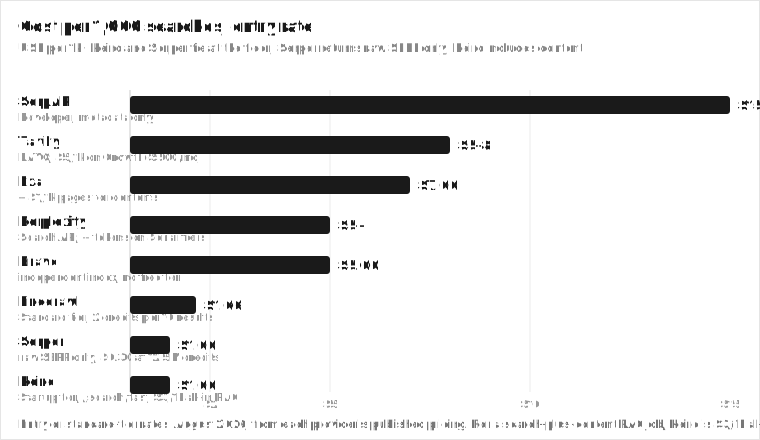
Cost per 1,000 searches at entry rates. Keiro and Serper tie at the $1 floor; everything above $5 is 5-15x more for the same volume.
The price list, with sources:
| API | $/1k | What you get for it | Source |
| --- | --- | --- | --- |
| **Keiro** | $1.00 | /search/fast: ranked results, snippets, freshness timestamps. $3/1k for /search/content with clean markdown + embeddings | [pricing](/pricing) |
| **Serper** | $1.00 | Raw Google SERP, up to 10 results per credit. $0.30/1k only at 12.5M credits ($3,750 prepaid) | [pricing](https://serper.dev) |
| **Firecrawl** | $1.98 | Search at the Standard tier (2 credits per 10 results). Extraction, scraping, and crawling billed separately | [pricing](https://firecrawl.dev/pricing) |
| **Brave** | $5.00 | Independent-index search results with schema-enriched metadata. Answers API is $4/1k + $5/M tokens | [pricing](https://brave.com/search/api/) |
| **Tavily** | $5-8 | Agent-optimized results. PAYG is $8/1k ($0.008/credit); the $5/1k rate requires the $500/mo Growth plan | [credits](https://docs.tavily.com/documentation/api-credits) |
| **Perplexity** | $5+ | Raw Search API is $5/1k. Sonar request fees run $5-12/1k by context size, plus $1/$1 per 1M tokens | [pricing](https://docs.perplexity.ai/docs/getting-started/pricing) |
| **Exa** | $7.00 | Semantic search, first 10 results. Every result above 10 costs $1/1k; contents are $1/1k pages | [pricing](https://exa.ai/pricing) |
| **SerpAPI** | $15.00 | Google SERP fidelity, 40+ engines. Drops to $9.17/1k at the Big Data tier | [pricing](https://serpapi.com/pricing) |
**The floor is $1/1k, and it is a two-way tie.** Keiro and Serper both sell searches at $1 per thousand. The difference is what the search returns: Serper returns titles, URLs, and snippets and stops; Keiro's /search/fast returns the same rank-and-snippet layer, and its /search/content returns the clean page text and optional embeddings at $3/1k, three times the price for a product the SERP APIs do not sell at any price. **For an apples-to-apples search-plus-content job, the real price ranking is Keiro at $3/1k all-in, Firecrawl at $1.98/1k for search plus separate extraction costs, Tavily at $5-8/1k, Brave at $5/1k, Exa at $7/1k plus $1/1k contents, and Perplexity at $5-12/1k plus tokens.**
Two cost traps to price before you sign up. **Serper's $0.30/1k headline only appears at 12.5 million credits, which costs $3,750 and expires in six months, most teams never burn that.** And **Firecrawl's search price assumes the $99/mo Standard tier ($1.98/1k); on the $19/mo Hobby tier, the same 2 credits per 10 results works out to about $7.60/1k.** Always price search at the tier you will actually buy.
## How fast is each API?
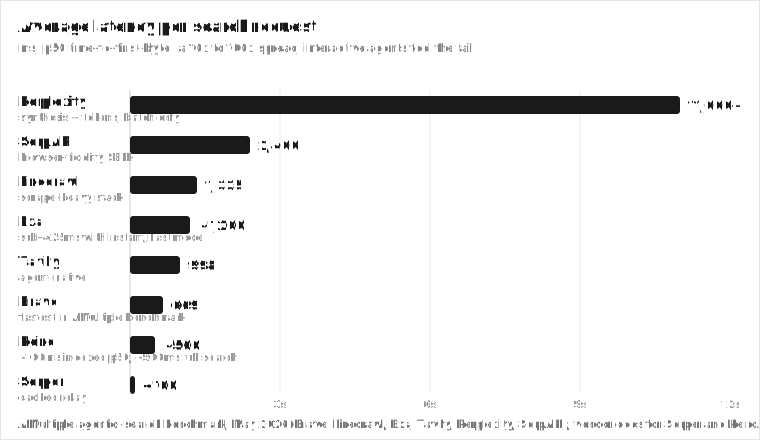
Average latency per request. Serper and Keiro sit at the sub-second floor; Perplexity at 11+ seconds is in a different regime entirely.
Latency compounds in agents. A research loop that runs five searches takes about 3 seconds with Brave (669ms each) and over a minute with Perplexity (11,000ms each). **At 11+ seconds per request, Perplexity is a batch tool: fine for async research, disqualifying for interactive agents.** The interactive-feasible zone is everything under ~1 second.
| API | Latency (p50) | Source |
| --- | --- | --- |
| **Serper** | <100ms (cached relay) | vendor docs |
| **Keiro** | ~100ms indexed p50; ~500ms full search | [API docs](https://api.keirolabs.cloud) |
| **Brave** | 669ms | [AIMultiple benchmark](https://aimultiple.com/agentic-search) |
| **Tavily** | 998ms | AIMultiple |
| **Exa** | ~1,200ms (sub-425ms in Instant/Fast mode) | AIMultiple + [Exa docs](https://exa.ai) |
| **Firecrawl** | 1,335ms | AIMultiple |
| **SerpAPI** | 2,400ms | AIMultiple |
| **Perplexity** | 11,000ms+ | AIMultiple |
**The latency spread is more than 100x, and it is not a quality trade.** Brave is simultaneously the fastest and the highest-scoring API in AIMultiple's benchmark, you do not have to give up speed for quality. Keiro's ~500ms full-search average sits mid-pack, and its indexed p50 (~100ms) is among the fastest in the set, but it is not the speed leader. Serper's sub-100ms cached-relay figure is the fastest of the eight, which is part of why it dominates raw SERP workloads.
## How does each of the 8 APIs rank, in detail?
### 1. Keiro, the value leader
Price $1/1k on /search/fast at the Startup tier ($50/mo, 50,000 credits, 1,000 req/min). $3/1k all-in for /search/content (search + clean markdown + optional embeddings, 3 credits). Free tier: 500 credits/mo, 30 req/min, no card. [pricing](/pricing)
Best for Agent and RAG retrieval where you want the cheapest one-call path from query to clean, embedding-ready content.
The catch Not the fastest (mid-pack), not the biggest free tier, no keyword-free find-similar. The agentic deep-research endpoint is 20 credits per call.
Keiro is a search-plus-extraction API. Its index covers 50B+ pages, and every result carries a freshness timestamp, hot URLs are re-crawled in seconds, trending topics in minutes. The credit map is flat: /search/fast is 1 credit, /search/content is 3 credits (returning full markdown and optional 384-to-1024-dim embeddings in the same call), /answer is 5 credits for a synthesized cited answer, /extract is 3 credits, and /search/batch is 1 credit per query for async bulk search. **The headline number is the RAG math: /search/content at 3 credits costs about $3/1k all-in, and nothing in the search-plus-content category prices below $5/1k.** Tavily is $5-8/1k for comparable output; Exa is $7/1k plus $1/1k page contents; Brave's LLM Context is $5/1k.
On published QA benchmarks, Keiro leads the three APIs that return answers: SimpleQA 94 vs Perplexity 86 and Tavily 78, FreshQA 91 vs 83 and 77, HotpotQA 82 vs 74 and 68, all scored by a Gemma 3 12B judge. [FinanceBench](/financebench), the finance-focused QA set, comes in at 78%. **These are self-published numbers, AIMultiple did not include Keiro in its May 2026 benchmark, so treat them as vendor data with a reproducible judge rather than third-party verification.** The 500-credit free tier is small by the standards of this list (Exa grants 20,000 search/mo) but it covers every endpoint and requires no card, which is more than Brave (whose $5/mo credit needs a card and public attribution) or Perplexity offer at all.
Pros
Floor price: $1/1k search, $3/1k all-in RAG, the only API that combines both.
Content bundled in the search call: markdown + embeddings, no separate pipeline.
Native MCP, 50B+ index, freshness timestamps on every result.
Free tier works: 500/mo, no card, commercial use allowed.
Cons
Self-reported benchmarks; not in AIMultiple's third-party set.
No keyword-free semantic find-similar (Exa's specialty).
Not the fastest, ~500ms full search, ~1s fast endpoint.
Agentic deep research at 20 credits/call is expensive per request.
Newer SDK ecosystem than Tavily's LangChain-native integrations.
### 2. Firecrawl, the full web stack
Price Search is 2 credits per 10 results. Free tier 1,000 credits/mo. Standard is $99/mo for 100,000 credits ($1.98/1k searches; $83/mo billed annually). Scrape, crawl, map, and monitor are 1 credit/page. [pricing](https://firecrawl.dev/pricing)
Best for RAG pipelines that need search plus deep scraping, crawling, and browser interaction under one API.
The catch Credit multipliers (stealth mode is 5 credits/page), $99/mo to reach the cheap search rate, and the slowest search of the top three.
Firecrawl is the deepest tool in this set. Search, scrape, crawl, map, interact (a headless browser session), and an agent endpoint, all under one key, all returning token-efficient markdown. **Its MCP server is the best in the category: official, remote-hosted, keyless on the free tier, with 14+ tools.** The open-source client has 130K+ GitHub stars and can be self-hosted for data residency. In AIMultiple's benchmark it scored 14.58, statistically tied with Brave and Exa on quality, at 1,335ms.
The pricing is where Firecrawl's ranking slips from #1 contender to #2. **Search costs 2 credits per 10 results, which is $1.98/1k only at the $99/mo Standard tier, and the credit model has a long tail of multipliers.** Stealth mode (anti-bot) is 5 credits per page. JSON output and enhanced mode add more. A search-then-scrape workflow that burns 2 credits on search plus 1 per page for scraping ends up well past the $1.98 headline. Free tier is 1,000 credits/mo, which covers roughly 5,000 search results.
Pros
Full web stack: search, scrape, crawl, map, interact under one API.
Best MCP tooling: official remote server, keyless free tier, 14+ tools.
Open-source core (130K+ stars), self-hostable.
High quality: 14.58 agent score in AIMultiple, tied with the leaders.
Cons
$1.98/1k search requires the $99/mo Standard tier.
Credit multipliers: stealth 5cr/page, JSON/enhanced add more.
1,335ms latency, mid-pack for interactive agents.
Search-only rate is 2 credits per 10 results; content is billed separately.
### 3. Exa, semantic depth, biggest free tier
Price $7/1k search (up to 10 results; $1/1k per extra result). Contents $1/1k pages. Answer $5/1k, deep $12/1k, deep-reasoning $15/1k. Free: 20,000 search/mo. [pricing](https://exa.ai/pricing)
Best for Concept-based discovery, finding pages that mean the same thing with zero shared keywords.
The catch $7/1k is 7x the floor, freshness lags keyword engines on breaking news, and contents bill per content type per page.
Exa is the only provider here with a neural index: search by meaning rather than term overlap, built on link-prediction training. Give it "companies building vector databases" and it returns startups that say "storage engine for embeddings" and never use the phrase. **That is a genuinely different retrieval primitive, and it is the reason Exa is the semantic-discovery specialist even at 7x the floor price.** The free tier is the biggest in this list at 20,000 search/mo, and its remote MCP server (mcp.exa.ai) is official and OAuth-enabled.
The cost model has three traps. **The $7 headline covers only the first 10 results, asking for 30 results per search bills the extra 20 at $1/1k each, turning a $7/1k request into $27/1k.** Contents bill per content type per page: request text and highlights for the same page and you are billed twice. And since a March 2026 change, contents for the first 10 results are bundled into the search price, good, but the moment you go past 10 results the extras meter. Exa's 14.39 agent score in AIMultiple is genuinely strong, but its neural index is weaker on freshness than a keyword engine for breaking news, which is why it scores 7.5 rather than higher on quality.
Pros
Keyword-free semantic find-similar, a different retrieval primitive.
Biggest free tier: 20,000 search/mo, plus $1,000 startup grants.
Official remote MCP with OAuth.
Sub-425ms Instant/Fast mode for latency-sensitive loops.
Cons
$7/1k is 7x the floor; extras above 10 results meter at $1/1k each.
Contents bill per content type per page.
Freshness lags keyword engines for breaking news.
10 QPS default cap; rate-limit upgrades cost more.
### 4. Tavily, the agent-native incumbent
Price Free 1,000 credits/mo. PAYG $8/1k ($0.008/credit). Growth: 100,000 credits for $500/mo = $5/1k. Basic search is 1 credit; advanced is 2. [credits](https://docs.tavily.com/documentation/api-credits)
Best for LangChain/LlamaIndex-native agent stacks that want search, extract, and research under one SDK.
The catch The competitive $5/1k rate is locked behind $500/mo; PAYG is $8/1k, and the Research endpoint can burn 4-250 credits per request.
Tavily built the search API category for agents and still has the best framework ergonomics in the set. **Its remote MCP server (mcp.tavily.com) with native OAuth is the smoothest MCP onboarding of the eight, no local install, no key in a URL, just an authorize flow.** Search returns agent-optimized results with inline content and citations, and /extract pulls full page text at 5 pages per credit. AIMultiple scored it 13.67 at 998ms, solid mid-pack quality, interactive-grade latency.
The pricing story is mixed. **At $0.008/credit PAYG, a basic search is $8/1k, 8x Keiro and Serper.** The $5/1k rate exists, but it requires the $500/mo Growth plan, which is a big commitment for a pricing comparison. The Research endpoint is the real cost hazard: 4 to 250 credits per request depending on model and depth, with no hard cap, a single deep research call can cost more than a month of basic searches on the free tier. Tavily ranks #4 not because it is bad, but because it is the most expensive of the four agent-native APIs for the same output.
Pros
Best MCP ergonomics: official remote server with OAuth.
Solid quality (13.67) and latency (998ms) from AIMultiple.
Free 1,000 credits/mo recurring, no card.
Cons
$8/1k PAYG; $5/1k only at $500/mo commitment.
Advanced search doubles to 2 credits per request.
Research endpoint: 4-250 credits/request, hard to forecast.
Basic search has no bundled embeddings.
### 5. Brave, the independent index, fastest in the benchmark
Price $5/1k Search plan. Free tier removed February 2026; its replacement is a $5/mo credit allowance (about 1,000 requests) on a card-required free plan, with public attribution. Answers API $4/1k + $5/M tokens. [pricing](https://brave.com/search/api/)
Best for Privacy-sensitive apps on an independent 30B+ page index with zero query retention and SOC 2.
The catch The free tier is a shallow $5/mo credit allowance (card required), $5/1k, and the LLM Context API only exists on the paid Search plan.
Brave owns the only independent Western index in this set. Not a Google or Bing wrapper, 30B+ pages crawled in-house, SOC 2 Type II, zero data retention on queries. **AIMultiple's May 2026 benchmark crowned it: the highest agent score (14.89) and the lowest latency (669ms) of the eight.** For legal, health, or financial work where the query log itself is a liability, Brave's posture is unmatched in this list.
The LLM Context API (launched February 2026) does deep extraction plus structured data (JSON-LD, tables, code blocks, Reddit threads) and ranks smart chunks under a token budget, genuinely competitive with the search-plus-content APIs. **But it is gated behind the $5/1k Search plan, and the $5/mo credit goes fast.** Brave's $5/mo credit (with public attribution required) is an allowance, not a generous free tier: roughly 1,000 requests, and the card required at signup is an anti-fraud check that is not charged on the free plan. That is why Brave scores 1.0/10 on free tier while scoring 9.0 on quality, it is the best engine in the benchmark and the shallowest to try.
Pros
Independent 30B+ page index, not a Google/Bing wrapper.
Best benchmark numbers: 14.89 agent score, 669ms latency.
SOC 2 Type II, zero data retention, no tracking.
LLM Context API bundles deep extraction + structured data.
Cons
Free tier replaced in February 2026 by a shallow $5/mo credit (card required).
$5/1k is 5x the floor for raw search.
No bundled embeddings; RAG needs a separate embedding step.
MCP server is official but local-only (no remote/cloud option).
### 6. Serper, the cheapest raw Google SERP
Price $1/1k at $50 for 50,000 credits, down to $0.30/1k at 12.5M credits. 1 credit = up to 10 results; 11-100 results = 2 credits. 2,500 free one-time. [pricing](https://serper.dev)
Best for High-volume raw Google SERP where you already run your own extraction pipeline.
The catch No content, no answers, no embeddings, and no official MCP server. Extraction is entirely on you.
Serper is a relay, not an index. Send `q`, `num`, `gl`, `hl`, get structured Google JSON in under 100ms. **It is the cheapest raw SERP on the market and the fastest API in this list, which is exactly why it dominates SERP-only workloads.** The credit math is simple: 1 credit for up to 10 results, 2 credits for 11-100. Ten search types (web, images, news, maps, shopping, scholar, patents) under one key.
But Serper sells links, not context. **There is no bundled content, no answer endpoint, no embeddings, and no official MCP server, integration means a community wrapper or your own glue.** Its 2,500 free credits are one-time, not recurring, and the $0.30/1k headline requires buying 12.5M credits ($3,750) that expire in six months. For a raw-SERP workload where you parse links yourself, Serper is the right tool and nothing beats its price/speed. For an agent that needs to read what it finds, the extraction pipeline you would have to build closes the gap to the search-plus-content APIs, and then Serper is no longer the cheapest option.
Pros
Cheapest raw Google SERP: $1/1k, $0.30/1k at extreme volume.
Sub-100ms latency, ten search types, one key.
Prepaid credits, no subscription.
Cons
No content, answers, or embeddings, extraction is on you.
No official MCP server (community wrappers only).
Credits expire in ~6 months; the volume discount needs $3,750.
Google-only; no independent index, no SLA published.
### 7. Perplexity Sonar, the best citations, the slowest answer
Price Raw Search API $5/1k. Sonar request fees $5-12/1k by context size plus $1/$1 per 1M tokens; Sonar Pro $3/$15 per 1M plus $6-14/1k. No free tier. [pricing](https://docs.perplexity.ai/docs/getting-started/pricing)
Best for Batch research pipelines that want a finished cited answer without running their own LLM.
The catch 11+ seconds per request. Not an interactive API. And the token bill compounds on top of the per-request fee.
Perplexity is the only provider here that sells a finished answer: question in, cited synthesis out, no retrieval pipeline on your side. **Its citations are the best in the category, native, per-claim, and good enough to ship in a product.** Its official MCP server is remote-hosted (api.perplexity.ai/mcp) with a local npm option, so agent integration is easy. In AIMultiple's benchmark it scored 12.96, not the leader, but respectable, at 11,000ms+, by far the slowest of the eight.
The cost model has two meters. **The per-request fee runs $5-12/1k depending on context size, and the token bill is separate: $1/$1 per 1M for Sonar, $3/$15 per 1M for Sonar Pro.** A short factual lookup where the search fee is $0.005-0.012 is fine, but a long cited answer on Sonar Pro burns output tokens at $15/M, and Deep Research adds yet another $2/M citation + $3/M reasoning meter plus $5/1k searches. **At 11 seconds and $5-12/1k plus tokens, Sonar is a batch/async tool, not a drop-in search API for interactive agents.** Its 1.5/10 latency score is the single lowest criterion score in the entire table.
Pros
Best citations: native, per-claim, product-ready.
Finished cited answer in one call, no retrieval pipeline.
Official remote MCP server.
Standalone Search API at $5/1k for teams that already run an LLM.
Cons
11,000ms+ latency, batch only, not interactive.
$5-12/1k request fees plus separate token billing.
No free tier.
Returns an answer, not raw results, no reranking or chunk control.
### 8. SerpAPI, the most expensive, and it does the least
Price from $15/1k Developer, $25/1k Starter, $9.17/1k Big Data. 250 free/mo. 40+ engines, 99.9% SLA, 100 QPS. [pricing](https://serpapi.com/pricing)
Best for Teams that need browser-fidelity Google SERP verticals (shopping, maps, images, flights, scholar) across many markets.
The catch 10-15x the cheapest options, metadata only, and the lowest quality score in the AIMultiple benchmark.
SerpAPI mirrors browser clicks: one API request equals one browser page visit, with 40+ engines and rich structured verticals. It has an official hosted MCP server, a 99.9% SLA, and up to 100 QPS, serious infrastructure for serious SERP teams. **At $15/1k, it is the most expensive API in this list, and AIMultiple scored its results the lowest (12.28) of the eight.** The rate drops to $9.17/1k at the Big Data tier (30,000 searches for $275), but at any realistic volume it remains 10-15x the floor.
The ranking is blunt here. **SerpAPI scores 2.0/10 on cost and 1.5/10 on bundled content, you pay the most for the least machine-readable output.** Its metadata is rich (knowledge panels, shopping grids, maps data) but it is metadata: no clean page text, no answers, no embeddings. If you need Google SERP fidelity for SEO tooling or market research, SerpAPI's verticals justify the price. For agent and RAG retrieval, it is not in the conversation.
Failed/cached requests are free (successful searches only count).
Cons
$15/1k is 15x the cheapest options.
Metadata only, no content, no answers.
Lowest quality score (12.28) in the AIMultiple benchmark.
2,400ms latency, mid-slow pack.
## Where does Keiro lose?
The ranking puts Keiro first, and this section exists so you can trust the ranking. **Keiro genuinely loses in four places, and the honest move is to name them with the numbers.**
**To Exa on free tier and semantic find-similar.** Exa's 20,000 free search/mo is 40x Keiro's 500. For discovery workloads, "find pages that mean this, even if they never say it", Exa's neural index is a different primitive that Keiro does not attempt. If your whole job is semantic recall, Exa is the specialist, and no score in this ranking changes that.
**To Brave on independent-index quality, privacy, and raw latency.** AIMultiple measured Brave at 14.89 agent score and 669ms, better numbers than any API in this list on both axes. Brave's zero-data-retention, SOC 2 posture is unmatched. Keiro's own published QA scores are strong, but they are self-reported; Brave's are third-party. For a privacy-first app, Brave wins outright.
**To Serper on raw SERP price at volume.** For a pure links-and-snippets feed, Serper at $1/1k (and $0.30/1k at extreme volume) beats Keiro's $1/1k /search/fast on speed (<100ms vs ~500ms) and ties it on price for a product that is strictly less capable. If you do not need content, Serper is the cheaper tool.
**To Perplexity on citation polish.** Perplexity's citations are native, per-claim, and product-ready in a way that Keiro's /answer citations (URLs + snippets + scores) are not. Keiro's are sufficient for grounding; Perplexity's are the best in the category.
**Where Keiro wins is the combination.** **No other API in the set sells a $1/1k search and a $3/1k search-plus-content call. That is not a marketing claim; it is arithmetic off published prices.** You cannot buy Tavily's content at Keiro's price, or Exa's semantics at Keiro's price, or Serper's price with any content at all. The value gap is the product.
## What do the hidden costs do to the real bill?
Headline prices are the marketing layer; the invoice is what the credit multipliers do. **The biggest hidden cost in this category is the SERP-only trap: Serper at $1/1k and SerpAPI at $15/1k both return links, so a RAG pipeline adds a scraping step that is billed by a second provider.** At 100k queries/month with 3 pages read per query, that extraction layer runs $300-1,000/month on top of the search bill, which is why the search-plus-content APIs price the way they do.
The other traps, priced:
| Trap | Who | The real number |
| --- | --- | --- |
| Extra results meter | Exa | 30 results/search = $7 + $20 = $27/1k, not $7/1k |
| Credit multipliers | Firecrawl | Stealth mode 5cr/page; JSON/enhanced add more |
| Research endpoint | Tavily | 4-250 credits per request, no cap |
| Token meter | Perplexity | $5-12/1k request fee + $1/$1 to $3/$15 per 1M tokens |
| Volume-gated discount | Serper | $0.30/1k only at $3,750 prepaid, credits expire in 6 months |
| Rate-limit upgrade | Exa | 10 QPS default; higher QPS is enterprise-priced |
| Free-tier strings | Brave, Perplexity | Perplexity has no recurring tier; Brave's $5/mo credit (card required) requires attribution |
**Keiro's hidden-cost profile is the flattest in the set: 1 credit per search, 3 per content call, no token meter, no extra-result surcharge, and 1,000 req/min on the $50 Startup tier.** The flatness is itself a feature, a predictable bill is worth more than a lower one that surprises you. The 20-credit agentic deep-research endpoint is the one genuinely expensive line, and it is optional.
## Which search API should you pick?
Run this decision tree, not the ranking. **You need raw Google SERP at high volume and already run extraction: Serper, $1/1k, sub-100ms.** You need Google SERP vertical fidelity (shopping, maps, flights) across many markets: SerpAPI, $15/1k, worth it only for the verticals. You need an independent index with zero query retention: Brave, $5/1k, the fastest and highest-scoring in the benchmark. You need a finished cited answer for batch research: Perplexity Sonar, $5-12/1k plus tokens, 11s latency, citations you can ship.
**You need search + clean content for agents or RAG: Keiro at $3/1k all-in is the cheapest complete path, Firecrawl at $1.98/1k search + scraping is the deepest, Tavily at $5-8/1k is the most framework-native.** You need semantic find-similar with a big free tier to prototype: Exa, 20,000 search/mo, $7/1k after. The ranking above is the weighted average of these decisions; the tree is the decision itself.
One honest caveat about the ranking. **The weights are mine, and the order is sensitive to them, at 40% cost weighting, Serper overtakes Keiro for SERP-only work, and at 30% latency weighting, Brave closes most of the gap.** The value case for Keiro does not depend on a single weight: it holds at any weighting where bundled content is worth more than zero, because Keiro is the only API that pairs the floor price with a content call. Recompute with your own weights before you commit; every score is in the scorecard above.
Keiro is the cheapest full-featured search API in this ranking, $1/1k search, $3/1k all-in RAG, 500 free credits a month with no card.Start free · 1,250 credits/moSee pricing
## Further reading
For the full 12-provider cost comparison, latency data, and independent methodology behind this ranking, see the [AI search API pricing comparison](/blogs/comparisons/ai-search-api-pricing-compared) and the [cheapest web search APIs (Aug 2026)](/blogs/comparisons/cheapest-web-search-apis-aug-2026). If you are building the extraction pipeline that these APIs feed, see [Scraping at scale: queues, caching, and not getting banned](https://www.webscraping.space/blog/scraping-at-scale). And for the index-based pick behind the $1/1k math, see [the best web search API in 2026](/best-web-search-api). For the category-level decision tree behind this ranking, [What Type of Search API Do You Need?](/blogs/comparisons/top-8-ai-search-apis-compared-2026).
More from this series:
- [Cheapest Web Search APIs (Aug 2026)](/blogs/guide/cheapest-web-search-apis-2026)
- [Best Free Web Search APIs 2026](/blog/best-free-web-search-apis-2026)
- [Best Web Search API for AI Agents (Aug 2026)](/blogs/guide/best-ai-search-apis-for-agents-aug-2026)
- [Cheapest Web Scraping APIs (Aug 2026)](/blogs/guide/cheapest-web-scraping-apis-aug-2026)
- [Keiro pricing](/pricing), the exact credit math behind the $1/1k figure
- [FinanceBench: how the 78% score is measured](/financebench)
## FAQ
### What is the best web search API for AI agents in 2026?
On overall value, Keiro ranks #1 (8.93/10 weighted score). It is the only API that combines the $1/1k price floor with a $3/1k search-plus-content call that returns clean markdown and optional embeddings. For specific workloads: Serper is the cheapest raw SERP ($1/1k), Brave is the fastest and highest-scoring in AIMultiple's benchmark (669ms, 14.89), Exa has the biggest free tier (20,000/mo), and Perplexity has the best citations. The best API depends on whether you need links, content, or answers.
### How did you weight the ranking criteria?
Cost per 1k gets 25%, result quality/freshness 20%, bundled content 15%, and citations, MCP/agent support, free tier, and latency 10% each. Every score is a 0-10 judgment on published numbers with sources inline in each provider section. The ranking is sensitive to the weights: at 40% cost weighting, Serper overtakes Keiro for SERP-only work; at 30% latency weighting, Brave closes most of the gap.
### What is the cheapest search API per 1,000 requests?
Two APIs tie at the floor: Keiro and Serper both sell searches at $1/1k. Serper returns a raw Google SERP (links and snippets); Keiro returns ranked results plus freshness timestamps, and its /search/content endpoint adds clean markdown and embeddings at $3/1k all-in. The cheapest search-plus-content option is Keiro at $3/1k. Serper's $0.30/1k rate requires buying 12.5M credits for $3,750, which expire in six months.
### Why is Keiro ranked #1 if it is not the best at anything?
Keiro is the best at the combination, which is what value means: it scores 9.5 or higher on both cost (25% weight) and bundled content (15% weight), and no other API in the set does. Brave beats it on quality and latency; Exa beats it on free tier and semantic search; Serper beats it on raw-SERP price; Perplexity beats it on citations. Keiro is the only API that pairs the $1/1k floor with a $3/1k content call, that combination, not any single metric, is why it ranks #1.
### Where does Keiro lose to its competitors?
Four places, stated openly. Exa wins on free tier (20,000/mo vs 500) and keyword-free semantic find-similar. Brave wins on third-party benchmark quality (14.89 vs Keiro's self-reported 94/91/82 on SimpleQA/FreshQA/HotpotQA) and on zero-data-retention privacy. Serper wins on raw-SERP price at volume ($0.30/1k vs $1/1k) and latency (<100ms vs ~500ms). Perplexity wins on citation polish.
### How fast is each search API?
Serper is the fastest at under 100ms. Keiro is ~100ms indexed p50 and ~500ms full search. Brave measured 669ms, Tavily 998ms, Exa ~1,200ms (sub-425ms in Instant mode), Firecrawl 1,335ms, SerpAPI 2,400ms, and Perplexity 11,000ms+ in AIMultiple's May 2026 benchmark. Perplexity's latency makes it a batch tool; everything under ~1 second is interactive-feasible.
### Do these APIs have MCP servers?
Six of the eight have official MCP servers. Tavily and Firecrawl have remote-hosted servers with OAuth and the most tools; Exa and Perplexity have official remote servers; SerpAPI has a hosted server (API key in the URL); Brave has an official server but it is local-only. Keiro has a native MCP server. Serper is the only one with no official MCP, only community wrappers.
### Are Keiro's benchmark scores trustworthy?
Keiro's QA scores (SimpleQA 94, FreshQA 91, HotpotQA 82, FinanceBench 78%) are self-published, scored by a Gemma 3 12B judge against the public SimpleQA/FreshQA/HotpotQA leaderboards, and Keiro was not included in AIMultiple's third-party May 2026 benchmark. The methodology is reproducible, the judge is open-weights and the query sets are public, but they are vendor data, so treat them as unverified until you run them yourself. Brave's 14.89 score and 669ms latency are third-party measured.
### Which API should I use for RAG pipelines?
Keiro at $3/1k all-in is the cheapest complete path: search, clean markdown, and optional embeddings in one call. Firecrawl ($1.98/1k search on Standard, scraping billed separately) is the deepest for crawl-heavy pipelines. Tavily ($5-8/1k) is the most framework-native for LangChain stacks. Brave's LLM Context API ($5/1k) is the strongest if privacy and zero query retention are requirements. Avoid SERP-only APIs (Serper, SerpAPI) for RAG, they return links, and the extraction pipeline you would build costs more than the difference.
### Why is SerpAPI the most expensive?
SerpAPI sells browser-fidelity SERP across 40+ engines with a 99.9% SLA, 100 QPS, and legal indemnification. That infrastructure is real and expensive to run. But it is metadata only, and AIMultiple scored its results lowest (12.28) of the eight APIs it tested. At $15/1k (from) it is 15x the cheapest options and 5x Keiro's all-in RAG price. It is only worth it if you specifically need its SERP verticals, shopping, maps, flights, scholar, across many markets.