---
title: "Top 5 Exa Alternatives in 2026: Cheaper, Faster, Higher-Accuracy AI Search APIs"
dek: "Exa pioneered keyword-free semantic search at $7/1k. Five alternatives, with the public QA benchmarks and 2026 pricing that show where Keiro, Tavily, Perplexity, Brave, and SerpAPI each win."
category: "comparisons"
tags: [exa, alternatives, ai-search, api-comparison, keiro, benchmarks]
author: "Manny"
published: 2025-12-05T03:30:00+00:00
updated: 2026-07-16T00:00:00+00:00
url: https://keirolabs.cloud/blogs/comparisons/top-exa-alternatives
---
$1Keiro / 1k search
94Keiro SimpleQA
$7Exa / 1k search
7xprice gap
AI agents and RAG pipelines are in production now, and they need a search API that hands back clean, citable context. Not ten blue links. Exa got there early with embeddings-based semantic search built for machines, and it is still the tool you reach for when you want pages that mean the same thing as the one in your hand. But $7 per 1,000 search queries adds up, Contents is a separate paid call, and there is no batch. So a lot of teams are looking around.
This guide covers five alternatives, with the benchmark numbers and 2026 pricing to back each pick. It also covers how each tool actually works under the hood, because the per-1k price is not the whole bill. The shape of the bill is.
TL;DR · the five alternatives, by what they win on
- **Keiro:** QA and RAG accuracy at the lowest cost. Leads SimpleQA (94), FreshQA (91), HotpotQA (82). $1/1k, 500 free credits/mo, no card.
- **Tavily:** agent-native search with native LangChain and CrewAI integrations. $8/1k PAYG, 1,000 free/mo, inline content.
- **Perplexity (Sonar):** a cited, synthesized answer in one call. $5 to $12/1k plus tokens, 128K context, no permanent free tier.
- **Brave:** an independent 30B+ page index, SOC 2, privacy-first. $5/1k, free tier removed Feb 2026; its replacement is a $5/mo credit allowance (about 1,000 requests) on a card-required free plan.
- **SerpAPI:** Google SERP fidelity across 40+ engines. From $15/1k, free 250/mo, metadata only.
- **The honest line:** for pure "find similar" retrieval, Exa is still the specialist. For QA, RAG, and agent workloads, Keiro leads the benchmarks and is 7x cheaper.
## Why people look for Exa alternatives
It is usually one of five things.
- **The bill at scale**, when 100k queries a month turns into a real number.
- **No batch endpoint**, so every async job is a loop of paid calls.
- **No bundled content extraction**, so you call search, then you call Contents, then you chunk.
- **No first-class answer endpoint that comes back in milliseconds.**
- **The 10 QPS default rate limit**, which is tight for a busy agent stack.
None of that makes Exa bad. Its semantic "find similar" search is real and useful and unmatched. It means the rest of the stack moved and Exa's pricing did not.
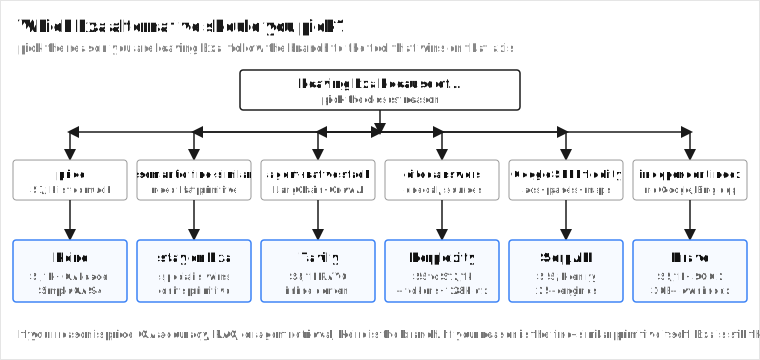
Branch on the reason you are leaving Exa. Price and QA accuracy go to Keiro. The find-similar primitive itself stays on Exa.
## What is Exa: quick overview
Exa is a search engine built for machines. Instead of preprocessing documents into keywords the way Google does, Exa trains specialized transformer models to convert each document into an embedding, then serves those embeddings from a custom vector database it built from high-level clustering down to low-level assembly. The "Bitter Lesson" framing: embedding models can keep eating more compute, static keyword algorithms cannot. It runs a 144-H200-GPU cluster they call the Exacluster.
The main APIs:
- **Search** for semantic queries that capture context and intent. Latency tiers: `instant` (sub-150ms), `fast` (p50 under 425ms), `auto` (about 1s, default), `deep` (4 to 12s), `deep-reasoning` (12 to 50s).
- **Contents** for clean, parsed content off the results. First 10 result pages are free with a search call.
- **Find Similar** for "give it one URL, get similar pages back." The standalone `find_similar` method is deprecated but still functional; the unified `search` endpoint now returns `score` and `highlightScores` (cosine similarity per snippet), so similarity is a parameter on search, not a separate endpoint.
- **Answer** for summarized responses with citations.
- **Research / deep-reasoning** for multi-step reasoning that returns structured JSON with field-level citations. `deep-reasoning` replaced the legacy `/research` endpoint, which was deprecated in April 2026.
- **Websets** for big queries that return thousands of results (can take up to an hour).
Pricing: free tier of **20,000 requests a month** (search only), then **$7/1k** for search, **$12/1k** for deep search and **$15/1k** for deep-reasoning search, **$1/1k pages** for Contents (first 10 free with search), **$5/1k** for answers. Default rate limit is 10 QPS. Closed source, cloud only. There is also an Agent product at $0.10 per Agent Compute Unit with fixed effort modes from $0.012 (minimal) to $1.00 (X-high).
The shape of the bill matters more than the headline. A RAG pipeline that runs 50,000 searches a month and fetches content for each result pays roughly $350 for search plus another $200 to $400 for Contents, depending on how many pages it pulls. The same workload on Keiro's bundled `/api/v2/search/content` is about $150 total. That is the gap people are trying to close.
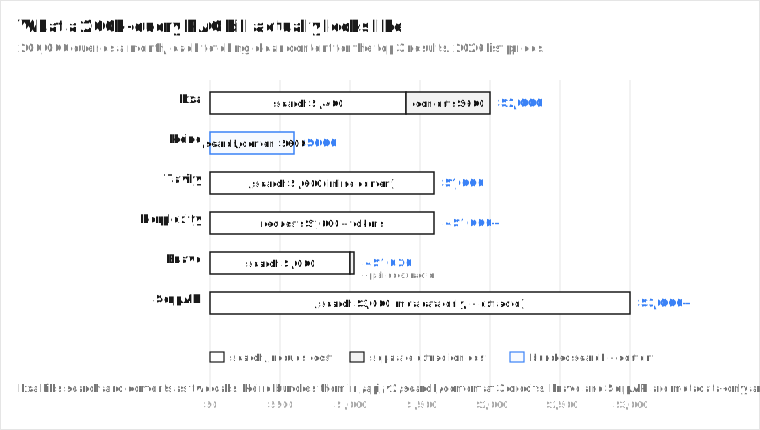
Same 200k-query RAG workload, 2026 list prices. Exa bills search and contents as two calls and lands at about $2,000. Keiro bundles them in one /search/content call at $600. Brave and SerpAPI are metadata-only and need a paired extractor for RAG, which is why their bar leaves a gap.
## Top 5 Exa alternatives
Keiro the cheapest full-featured layer
This is our product, so I will be specific. Keiro is first because it leads the public factual-QA benchmarks and costs a fraction of the field. Not because I say so. Because the numbers do.
On three standard QA benchmarks (judge: Gemma 3 12B, same endpoint):
Keiro leads Perplexity and Tavily on SimpleQA, FreshQA, and HotpotQA. Exa, Brave, and SerpAPI are not on these benchmarks; their claim is a different primitive, not QA accuracy.
- **SimpleQA:** Keiro 94, Perplexity 86, Tavily 78
- **FreshQA:** Keiro 91, Perplexity 83, Tavily 77
- **HotpotQA:** Keiro 82, Perplexity 74, Tavily 68
- **FinanceBench:** 78% (the [full FinanceBench breakdown](/financebench) is here)
| Feature | Keiro | Exa |
| --- | --- | --- |
| Primary use case | QA / RAG / agent search + extraction | Semantic search and discovery |
| Search method | 50B+ page index, keyword plus freshness | Embeddings-based semantic |
| Latency (indexed) | ~100ms | ~1s (auto) |
| Content extraction | Bundled in `/search/content`, 3 credits | Separate Contents API, $1/1k pages |
| Batch | Yes, async, thousands per job, 1 credit each | No |
| Answers | `/api/v2/answer`, 5 credits | Answer API, $5/1k |
| Price per 1k search | $1.00 (Startup list) | $7.00 |
| Free tier | 500 credits/mo, no card, commercial OK | 20,000/mo, search only |
**How it actually works.** Keiro is index-first. A 50B+ page web index, keyword retrieval plus a freshness signal, with nine v2 endpoints layered on top. Indexed search (`/api/v2/keiro`, 1 credit, ~100ms) for fast lookups. Always-fresh search (`/api/v2/search/fast`, ~1s) and a ~500ms flash search (`/api/v2/search/flash`) for when you need the latest. Search-plus-content (`/api/v2/search/content`, 3 credits) returns results and clean page text in one call, with optional embeddings at 384, 512, 768, or 1024 dimensions. Structured extraction (`/api/v2/data`, 2 credits) for pulling fields off a URL. Async batch (`/api/v2/search/batch`, 1 credit per query) for thousands of queries in one job. An answer endpoint (`/api/v2/answer`, 5 credits), agentic deep research (`/api/v2/agentic`, 20 credits), and a standalone extract (`/api/v2/extract`, 3 credits).
Average latency is about 487ms across the suite. Hot URLs refresh in seconds, trending pages in minutes. The index is an index, not a scraper that hits the live web on every query, which is why indexed search sits at ~100ms instead of ~1s.
**A concrete scenario.** You run a support agent that answers 200,000 questions a month. Each answer needs a search plus clean page text for the top 3 results.
- On Exa: 200k searches at $7/1k ($1,400) plus 600k Contents pages at $1/1k ($600) = about $2,000.
- On Keiro `/api/v2/search/content`: 200k calls at 3 credits each = 600k credits, at $1/1k list = $600.
Same workload, same retrieval-plus-extraction shape, roughly 3.3x cheaper. The gap widens if you batch, because Keiro's batch endpoint is 1 credit per query and Exa has no batch at all.
```bash
curl -X POST https://api.keirolabs.cloud/api/v2/keiro \
-H "Authorization: Bearer keiro_your_api_key_here" \
-H "Content-Type: application/json" \
-d '{"query": "latest AI developments", "maxResults": 10}'
```
Auth is `Authorization: Bearer keiro_...` in the header, not an `apiKey` in the body. Free tier gets 30 requests/min; Pro gets 300; Enterprise gets 1,000.
Best for QA, RAG, and agent retrieval where benchmark accuracy at the lowest cost is the goal.
Price $1/1k (Startup list). 500 free credits/mo, no card, commercial use allowed on the free tier.
The catch Keiro is index-first with a freshness fallback, not a keyword-free similarity engine. If your job is "find pages semantically similar to this rare document," Exa is still the specialist. For QA and RAG, that is not the job.
Pros
Leads SimpleQA, FreshQA, HotpotQA on public benchmarks
$1/1k, 7x cheaper than Exa, with 500 free credits/mo and no card
Search plus clean content bundled in one call at /search/content
Async batch for thousands of queries per job
Nine endpoints cover search, answers, extraction, embeddings, deep research
Cons
Not a keyword-free "find similar" engine; similarity is not the primitive
Our product, so read the benchmark methodology yourself
Younger ecosystem of framework integrations than Tavily
Tavily agent-native, LangChain first
Tavily is the closest thing to an "agent-native" search API. Results come pre-ranked with relevance scores, content snippets inline, and an optional AI answer. The framework integrations are the best in the category. LangChain, CrewAI, and LlamaIndex all treat it as first-class.
| Feature | Tavily | Exa |
| --- | --- | --- |
| Primary use case | AI search and research workflows | Semantic search and discovery |
| Search method | Multi-source aggregation + rerank | Embeddings-based semantic |
| Standout | Native LangChain, inline content | Find Similar |
| Output | Structured results + raw content | Parsed HTML, snippets |
| Price per 1k | $8.00 PAYG (1,000 free/mo) | $7.00 |
**How it actually works.** Tavily aggregates across up to 20 sources per `/search` call, runs a proprietary rerank model over them, and returns structured results with raw content inline. That inline content is the lever: you skip the separate extraction call that Exa charges for. The endpoint set is `search`, `extract`, `crawl`, `map`, and `research`. Search depth toggles latency versus relevance: `basic`/`fast`/`ultra-fast` are 1 credit, `advanced` is 2 credits. Extract takes up to 20 URLs and returns clean markdown, with `advanced` depth for JS-rendered pages and tables. Crawl is graph-based site traversal with instructions, max depth 1 to 5, and a default limit of 50 pages.
The framework ergonomics are real. A LangChain tool-call to Tavily is two lines, and CrewAI agents ship with Tavily as the default search tool in most tutorials. Session tracking via `session_id` and `human_id` is built in for multi-step agents.
**The gotchas.** A few real ones from the docs.
- `auto_parameters` can silently double your per-query cost by auto-setting `search_depth` to `advanced` (2 credits). Set `search_depth` explicitly if you care about the bill.
- `chunks_per_source` only works under specific conditions: `advanced` depth on search (max 3), with a `query` on extract (max 5), with `instructions` on crawl (max 5). Get this wrong and you silently get full content instead of chunks.
- Failed extractions are not charged, but `include_usage` can return 0 until you hit the 5-extraction minimum on a batch.
- Error codes to watch: `432` plan limit, `433` PAYG limit, `429` rate limit, `403` URL not supported.
- At $8/1k PAYG it is more than Exa's $7/1k search, and the 1,000 free credits a month run out fast for a production agent. On the QA benchmarks above, Keiro outscores Tavily by 16, 14, and 14 points. Tavily's strength is the integration layer, not the retrieval layer.
**A concrete scenario.** A CrewAI research agent runs 10,000 multi-step research tasks a month, each calling `/search` once at `advanced` depth (2 credits) for reranked results plus inline content.
- Tavily: 10k calls x 2 credits = 20k credits. At $0.008/credit PAYG that is $160/month.
- Exa equivalent: 10k searches at $7/1k = $70, plus Contents for top 3 results = 30k pages at $1/1k = $30, total $100. Exa is actually cheaper here per query, but you lose the CrewAI native wiring and the inline content shape that the agent expects.
This is the honest tradeoff. Tavily wins on integration ergonomics, not on per-query price or benchmark accuracy.
Best for Teams whose muscle memory is LangChain or CrewAI tool-calling and who value integration ergonomics over per-query cost.
Price $8/1k PAYG, 1,000 free credits/mo.
The catch Pricier than Exa per 1k, and Keiro outscores it by 16 points on SimpleQA. Pick Tavily for the framework fit, not the retrieval quality.
Pros
Native LangChain, CrewAI, LlamaIndex integrations
Raw content inline on /search, no separate extraction call
Flat transparent PAYG pricing, failed extractions not charged
Crawl with natural-language instructions and graph traversal
Cons
$8/1k is more than Exa's $7/1k search
auto_parameters can silently double cost to 2 credits
1,000 free credits/mo is tight for production agents
Trails Keiro by 16/14/14 points on the three QA benchmarks
Perplexity (Sonar API) cited answers in one call
Sonar pairs a live web crawl with an in-house LLM and returns a synthesized, cited answer in one call. It replaces a search-plus-LLM pipeline. The API is OpenAI-compatible: point your OpenAI SDK at `api.perplexity.ai` and you are done.
| Feature | Perplexity Sonar | Exa |
| --- | --- | --- |
| Primary use case | Cited answers with sources | Semantic search and discovery |
| Search method | Live crawl plus LLM | Embeddings-based semantic |
| Output | Summarized answer plus citations | Parsed HTML, snippets |
| Context | 128K tokens | Snippet-based |
| Price per 1k | $5 to $12 + tokens | $7.00 |
**How it actually works.** You send a chat-completions-style request with `model: sonar` and `web_search_options.search_context_size` set to low, medium, or high. Sonar crawls the live web, feeds the results into its LLM with a 128K token context window, and returns an answer with inline `[1][2]` citation markers plus a `citations` array of URLs and a richer `search_results` array. Low-context requests run about $5/1k; high-context run about $12/1k. On top of that you pay $1 per 1M input tokens and $1 per 1M output tokens.
The model lineup matters: `sonar` is the base, `sonar-pro` adds multi-step Pro Search ($3 in / $15 out per 1M), `sonar-reasoning-pro` exposes chain-of-thought, and `sonar-deep-research` runs long autonomous research with its own citation-token and search-query billing. Pro Search requires `stream: true` or it will not run.
**The gotchas.** More than the others, because the bill has more knobs.
- **Sonar is in maintenance mode.** Perplexity recommends the newer Agent API for new integrations. Existing Sonar workloads keep working, but treat Sonar as the stable-but-legacy path.
- **Deep Research billing balloons.** Reasoning tokens can hit 300k+ per query, so a single deep-research call can cost over $1. The model auto-decides how many searches to run and you bill $5/1k search queries inside it. You cannot cap it directly.
- **`response_format` does not strip reasoning tokens** on `sonar-reasoning-pro`. It emits a `` block before the JSON, so you need a custom parser.
- **No SLA or uptime guarantee** on the API.
- **No permanent free tier.** API credits were paused in early 2026, so you pay from the first request. Usage tiers advance only by cumulative credit purchase ($50 up to $5,000), not by usage volume.
- **API results can differ from the Perplexity UI** even for the same query, because the configurations and underlying model versions differ.
On QA benchmarks, Keiro outscores Sonar by 8, 8, and 8. Perplexity's strength is finished cited answers with no retrieval pipeline to build, not raw retrieval quality.
**A concrete scenario.** A legal-research tool answers 5,000 questions a month and needs every answer citable, no retrieval pipeline to maintain.
- Perplexity Sonar, medium context: 5k requests at $8/1k = $40, plus maybe 2.5M input + 1M output tokens = $2.50 + $1, total about $43.50/month.
- Exa equivalent: 5k searches at $7/1k = $35, plus Contents for top 3 = 15k pages at $1/1k = $15, then your own LLM call to synthesize and your own citation plumbing. Total about $50 plus LLM cost, and you own the pipeline.
Perplexity wins when the citation plumbing and LLM synthesis are the expensive part of your build, not the per-query price. For pure retrieval volume, it is not the pick.
Best for Workloads that want a finished, cited answer and do not need control over retrieval.
Price $5 to $12/1k requests plus $1/$1 per 1M tokens. No permanent free tier.
The catch Per-request plus per-token pricing is hard to forecast, Deep Research can cost over $1 per query, and you give up retrieval control. Keiro beats it by 8 points across the three QA benchmarks.
Pros
Cited synthesized answer in one call, no pipeline to build
128K token context window for long queries
OpenAI-compatible, swap base_url and go
Built-in citations for compliance-sensitive work
Cons
Sonar in maintenance mode; Agent API is the new path
No permanent free tier; API credits paused early 2026
Deep Research reasoning tokens can push a single query over $1
Per-request plus per-token pricing is hard to model
Trails Keiro by 8 points on all three QA benchmarks
Brave Search API independent index, privacy-first
Brave runs its own web index, 30B+ pages, refreshed by 100M+ page updates daily. Not a Google or Bing wrapper. Privacy-first. SOC 2 Type II. No user tracking. After Microsoft shut down the Bing Search API in summer 2025, Brave became the only independent Western search index available to developers at scale. That fact alone moved it onto a lot of shortlists.
| Feature | Brave | Exa |
| --- | --- | --- |
| Primary use case | Independent search, privacy-focused | Semantic search and discovery |
| Index | Own 30B+ pages | Custom embedding index |
| Standout | SOC 2, no tracking, Search Goggles, LLM Context | Find Similar |
| Rate limit | Up to 50 QPS | 10 QPS |
| Price per 1k | $5.00 | $7.00 |
**How it actually works.** Brave's independent index means no dependency on Google or Bing API changes, which is a real risk if you are building a long-lived product. The API surface is split by plan: `Search` ($5/1k) covers Web, LLM Context, Images, News, Videos. `Answers` ($4/1k plus $5/1M tokens) returns synthesized answers. The flagship LLM Context API digs into top-ranked pages in real time and extracts "smart chunks": clean text, JSON-LD structured data, code blocks, forum threads, YouTube captions, in a token-efficient format. Overhead is under 130ms at p90, total latency under 600ms.
Search Goggles let you re-rank or drop domains by rule, up to 3 per query. That is useful for biasing away from content farms or pinning to a trusted allowlist. No other search API in this list offers that level of ranking control. Up to 50 QPS, five times Exa's default.
**The gotchas.**
- **The free tier was removed in February 2026.** Its replacement is a $5/mo credit allowance (about 1,000 requests) on a card-required free plan — a $0 path, but a shallow one. The credit is still tied to publicly attributing Brave in your product. Drop the attribution and the credit disappears.
- **A card is required at signup.** It is an anti-fraud measure: on the free plan the card only confirms your identity and is not charged. Usage beyond the $5 credit means a paid plan.
- **Brave returns raw JSON SERPs, not AI-optimized semantic results**, and it has no built-in full-page extraction. For RAG, pair it with an extractor like Jina Reader or Keiro `/extract`.
- The structural fit is privacy-sensitive or compliance-driven apps at high keyword-search volume, not semantic retrieval. The LLM Context API is the closest thing Brave has to an AI-native surface, and it is good, but it is chunked SERP context, not embeddings-based similarity.
Best for Privacy-sensitive or compliance-driven apps, or high-volume keyword search on an independent index.
Price $5/1k. Free tier removed Feb 2026; its replacement is a $5/mo credit allowance (about 1,000 requests) on a card-required free plan, with public attribution.
The catch Raw JSON SERPs, not semantic results, and no built-in full-page extraction. Pair with an extractor for RAG. A card is required at signup but is not charged on the free plan.
Pros
Independent 30B+ page index, only Western independent option after Bing API shutdown
SOC 2 Type II, no user tracking, privacy-first
Search Goggles for domain re-ranking, up to 3 per query
LLM Context API under 600ms with smart chunks and JSON-LD
Up to 50 QPS, 5x Exa's default
Cons
Free tier removed Feb 2026; replacement is a $5/mo credit on a card-required free plan, with public attribution
Credit is about 1,000 requests/mo — shallow for production
Raw JSON SERPs, not AI-optimized semantic results
No built-in full-page extraction; pair with Jina or Keiro /extract for RAG
SerpAPI Google SERP fidelity across 40+ engines
SerpAPI goes for SERP fidelity, not AI-readiness. It scrapes 40+ engines (Google, Bing, YouTube, Shopping, Maps, Images, Baidu, Yandex, Naver, DuckDuckGo, Amazon, Yelp, and more) and returns the richest structured SERP data out there. Ads, knowledge panels, featured snippets, local results, the lot.
| Feature | SerpAPI | Exa |
| --- | --- | --- |
| Primary use case | Google SERP fidelity | Semantic search and discovery |
| Engines | 40+ (Google, Bing, Maps, Images, Amazon) | Web semantic |
| Output | Structured SERP (ads, panels, snippets) | Parsed HTML, snippets |
| Price per 1k | from $15.00 (Developer) | $7.00 |
**How it actually works.** SerpAPI is a structured SERP mirror. You send a query and an engine, it executes the search in real time with full browser rendering, geolocated residential proxies, and CAPTCHA handling, and you get back a parsed JSON object with every SERP element: ads, knowledge graph, featured snippets, related searches, pagination, local pack. 99.9% SLA on paid plans. SOC 2 Type II, SOC 3, ISO 27001. The catalog is 113+ endpoints, far beyond Google web search: Maps Reviews, Maps Photos, Jobs, Shopping, News, Scholar, Flights, Hotels, Finance, Trends, AI Mode, AI Overview, Lens, plus Bing, Baidu, YouTube transcripts, Amazon, eBay, Apple App Store.
Pricing is tiered: Developer at $75/mo for 5k searches ($15/1k), Starter at $25/mo for 1k ($25/1k), Big Data at $275/mo for 30k ($9.17/1k). Free tier is 250 searches a month, 50/hour throughput. Engine schemas are now exposed as MCP resources (`serpapi://engines/{engine}`) so agents can programmatically discover parameters per engine.
**The gotchas.** The SERP-scraping life has specific failure modes.
- **Every engine call is a billed search.** A pipeline hitting Search, then Maps, then Reviews per keyword burns 3 credits per keyword. Deep pagination multiplies this: each page is its own search, so top-100 rankings is multiple credits per keyword.
- **Hourly throughput cap matters more than monthly quota** for bursty workloads. The free tier is 50/hour; Developer is 1,000/hour. Spread requests or size to your peak.
- **Schemas evolve with SERPs.** Google renames features and new JSON fields appear. Build tolerant parsing, not rigid assumptions about field names.
- **Google Maps location gotcha:** results are not guaranteed to be within the `ll` GPS coordinates. Use the `nearby` parameter with "near me" queries, but not when the query already includes a location.
- **`place_id` vs `data_cid` confusion:** `place_id` in the Maps API is different from `place_id` in Google Search/Local APIs (which equals `data_cid` in Maps). They cannot be used together.
- **Metadata only. No content extraction, no answers, no AI.** The output needs post-processing before an LLM can use it, and at $15/1k entry it is the priciest option here per query.
If you just need cheap raw Google SERP, Serper is the leaner option at about $1/1k entry, down to $0.30/1k at volume. SerpAPI's value is the structured richness across 40+ engines, not the per-query price.
Best for Workloads that specifically need Google SERP verticals and full structured SERP fidelity.
Price from $15/1k (Developer). Free 250/mo. 99.9% SLA on paid plans.
The catch Metadata only, no content or answers, and $15/1k entry is the priciest here. Every engine call bills separately, so multi-vertical pipelines burn credits fast. Use Serper for raw Google SERP at $1/1k.
Pros
40+ engines including Maps, Shopping, Images, YouTube, Amazon, Yelp
Richest structured SERP data (ads, panels, snippets, local pack)
99.9% SLA, SOC 2 Type II, ISO 27001
Engine schemas exposed as MCP resources for agent discovery
Tiered pricing down to $9.17/1k at Big Data volume
Cons
Metadata only; no content extraction, answers, or AI layer
From $15/1k is the priciest per-query option here
Every engine call bills; multi-vertical pipelines burn credits fast
Free tier is just 250/mo with a 50/hour throughput cap
Output needs post-processing before an LLM can use it
## How to choose
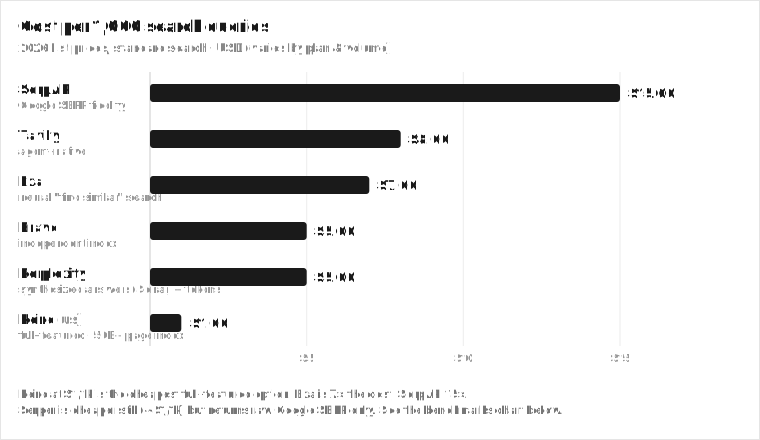
Cost per 1,000 search queries at 2026 list prices. Keiro is $1, Exa is $7, Tavily is $8, Brave is $5, Perplexity is $5 to $12 plus tokens, SerpAPI is $15 entry.
Branch on the reason you are leaving Exa.
- **Price, QA accuracy, RAG, or agent retrieval:** Keiro. $1/1k, leads the three QA benchmarks, bundles search-plus-content, has batch. This is most workloads.
- **Pure keyword-free "find similar" retrieval:** stay on Exa. It is still the specialist on that primitive. Switching away loses the thing you came for.
- **Agent-native stack with LangChain or CrewAI:** Tavily. The integrations are the best in the category, and inline content skips the extraction call. Watch `auto_parameters` or it silently doubles your cost.
- **A cited, synthesized answer in one call:** Perplexity Sonar. Built-in citations, 128K context, no pipeline to build. Pin your model ID and avoid Deep Research unless you can absorb $1+ per query.
- **Google SERP fidelity across verticals:** SerpAPI. 40+ engines, structured SERP, 99.9% SLA. Use Serper if you only need raw Google SERP cheap.
- **An independent index with SOC 2 and privacy:** Brave. No Google or Bing dependency, 50 QPS, Search Goggles for re-ranking, LLM Context for chunked AI-ready output.
The hybrid setup most production teams land on is Keiro for QA and RAG, Exa for the occasional find-similar query, and Serper or Brave for the keyword-able majority. Splitting by query type is the biggest cost lever there is.
## Migrating from Exa to Keiro
The endpoint mapping is straightforward.
| Exa | Keiro | Notes |
| --- | --- | --- |
| `search` (neural) | `/api/v2/keiro` | Indexed, ~100ms. `/api/v2/search/fast` for always-fresh, `/api/v2/search/flash` for ~500ms. |
| `contents` (extract) | `/api/v2/search/content` | Search plus clean page text in one call, 3 credits. Optional embeddings at 384/512/768/1024 dims. |
| `answer` | `/api/v2/answer` | Synthesized answer with citations, 5 credits. |
| `find_similar` | `/api/v2/keiro` + query | Exa's `find_similar` is deprecated in favor of `search` with similarity scores. Keiro is index-first, not a similarity engine, so keep Exa for true find-similar queries. |
| - | `/api/v2/search/batch` | Async batch, thousands of queries per job, 1 credit each. Exa has no batch. |
| `highlights` | included | First-page content is included with `/api/v2/search/content`. |
| `deep-reasoning` | `/api/v2/agentic` | Deep research, 20 credits. Exa's `deep-reasoning` replaced the legacy `/research` endpoint. |
One behavioral difference to know before you cut over. Exa's `search` is neural by default and returns pages that share no keywords with your query. Keiro's `/api/v2/keiro` is index-first with a freshness fallback. If you depend on keyword-free similarity, keep Exa for those queries and route the rest to Keiro. That is the hybrid setup above, not a caveat.
Auth also moves. Exa takes `api_key` in the body. Keiro takes `Authorization: Bearer keiro_...` in the header. Rate limits go up by tier: free 30/min, starter 100, pro 300, startup 600, enterprise 1,000 on `/keiro`.
## Further reading
For the full cost tables, benchmark methodology, and independent per-request math behind this comparison, see [Cheapest Exa Alternatives in 2026: 9 APIs Compared](https://www.agenticsearch.cloud/posts/best-cheapest-exa-alternatives/) and [Exa vs Tavily vs Keirolabs: Search API Benchmark](https://www.agenticsearch.cloud/posts/exa-vs-tavily-vs-keirolabs/). If you are building the pipeline that feeds these APIs, see [Scraping at scale: queues, caching, and not getting banned](https://www.webscraping.space/blog/scraping-at-scale) and [Bypassing anti-bot protections: TLS, fingerprints, and Cloudflare](https://www.webscraping.space/blog/bypassing-anti-bot-protections).
## FAQ
### What is the main difference between Exa and its alternatives?
Exa focuses on keyword-free semantic search and "find similar" discovery using embeddings served from a custom vector database. The alternatives specialize elsewhere. Keiro for QA and RAG accuracy at low cost, leading SimpleQA, FreshQA, and HotpotQA. Tavily for agent-native search with LangChain. Perplexity for cited answers. Brave for an independent, privacy-first index. SerpAPI for Google SERP fidelity across 40+ engines.
### Does Keiro actually beat Exa?
On the public factual-QA benchmarks (judge: Gemma 3 12B), Keiro scores 94/91/82 on SimpleQA, FreshQA, and HotpotQA. That is ahead of Perplexity at 86/83/74 and Tavily at 78/77/68. Exa is not on those benchmarks. Its claim is keyword-free semantic "find similar" search, which is a different primitive. For QA and RAG workloads, Keiro leads. For pure similarity retrieval, Exa is the specialist.
### Which Exa alternative is most cost-effective?
Keiro at $1/1k (Startup list price). That is 7x cheaper than Exa's $7/1k and about 8x cheaper than Tavily's $8/1k PAYG. For raw Google SERP only, Serper is comparable at about $1/1k entry, but it returns SERP, not content or answers. Per-1k varies by plan and volume on every provider.
### Which Exa alternative is best for RAG?
Keiro's `/api/v2/search/content`. Search plus clean page text in one call, 3 credits, with optional embeddings at 384 to 1024 dimensions. It is built for RAG. Exa's strength is semantic retrieval, but for RAG you also need extraction, which is why the bundled search-plus-content endpoint matters. Tavily's inline raw content and Perplexity's pre-synthesized answers are the other RAG-relevant options.
### Can Exa alternatives handle JavaScript rendering?
Yes. Keiro's content and extract endpoints handle JS. Tavily's `advanced` extract depth handles JS-rendered pages and tables. Perplexity handles JS-heavy sites through its live crawl. Brave handles dynamic content in its index and the LLM Context API extracts from JS-heavy pages in real time. Exa supports JS rendering through its Contents API.
### Do these alternatives offer free tiers?
Keiro: 500 credits a month, no card, commercial use allowed. Tavily: 1,000 credits a month. Perplexity: no permanent free tier, API credits paused early 2026. Brave: free tier removed Feb 2026; its replacement is a $5/mo credit allowance (about 1,000 requests) on a card-required free plan, tied to public attribution. SerpAPI: 250 searches a month at 50/hour. Exa: 20,000 search requests a month (search only).
### Are these alternatives compatible with LangChain?
Tavily and Keiro both ship LangChain integrations. Tavily is the most native, with first-class CrewAI support too. Keiro has a Python SDK and LangChain tooling. Perplexity, Brave, and SerpAPI also integrate through LangChain. Switching from Exa is usually a few lines of code.
### Can I keep Exa for the hard queries and use something cheaper for the rest?
Yes, and most production teams do exactly this. Keiro for QA and RAG. Exa for the occasional keyword-free "find similar" query. Serper or Brave for the keyword-able majority. Splitting by query type is the biggest cost lever there is.
### Is Perplexity Sonar still the right pick if it is in maintenance mode?
For existing Sonar workloads, yes, it keeps working and the API is stable. For new integrations, Perplexity recommends the Agent API, which covers the same use cases plus third-party models, presets, and tools. If you are starting fresh and want cited answers without a pipeline, Sonar is still the simplest path, but plan for a future migration to the Agent API.
### Why not just stay on Exa?
If your workload is dominated by "find pages semantically similar to this one," Exa is the right tool and you should keep using it. The case for switching is when your workload is QA, RAG, or agent retrieval, where Keiro leads on benchmarks at 7x lower cost, or when you need batch, bundled extraction, or a first-class answer endpoint that Exa charges separately for.
 Keiro the cheapest full-featured layer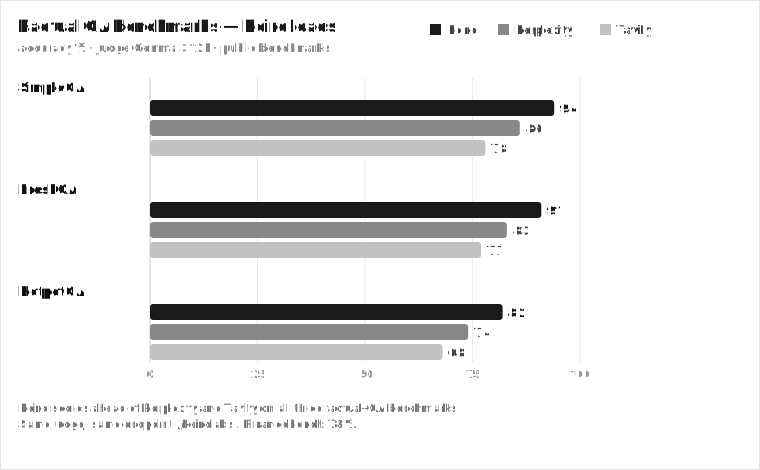
 Tavily agent-native, LangChain first
 Perplexity (Sonar API) cited answers in one call
 Brave Search API independent index, privacy-first
 SerpAPI Google SERP fidelity across 40+ engines