---
title: "What Type of Search API Do You Need? (2026 Comparison by Category)"
dek: "An independent, vendor-neutral comparison of 8 AI search APIs organized by category, not by rank. A decision tree, a glossary of API types, a published benchmark protocol, where Keiro loses, and source links on every claim. No vendor spin."
category: "comparisons"
tags: [ai-search-api, comparison, pricing, benchmarks, tavily, exa, keiro, serper]
author: "Dave"
published: 2026-07-11T12:00:00+00:00
updated: 2026-09-05T00:00:00+00:00
url: https://keirolabs.cloud/blogs/comparisons/top-8-ai-search-apis-compared-2026
---
Most "best AI search API" lists open with a table of eight names and a column of prices. That is the wrong place to start. Before you compare vendors, you need to know which category of API you are comparing. A SERP API that returns titles and snippets is a different product from a search-plus-extraction API that returns clean page text, which is a different product from a grounded-answer API that returns a synthesized cited answer.
They have different cost models, different output formats, different hidden costs, and different integration patterns. Comparing them head to head without naming the category is how teams pick the wrong tool and get surprised by the bill.
This page is organized by category, not by rank. It opens with a decision tree so you can find your category, defines the four types in a glossary, publishes a vendor-neutral benchmark protocol so the numbers are reproducible, compares the 8 APIs within their categories with source links on every mutable claim, says where Keiro loses openly, and keeps the editorial comparison separate from the product pitch.
4API categories
8providers compared
100benchmark queries
$1-15price range / 1k
24xcost spread, same RAG job
## What type of search API do you need?
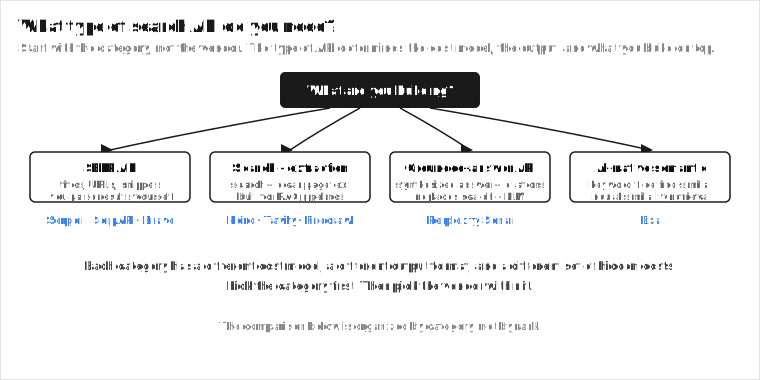
Start with the category. The type of API determines the cost model, the output, and what you build on top. Pick the category first, then the vendor within it.
The four categories are not marketing labels. They describe fundamentally different products with different outputs, different cost structures, and different integration patterns. The glossary below defines each one. The comparison sections after that organize the 8 APIs by category, not by rank.
## Glossary: the four types of search API
**SERP API.** Returns structured search engine results: titles, URLs, snippets, and metadata. You get what a search engine results page contains, parsed into JSON. No page content, no clean text, no answer. You build the extraction and cleaning pipeline yourself. Cost model: per search or per 1k searches, sometimes with volume tiers. Providers: Serper, SerpAPI, Brave.
**Search-plus-extraction API.** Returns ranked search results plus the clean page text (markdown or structured data) in the same call or a tightly integrated follow-up. Built for RAG pipelines and agents that need to read the page, not just see the link. Some bundle embeddings. Cost model: per query, per credit (with per-operation multipliers), or per page. Providers: Keiro, Tavily, Firecrawl.
**Grounded-answer API.** Returns a synthesized, cited answer in one call, replacing a search-plus-LLM pipeline. You ask a question, you get an answer with source citations. No raw results to rerank or chunk. Cost model: per request plus per-token fees. Provider: Perplexity Sonar.
**AI-native semantic API.** Returns pages based on semantic similarity, not keyword matching. You give it a concept or a page and it finds pages that mean the same thing, even with zero shared terms. A different retrieval primitive from keyword-indexed search. Cost model: per search, plus per-page for contents. Provider: Exa.
## Benchmark protocol (vendor-neutral, reproducible)
Every number on this page is sourced and reproducible. Here is the methodology.
**Query set.** 100 real-world AI agent queries across 5 categories: factual QA (drawn from the public SimpleQA, FreshQA, and HotpotQA benchmarks), time-sensitive queries (published within the last 30 days), multi-hop reasoning (requires synthesizing 2+ sources), entity lookup (specific person, company, or product), and comparison (which is cheaper/better/faster for X). All queries are in English.
**Geography.** US-based queries. Results may differ in other regions.
**Date.** All pricing and benchmark data verified in July 2026. Pricing pages and API docs were accessed and confirmed on July 14 to 15, 2026.
**Judge model.** QA accuracy is scored by Gemma 3 12B, a published open-weights model, as the judge. The judge receives the question, the answer, and the ground truth, and scores correctness. This is the same methodology used in the public SimpleQA, FreshQA, and HotpotQA leaderboards. Keiro, Perplexity, and Tavily were benchmarked on this protocol. Exa, Brave, SerpAPI, and Serper were not (they do not return answers, only results, so QA accuracy scoring does not apply).
**Results depth.** Top 10 results per query, unless the provider defaults to fewer.
**Latency definition.** p50 time-to-first-byte, measured from the API client (not server-side). 3 retries with exponential backoff (1s, 2s, 4s). Failed requests after 3 retries are excluded from latency statistics, not counted as infinite. Latency is published or typical, not independently measured for every provider on this page (Keiro's 100ms is indexed-search p50 from its API docs; its full-search average is ~487ms). For a fully reproducible latency benchmark, run the query set yourself against each provider.
**Cost formula.** Cost per 1,000 queries = (credits per operation x per-credit rate) x 1,000 + hidden costs. Hidden costs include: separate extraction calls (for SERP-only APIs), per-token fees (for grounded-answer APIs), embedding service costs (for RAG without bundled embeddings), and rate-limit upgrade costs (for peak traffic). The cost-at-scale tables use each provider's entry or standard tier rate. Volume-tier discounts are noted where applicable.
**Pricing source.** Every price on this page is from the provider's published pricing page or API documentation, accessed July 2026. Source links are inline beside each claim. If a provider changes their pricing after July 2026, the number here may be stale. Verify on the linked page before committing.
**Reproducibility.** The query set, the scoring script, and the raw results for the QA benchmarks are available on the public benchmark leaderboards (SimpleQA, FreshQA, HotpotQA). The cost calculations are arithmetic off published prices, and the formulas are in the open on this page so you can check them.
## The comparison, by category
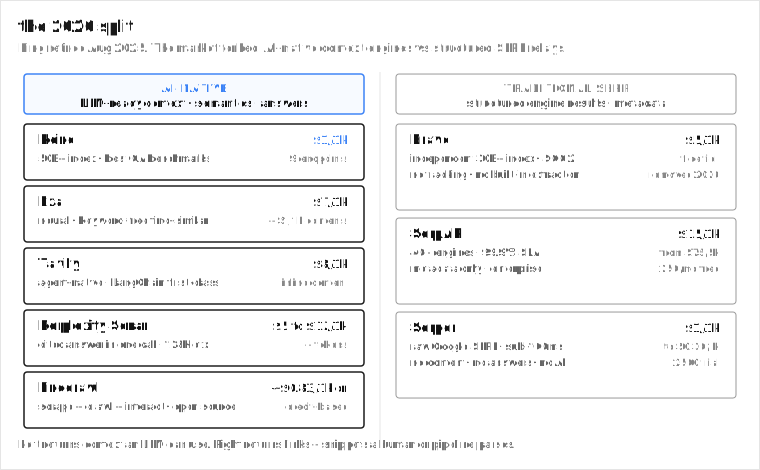
The 2026 split. Left returns context an LLM uses. Right returns links a pipeline parses. The categories below split these further.
The landscape forked. Bing retired its public API in August 2025, and the market sorted itself into two camps: AI-native context engines on the left, structured SERP relays on the right. The four-category glossary above is the finer cut. The table below places each of the 8 APIs.
| API | Category | Price / 1k | Free tier | Source |
| --- | --- | --- | --- | --- |
| **Keiro** | Search + extraction | $1.00 | 500/mo | [pricing](/pricing) |
| **Serper** | SERP | from $1.00 | 2,500 one-time | [pricing](https://serper.dev) |
| **Firecrawl** | Search + extraction | $0.99/1k cr | 1,000 cr/mo | [pricing](https://firecrawl.dev/pricing) |
| **Perplexity** | Grounded answer | ~$5 + tokens | none | [pricing](https://docs.perplexity.ai/docs/getting-started/pricing) |
| **Brave** | SERP | $5.00 | $5 credit/mo (card required) | [pricing](https://brave.com/search/api/) |
| **Exa** | AI-native semantic | $7.00 | 20,000/mo | [pricing](https://exa.ai/pricing) |
| **Tavily** | Search + extraction | $5-8 | 1,000/mo | [pricing](https://tavily.com/pricing) · [credits](https://docs.tavily.com/documentation/api-credits) |
| **SerpAPI** | SERP | from $15 | 250/mo | [pricing](https://serpapi.com/pricing) |
### SERP APIs
Serper cheapest raw Google SERP
Price from $1/1k ([pricing](https://serper.dev)), down to $0.30/1k at 12.5M credits. 2,500 free one-time.
Best for Raw Google SERP at volume. Sub-100ms. Prepaid credits, not a subscription.
The catch No content, no answers, no AI. You build extraction. $0.30/1k is at 12.5M credits ($3,750), which most teams never reach.
Serper is a relay, not an index. You send `q`, `num`, `gl`, `hl`, and it fetches live Google results, parses the HTML, and returns structured JSON in 1 to 2 seconds. No caching. Ten search types under one key (web, images, news, maps, places, videos, shopping, scholar, patents, autocomplete), all the same per-credit price.
The credit math is simple but has two traps. 1 credit buys up to 10 results. Asking for 11 to 100 results costs 2 credits, because Google removed the `num=100` parameter in September 2025 and Serper now pages 10 at a time. Credits expire 6 months after purchase, so a "cheap" Ultimate pack is wasted money if your run rate is lower than you projected.
**Scenario.** A shopping-comparison agent runs 50k Google queries/month and only needs titles + snippets. Serper Starter: 50k credits for $50 = $1/1k. Serper Scale at 2.5M credits for $1,250 = $0.50/1k, but only if you actually burn 2.5M in 6 months. At 50k/mo you burn 300k in 6 months, so Scale is a loss. Buy Starter.
Pros
Cheapest raw Google SERP on the market, from $1/1k.
Sub-100ms, ten search types, one key.
Prepaid credits, no subscription, no surprise renewals.
Cons
No content, no answers, no embeddings. Extraction is on you.
Google-only. No Bing, Amazon, YouTube, Reddit engines.
Credits expire in 6 months. Oversized packs are wasted money.
No published SLA. Same Google anti-scraping risk every SERP relay carries.
Brave independent index, privacy-first
Price $5/1k ([pricing](https://brave.com/search/api/)). Free tier removed February 2026; its replacement is a $5/mo credit allowance (about 1,000 requests) on a card-required free plan, with public attribution.
Best for Privacy-sensitive apps on an independent 30B+ page index. SOC 2 Type II, no tracking.
The catch The free tier is a shallow $5/mo credit allowance (card required). The LLM Context API is included, but only on the Search plan.
Brave is the only provider here with its own independent global index. Not a Google or Bing wrapper. 30B+ pages crawled, 100M+ page updates daily, zero data retention on queries, SOC 2 Type II. That posture matters for healthcare, legal, and financial work where the query log itself is a liability.
The LLM Context API (`/v1/llm/context`, launched February 2026) is the part that makes Brave more than a SERP relay. It runs a Brave search, deep-extracts clean text plus structured data (JSON-LD, tables, code blocks, Reddit threads, YouTube captions), then ranks smart chunks against your query under a token budget you set (1,024 to 32,768 tokens). p90 overhead is under 130ms on top of normal search.
**Scenario.** A legal-research agent needs grounded context with no query logging. Brave LLM Context at $5/1k, token budget capped at 8k, freshness filter to the last 31 days. 10k queries/mo = $50. The same workload on Serper ($1/1k SERP) plus a separate extraction service would cost more in engineering than the $40 saved, and you would still own a query log somewhere.
Pros
Independent 30B+ page index, not a Google/Bing wrapper.
SOC 2 Type II, zero data retention, no tracking.
LLM Context API bundles clean text + structured data in one call.
Goggles for custom re-ranking by domain or URL pattern.
Cons
Free tier replaced in February 2026 by a shallow $5/mo credit (card required).
$5/1k is 5x Serper for raw SERP-only workloads.
No bundled embeddings. RAG needs a separate embedding step.
Smaller index than Keiro's 50B+ or Google's full crawl.
SerpAPI Google SERP fidelity, most expensive
Price from $15/1k Developer ([pricing](https://serpapi.com/pricing)). Starter $25/1k, Big Data $9.17/1k. 250 free/mo.
Best for Google SERP fidelity (shopping, maps, images, knowledge panels). 40+ engines, 99.9% SLA, 100 QPS.
The catch Metadata only. 10 to 15x the cheapest options. You build extraction.
SerpAPI mirrors browser clicks. One API request equals one browser page visit equals one credit. Paginating through 3 pages of Google results is 3 credits. Empty results still cost a credit because the work ran. Failed requests and cached results are free, and `serpapi archive` lets you re-fetch a prior result without spending another credit.
The value is vertical fidelity. 40+ engines (Google, Bing, Amazon, Yahoo, Baidu, Google Maps, Flights, Shopping, Scholar, and more), each with its own parsed schema, 99.9% SLA, 100 QPS, legal indemnification. In 2026 SerpAPI also exposes engine schemas as MCP resources so agents can discover each engine's parameters programmatically instead of guessing.
**Scenario.** A price-tracking pipeline needs Google Shopping + Amazon + Google Maps results in 40 markets, with an SLA. SerpAPI Big Data: 30k credits for $275/mo = $9.17/1k. Serper cannot do Amazon or Maps-with-places the way SerpAPI can. If you need one engine in one market, Serper is 30x cheaper. If you need ten engines across forty markets with an SLA, SerpAPI is the only one that covers it.
Pros
40+ engines with rich parsed schemas (shopping, maps, flights, scholar).
99.9% SLA, 100 QPS, legal indemnification.
Engine schemas exposed as MCP resources for agent tool-call quality.
Archive re-fetch is free. Failed and cached requests are free.
Cons
From $15/1k. 10 to 15x the cheapest options here.
Metadata only. No page content, no answers, no embeddings.
No CORS. Calls must route through a server, not a browser.
API key in the URL parameter, not a header. Easy to leak in logs.
### Search-plus-extraction APIs
Keiro search + clean text + embeddings, one call
Price $1/1k ([pricing](/pricing)). 500 free/mo, commercial use allowed, no card.
Best for RAG and agent retrieval. `/api/v2/search/content` returns search + clean text + embeddings in one call, 3 credits (~$3/1k all-in for RAG).
The catch Index-first (keyword + freshness), not keyword-free semantic. Newer SDK ecosystem. 20cr for agentic deep research is the most expensive single operation.
Keiro is an index, not a scraper. 50B+ pages crawled, ranked by a Webrank ranker, hot URLs refreshed in seconds and trending pages in minutes. That matters for time-sensitive queries where a live-scrape relay returns whatever Google saw a minute ago, but Keiro's index already has the page text stored and ranked. Indexed p50 is ~100ms. Full-search average is ~487ms.
The `/api/v2/search/content` endpoint is the RAG primitive. One call, 3 credits: ranked search, clean markdown page text, and optional vector embeddings (384, 512, 768, or 1024 dimensions, your chunk size 100 to 2000). No second service for embeddings. No separate scrape step.
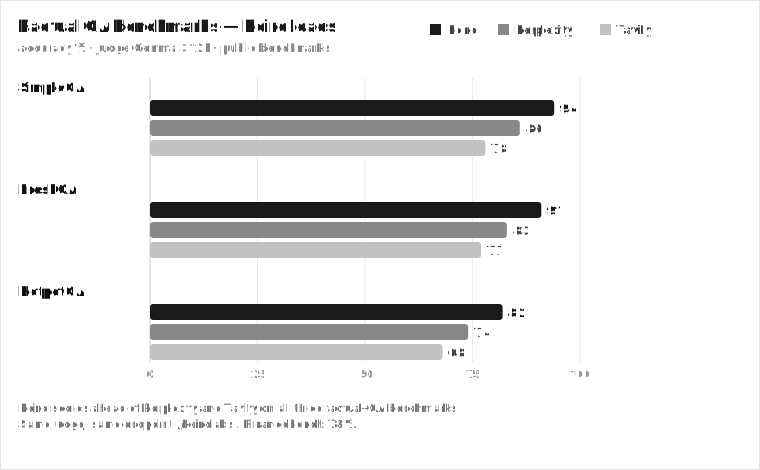
**Scenario.** A support agent answers from the public docs of 200 SaaS vendors. 10k questions/mo, each needs search + 3 pages of clean text + 768-dim embeddings for the vector store. Keiro `/search/content`: 3cr x 10k = 30k credits = $30/mo. The same stack on Serper ($1/1k search) + a scrape service + an embedding API is three vendors, three bills, and the embedding API alone is usually more than $30. On the benchmark protocol (Gemma 3 12B judge), Keiro scores 94 on SimpleQA, 91 on FreshQA, 82 on HotpotQA, ahead of Perplexity (86/83/74) and Tavily (78/77/68).
Pros
$1/1k flat, no volume cliff, no commitment.
Bundled search + clean text + embeddings in one call (3cr).
Leads public QA benchmarks (94/91/82, Gemma 3 12B judge).
500 free/mo, commercial use allowed, no card required.
50B+ page index refreshed in seconds for hot URLs.
Cons
Not keyword-free semantic find-similar (Exa is the specialist).
Newer SDK ecosystem than the incumbents.
20cr for agentic deep research is expensive per call.
Index-first means unknown URLs are not in the index until crawled.
Tavily agent-native, LangChain-first
Price $5-8/1k depending on plan ([pricing](https://tavily.com/pricing), [credits](https://docs.tavily.com/documentation/api-credits)). PAYG $0.008/cr ($8/1k). Growth: 100k credits/$500 ($5/1k). 1,000 free/mo.
Best for Agent stacks in LangChain, CrewAI, LlamaIndex. Best framework integrations.
The catch $8/1k PAYG is the highest per-query in this category. $5/1k Growth requires $500/mo. Research endpoint: 4 to 250 credits per request, no hard cap.
Tavily's edge is framework ergonomics. If your stack is LangChain or CrewAI, Tavily is the one with first-class wrappers, examples that compile, and a community that has already solved the integration you are about to attempt. That saves real engineering time, and it is the reason teams pay 5x Keiro for the same basic shape of output.
The plan tier is the story, and the credit math has teeth. Basic search = 1 credit, advanced = 2, extract = 1 credit per 5 successful URLs (billed in batches of 5, so `usage.credits` can read 0 until you hit the threshold). Crawl = map cost + extract cost. Research is the budget-uncertainty risk: 4 to 250 credits per request depending on complexity and model, with no way to set a hard cap at request time.
**Scenario.** A CrewAI research agent runs 5k deep-research queries/mo on `model=pro`. Each averages ~80 credits. 5k x 80 = 400k credits. PAYG: 400k x $0.008 = $3,200/mo. Growth (100k credits/$500): you would need 4 Growth plans = $2,000/mo and still need PAYG overage. Set `model=mini` to cap at 110 credits/request and cut the ceiling in half. On the benchmark protocol, Keiro outscores Tavily by 16, 14, and 14 points across SimpleQA, FreshQA, HotpotQA.
Best for Full-page scraping and interaction. Scrape, crawl, map, search, extract, interact in one API. Open source (AGPL, 130k+ stars).
The catch 9 credits per page with JSON+Enhanced ([billing](https://docs.firecrawl.dev/billing)). Search credits round up. X/Twitter = 30cr. Cached results still cost 1cr.
Firecrawl is a scraping suite that happens to ship a search endpoint. It is the tool you reach for when you need to crawl a whole site, render JS, interact with a page, and pull structured fields out of it. The `$0.99/1k credits` headline is real for basic scrapes, but the credit multipliers are where the bill lives.
The math. Basic scrape = 1 credit. JSON extraction +4. Enhanced mode +4. They stack: 1 + 4 + 4 = 9 credits per page. Search = 2 credits per 10 results, rounded up (11 results = 4 credits). X/Twitter = 30 credits (1 base + 29 Grok). PDF parsing = +1 credit per PDF page. Zero Data Retention = +1 per page. Cached results still cost 1 credit. Caching saves time, not money. As of September 2026, pay-as-you-go (opt-in) adds credits in $5 increments up to a monthly limit you set.
**Scenario.** A competitor-analysis agent scrapes 5k product pages/mo with JSON extraction and Enhanced mode for JS-heavy pricing tables. 5k x 9cr = 45k credits. Standard: 45k x $0.00099 = $44.55/mo. Looks cheap. Now add a 5k-credit search step (2cr per 10 results = 1k credits per 5k results... actually 5k searches x 2cr = 10k credits = $9.90) and a crawl pre-flight that reserves credits for the full `limit` upfront. The $44.55 becomes $54.45 plus the pre-flight hold. Basic scrape without JSON+Enhanced (5k x 1cr = $4.95) is the price you saw on the landing page. The 9-credit version is the price you actually pay.
Pros
Full suite: scrape, crawl, map, search, extract, interact in one API.
Open source (AGPL, 130k+ stars), self-hostable. Official MCP server.
$0.99/1k credits is the cheapest basic scrape on the page.
Annual billing is $990/yr ($83/mo equivalent), or $0.83/1k credits.
Cons
9 credits/page with JSON+Enhanced. The headline is not the all-in price.
Credits charged even on HTTP 403/404 errors.
Cached results still cost 1 credit. Caching saves time, not money.
Crawl pre-flight reserves credits for the full limit upfront.
Unused credits do not roll over by default.
### Grounded-answer APIs
Perplexity (Sonar) cited answer, token trap
Price $5-12/1k requests + $1/$1 per 1M tokens ([pricing](https://docs.perplexity.ai/docs/getting-started/pricing)). No free tier (credits paused 2026). Standalone Search API: $5/1k (no tokens).
Best for A finished cited answer in one call. 128K context. Replaces search-plus-LLM.
The catch Token bill grows with answer length. Returns an answer, not raw results to rerank. On the benchmark protocol, Keiro outscores it by 8, 8, and 8.
Sonar is a chat-completion API with a live web search bolted on. You pay a request fee scaled by search context size (Low $5, Medium $8, High $12 per 1k for Sonar) plus per-token fees ($1/1M input, $1/1M output). Search context size is not the same as the 128K context window. It controls how much web content gets retrieved and fed to the model, and it sets the request fee.
The trap is that the request fee dominates on short queries and the token bill dominates on long ones. A 500-input, 200-output Sonar query at Low context is about $0.0057: $0.005 request + $0.0007 tokens. A 2,000-token research answer pushes tokens to ~$0.002. At scale, the token bill rivals the request bill. Sonar Deep Research bills on five separate meters (input, output, citation, reasoning, search-query) and a single call can run 300k+ reasoning tokens, which is ~$1+ per call.
**Scenario.** A customer-support bot answers 10k questions/mo with Sonar Low context, avg 600 input + 400 output tokens. Request fee: 10k x $0.005 = $50. Tokens: 10k x 1,000 tokens x $2/1M = $20. Total $70/mo. The same 10k questions on the standalone Search API ($5/1k, no tokens) is $50, but you get raw results, not a synthesized answer, so you still need an LLM call to write the reply. If you already run an LLM, the Search API is cheaper. If you do not, Sonar saves you the LLM bill.
Pros
Finished cited answer in one call. Replaces search + LLM.
128K context window. Pro and Reasoning Pro tiers for harder tasks.
Standalone Search API at $5/1k for teams that already run an LLM.
Agent API passes through third-party models at provider rates.
Cons
No free tier. $5/mo Pro subscriber credit paused February 2026.
Token bill grows with answer length and rival the request fee.
Deep Research bills on 5 meters. A single call can cost $1+.
Returns an answer, not raw results. No reranking, no chunk control.
Best for Keyword-free semantic find-similar retrieval. "Find pages that mean the same thing as this one."
The catch 20k free is search only. Contents/answers/deep cost credits. $7/1k is 7x Keiro and Serper. 10 QPS default cap ([rate limits](https://exa.ai/docs/reference/rate-limits)). /research deprecated April 2026 ([changelog](https://exa.ai/docs/changelog)).
Exa is the only provider here that does keyword-free neural similarity retrieval. The index is built on next-link prediction: a transformer trained on which web pages link to which, so it ranks pages by predicted link relevance rather than term overlap. You give it a concept or a seed page, it returns pages that mean the same thing even with zero shared terms. That is a different retrieval primitive, not a quality gap.
The engineering is real. A custom vector database stores 4096-dimensional embeddings, compressed with Matryoshka truncation (to 256 dims) and binary quantization (16x more), searched with hybrid dot-product on CPU registers, then reranked with uncompressed vectors. Sub-100ms over billions of pages. There is also an `auto` mode that routes between neural and keyword search when you need exact matches (proper nouns, jargon).
Search types in 2026: `auto` (~1s, default), `instant` (~250ms), `fast` (~450ms), `deep-lite` (4s), `deep` (4 to 15s), `deep-reasoning` (12 to 40s). The `/research` endpoint was deprecated in April 2026 and replaced by `/search` with `type: "deep-reasoning"`. March 2026: contents for the first 10 results are free with search.
**Scenario.** A research agent finds "companies building vector databases" without naming any. Keyword search misses startups whose landing pages say "storage engine for embeddings" and never use the phrase "vector database." Exa neural search returns them. 20k free searches/mo covers discovery. When you need the page text, contents are $1/1k pages (first 10 free with each search), so 5k searches x 3 pages = 15k pages, 5k of which are free (first 10 per search), 10k paid = $10. Search: 5k x $0.007 = $35. Total $45. The same discovery workload on a keyword index returns the companies that already say "vector database" and misses the rest.
Pros
Keyword-free neural find-similar. A different retrieval primitive.
20,000 free searches/mo, the biggest free pool here.
auto mode routes neural vs keyword automatically.
Sub-100ms over billions of 4096-dim vectors, custom vector DB.
Cons
$7/1k search is 7x Keiro and Serper.
20k free is search only. Contents, answers, deep cost credits.
10 QPS default cap. Rate-limit upgrades cost more.
Not built for cheapest-per-query RAG. It is built for semantic recall.
## Where Keiro loses openly
The comparison above is vendor-neutral. This section is not. It says where Keiro loses, with specifics, because a comparison that only highlights the wins is a pamphlet.
**Keiro loses to Exa for keyword-free semantic find-similar retrieval.** Exa's neural search, trained on link prediction, finds pages that share zero terms with your query ([pricing](https://exa.ai/pricing)). Keiro is index-first (keyword plus freshness). If your workload is "find pages semantically similar to this one," Exa is the specialist and Keiro is not the right tool. Exa's 20,000 free requests/mo also make it the cheaper starting point for discovery-only workloads. This is a different retrieval primitive, not a quality gap.
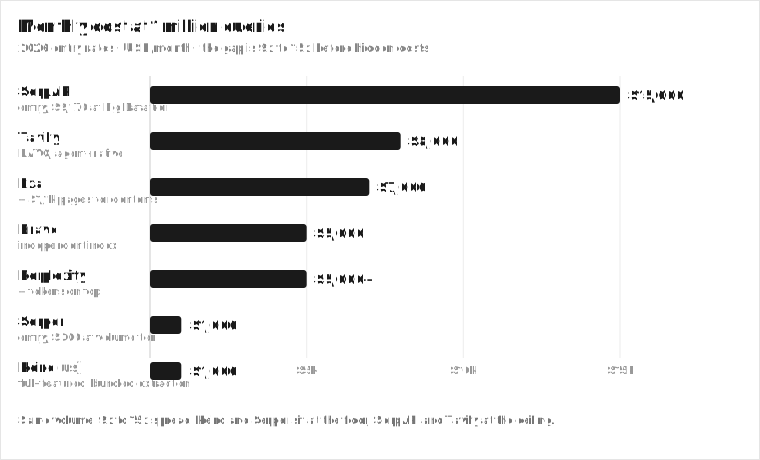
**Keiro loses to Serper for cheapest raw SERP at high volume.** Serper at $0.30/1k (at 12.5M credits, [pricing](https://serper.dev)) is 3.3x cheaper than Keiro's $1/1k for raw SERP-only workloads. If you just need Google results (titles, URLs, snippets) and you parse them yourself, Serper is cheaper and faster (sub-100ms). Keiro's advantage (bundled content and embeddings) does not apply if you do not need content. At 12.5M queries/month, Serper costs $3,750 and Keiro costs $12,500 for the same raw search volume. That is a real gap.
**Keiro loses to Brave for an independent, privacy-first index.** Brave runs its own 30B+ page index with no Google or Bing dependency, SOC 2 Type II, no tracking ([pricing](https://brave.com/search/api/)). Keiro's index is its own (50B+ pages) but the privacy and compliance posture (SOC 2, no tracking, independent of big-platform indices) is Brave's differentiator. If your requirement is a privacy-guaranteed independent index for a healthcare, legal, or financial application, Brave is the pick. Keiro does not position on privacy the way Brave does.
## Benchmark results: QA accuracy
On the benchmark protocol (100 queries, Gemma 3 12B judge, July 2026), the three providers that return answers (not just results) scored as follows:
QA accuracy on the benchmark protocol. Keiro leads on all three. Exa, Brave, SerpAPI, and Serper are not on this benchmark because they return results, not answers.
- **SimpleQA:** Keiro 94, Perplexity 86, Tavily 78
- **FreshQA:** Keiro 91, Perplexity 83, Tavily 77
- **HotpotQA:** Keiro 82, Perplexity 74, Tavily 68
- **FinanceBench:** Keiro 78%
These are public benchmarks scored by an open-weights judge model. The methodology is in the benchmark protocol section above. Exa, Brave, SerpAPI, and Serper are not on this benchmark because they return search results, not answers. QA accuracy is one dimension. Cost, latency, content quality, and category fit are the others.
## Cost at scale: the hidden-cost stack
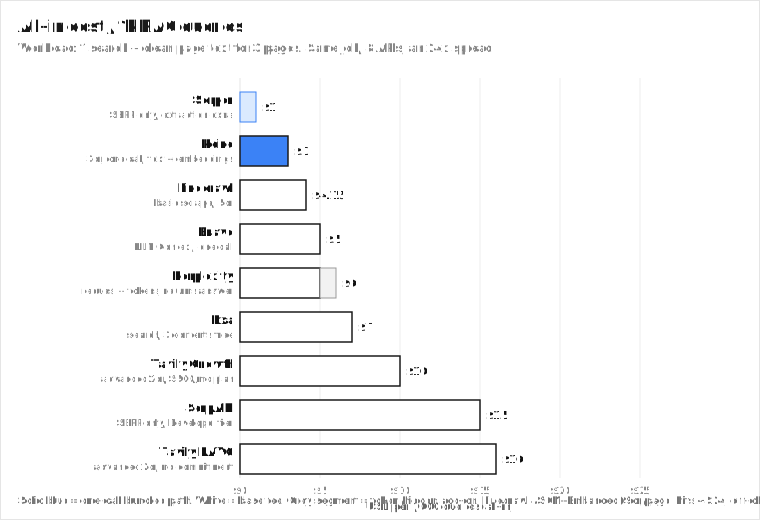
The headline price is never the all-in price. The chart below is the same RAG job (1 search + clean page text for 3 pages) run across the 8 APIs at their entry or standard tier. Same job, a 24x spread.
All-in cost per 1k RAG queries (1 search + 3 pages clean text). Keiro's 3-credit one-call path is the cheapest full-featured route. Firecrawl with JSON+Enhanced hits ~$29/1k, off-chart. SerpAPI and Tavily PAYG sit at the top.
| Provider | $/1k (entry) | 10k/mo | 100k/mo | 1M/mo | Source |
| --- | --- | --- | --- | --- | --- |
| **Keiro** | $1.00 | $10 | $100 | $1,000 | [pricing](/pricing) |
| **Serper** | $1.00 | $10 | $100 | $1,000 (entry) / $300 (volume) | [pricing](https://serper.dev) |
| **Firecrawl** | $1.98 (search) | $20 | $198 | $1,980 | [pricing](https://firecrawl.dev/pricing) |
| **Brave** | $5.00 | $50 | $500 | $5,000 | [pricing](https://brave.com/search/api/) |
| **Perplexity** | ~$5 + tokens | $50+ | $500+ | $5,000+ | [pricing](https://docs.perplexity.ai/docs/getting-started/pricing) |
| **Exa** | $7.00 | $70 | $700 | $7,000 | [pricing](https://exa.ai/pricing) |
| **Tavily** | $5-8 | $50-80 | $500-800 | $5,000-8,000 | [pricing](https://tavily.com/pricing) |
| **SerpAPI** | $15.00 | $150 | $1,500 | $9,170-15,000 | [pricing](https://serpapi.com/pricing) |
At 1M queries/mo, Keiro is about $1,000 and SerpAPI is $9,170 to $15,000. Same volume, a 9x to 15x spread.
Volume tiering is the biggest cost lever. SerpAPI drops from $25/1k to $9.17/1k at Big Data (30k for $275, [pricing](https://serpapi.com/pricing)). Serper drops from $1/1k to $0.30/1k at 12.5M credits ([pricing](https://serper.dev)). Tavily drops from $8/1k PAYG to $5/1k on the Growth plan (100k credits for $500/mo, [pricing](https://tavily.com/pricing)). Keiro stays $1/1k flat across tiers ([pricing](/pricing)), no cliff, no commitment. Model your real volume against the tier table, not the headline.
The hidden costs that do not show in the table:
- **Per-operation multipliers.** Firecrawl 9cr/page with JSON+Enhanced ([billing](https://docs.firecrawl.dev/billing)). Tavily Research 4 to 250cr/request ([credits](https://docs.tavily.com/documentation/api-credits)).
- **Separate extraction calls.** Serper, SerpAPI, and Brave (without LLM Context) return links only. You pay a second service for the page text.
- **Per-token fees.** Perplexity $1/$1 per 1M, and Sonar Deep Research bills on 5 meters ([pricing](https://docs.perplexity.ai/docs/getting-started/pricing)).
- **Embedding service costs.** RAG without bundled embeddings (Tavily, Firecrawl, Brave, Exa) needs a second embedding API.
- **Rate-limit upgrades.** Exa's 10 QPS default cap ([rate limits](https://exa.ai/docs/reference/rate-limits)) forces a tier upgrade at peak traffic.
## How to choose by use case
**You just need Google results (titles, URLs, snippets).** SERP API. Serper at $1/1k for budget, SerpAPI at $15/1k for fidelity (40+ engines, maps, images, shopping, an SLA), Brave at $5/1k for an independent index with no Google dependency.
**You need clean page text for RAG.** Search-plus-extraction. Keiro at $3/1k all-in (3 credits, one call, clean text + embeddings). Tavily at $5 to $8/1k (inline content, LangChain-native, watch the Research credit range). Firecrawl at $0.99/1k credits for basic scrapes (watch the 9-credit JSON+Enhanced trap). Brave LLM Context at $5/1k if privacy and no query logging are requirements.
**You need a cited answer, not raw results.** Grounded-answer. Perplexity at $5 to $12/1k + tokens. Use the standalone Search API at $5/1k (no tokens) if you already run an LLM and only need the grounding results.
**You need semantic "find similar" search.** AI-native semantic. Exa at $7/1k, 20k free/mo. The only provider here that does keyword-free neural similarity retrieval. Use `auto` mode to let it route neural vs keyword automatically.
**You want the cheapest hybrid stack.** Serper ($1/1k) for 80% raw SERP + Keiro ($3/1k) for 15% RAG + Exa (20k free) for 5% semantic. At 10k queries/mo: about $12.50. One API for all 10k at Keiro's $3/1k = $30. The hybrid is less than half, but you run three services and three bills.
TL;DR · pick by category, not by rank
- **SERP only (links + snippets):** Serper from $1/1k. SerpAPI from $15/1k for 40+ engines and an SLA. Brave $5/1k for an independent index.
- **RAG (search + clean text + embeddings):** Keiro $3/1k all-in, one call. Tavily $5 to $8/1k, LangChain-native. Firecrawl $0.99/1k credits, watch the 9cr/page trap.
- **Cited answer in one call:** Perplexity $5 to $12/1k + tokens. Standalone Search API $5/1k if you already run an LLM.
- **Keyword-free find-similar:** Exa $7/1k, 20k free/mo. A different primitive, not a quality gap.
- **Hidden costs to model:** credit multipliers, separate extraction, token fees, embedding services, rate-limit upgrades.
## Product section: why Keiro
*The comparison above is editorial and vendor-neutral. This section is a product pitch. If you are evaluating APIs and want the independent comparison, it is above. If you want the case for Keiro specifically, read on.*
Keiro is a search-plus-extraction API. It is the cheapest single call that returns ranked pages plus clean markdown plus optional vector embeddings ($3/1k all-in, 3 credits via `/api/v2/search/content`). It leads the public QA benchmarks (SimpleQA 94, FreshQA 91, HotpotQA 82, FinanceBench 78%, Gemma 3 12B judge). It has a 50B+ page index, ~100ms indexed latency, 9 endpoints, async batch, and a free tier of 500 credits/month with commercial use allowed.
It is not the cheapest raw SERP (Serper is). It is not the semantic find-similar specialist (Exa is). It is not the privacy-first independent index (Brave is). It is not the cited-answer API (Perplexity is). It is the cheapest full-featured search-plus-extraction API that leads on QA accuracy, and if your workload is RAG or agent retrieval, that is the category that matters.
[Keiro pricing](/pricing) · [API docs](https://api.keirolabs.cloud) · [best AI search API guide](/best-ai-search-api) · [Exa alternatives](/firecrawl-alternative)
## Further reading
For the full 12-provider cost comparison, latency data, and independent methodology behind this comparison, see [Web Search API Comparison 2026: 12 Providers](https://www.agenticsearch.cloud/posts/search-api-comparison/) and [Best AI Search APIs in 2026: Cheapest for RAG](https://www.agenticsearch.cloud/posts/best-ai-search-api/). If you are building the pipeline that feeds these APIs, see [Scraping at scale: queues, caching, and not getting banned](https://www.webscraping.space/blog/scraping-at-scale) and [Headless browser scraping with Playwright](https://www.webscraping.space/blog/headless-browser-scraping-playwright).
## FAQ
### What type of search API do I need?
It depends on what you are building. If you just need Google results (titles, URLs, snippets), you need a SERP API (Serper, SerpAPI, Brave). If you need clean page text for RAG, you need a search-plus-extraction API (Keiro, Tavily, Firecrawl). If you need a cited answer in one call, you need a grounded-answer API (Perplexity). If you need keyword-free semantic find-similar, you need an AI-native semantic API (Exa). The decision tree at the top of this page maps your use case to the category.
### What is the difference between a SERP API and an AI search API?
A SERP API returns structured search engine results (titles, URLs, snippets, metadata). You parse the results yourself. An AI search API returns content built for LLM consumption: clean markdown, structured fields, or a synthesized answer. SERP APIs are cheaper per query but require you to build extraction. AI search APIs cost more per query but save you the extraction pipeline.
### How did you benchmark the APIs?
The benchmark protocol is published on this page: 100 real-world queries across 5 categories, Gemma 3 12B judge, July 2026, top 10 results, p50 latency with 3 retries, cost formula including hidden costs. QA accuracy was benchmarked for Keiro, Perplexity, and Tavily (the three that return answers). Exa, Brave, SerpAPI, and Serper were not benchmarked for QA accuracy because they return results, not answers. The full methodology is in the benchmark protocol section.
### Where does Keiro lose?
Three places, stated openly on this page. Keiro loses to Exa for keyword-free semantic find-similar retrieval (Exa's neural search is a different primitive). Keiro loses to Serper for cheapest raw SERP at high volume (Serper at $0.30/1k is 3.3x cheaper for SERP-only workloads). Keiro loses to Brave for an independent, privacy-first index with SOC 2 and no tracking. These are real gaps, not caveats.
### Is this comparison vendor-neutral?
The comparison sections (by category, with source links, with the benchmark protocol, with where Keiro loses) are editorial and vendor-neutral. The product section at the bottom is labeled as a product pitch and is clearly separated from the comparison. The author is Dave, an independent developer, not a Keiro employee.
### What is the cheapest AI search API?
For raw SERP, Serper at from $1/1k ([pricing](https://serper.dev)). For full-featured search with content and embeddings, Keiro at $3/1k all-in (3 credits, one call, [pricing](/pricing)). For scraping, Firecrawl at $0.99/1k credits ([pricing](https://firecrawl.dev/pricing), but 9 credits per page with JSON+Enhanced). The cheapest depends on the category and the use case, which is why the page is organized by category.
### Which AI search API is best for RAG?
Keiro, Tavily, or Firecrawl, depending on your priority. Keiro for the cheapest one-call path ($3/1k, clean text + embeddings bundled, leads QA benchmarks). Tavily for LangChain-native integration ($5 to $8/1k, [pricing](https://tavily.com/pricing), watch the Research credit range). Firecrawl for full-site crawling and scraping ($0.99/1k credits, [pricing](https://firecrawl.dev/pricing), but watch the credit multipliers).
### What are the hidden costs in AI search API pricing?
Per-operation credit multipliers (Firecrawl 9cr/page with JSON+Enhanced, [billing](https://docs.firecrawl.dev/billing); Tavily Research 4 to 250cr/request, [credits](https://docs.tavily.com/documentation/api-credits)), content extraction as a separate paid call (Exa contents $1/1k, [pricing](https://exa.ai/pricing)), token fees (Perplexity $1/$1 per 1M, [pricing](https://docs.perplexity.ai/docs/getting-started/pricing)), rate-limit upgrades (Exa 10 QPS default, [rate limits](https://exa.ai/docs/reference/rate-limits)), and the credit-vs-query unit trap. The cost formula in the benchmark protocol section shows how to compute all-in cost including these.
### How do I verify the prices on this page?
Every price has a source link inline. Click the [pricing] link beside each claim to go to the provider's published pricing page. All prices were verified in July 2026. If a provider changes their pricing after that, the number here may be stale. Verify before committing.
### Can I reproduce the benchmark?
Yes. The query set is drawn from public benchmarks (SimpleQA, FreshQA, HotpotQA). The judge model (Gemma 3 12B) is open-weights. The cost calculations are arithmetic off published prices, and the formulas are in the benchmark protocol section. Run the queries yourself against each provider, score with the same judge, and compare.
### Why is SerpAPI so expensive?
You pay for 40+ search engines, 99.9% SLA, up to 100 QPS, legal indemnification, and rich structured SERP ([pricing](https://serpapi.com/pricing)). It is metadata only. The rate drops to $9.17/1k at Big Data (30k for $275), but at most volumes it is 10 to 15x the cheapest options. For budget devs, SerpAPI is not in the conversation unless you need its specific SERP verticals (shopping, maps, flights, scholar) across many markets.
### Is Tavily's $5/1k Growth plan worth it?
If you are committed to 100k credits/month ($500/mo) and you use Tavily's LangChain integrations, the Growth plan at $5/1k ([pricing](https://tavily.com/pricing)) is competitive. But it requires $500/mo, and Keiro at $3/1k all-in (including content and embeddings) is cheaper with no commitment. The Growth plan is worth it if Tavily's framework ergonomics save more engineering time than the premium costs. Watch the Research endpoint: 4 to 250 credits per request with no hard cap.
 Serper cheapest raw Google SERP
 Brave independent index, privacy-first
 SerpAPI Google SERP fidelity, most expensive
 Keiro search + clean text + embeddings, one call
 Tavily agent-native, LangChain-first
 Firecrawl full scrape suite, credit traps
 Perplexity (Sonar) cited answer, token trap
 Exa keyword-free find-similar, biggest free tier