---
title: "7 Best AI Search APIs in 2026, Ranked"
dek: "An opinionated #1 to #7 ranking of the seven AI search APIs that matter in 2026, with a verdict, the catch, and the price for each. Keiro leads the public QA benchmarks at $1/1k, so it is first. Here is why, and what each of the others is for."
category: "comparisons"
tags: [ai-search, api-comparison, rag, ai-agents, keiro, exa, tavily, serper, ranked]
author: "Manny"
published: 2025-11-12T03:30:00+00:00
updated: 2026-07-16T00:00:00+00:00
url: https://keirolabs.cloud/blogs/comparisons/best-ai-search-apis-2026
---
The AI search API market exploded in 2026, and most "best of" lists are the same blurry table with the prices wrong and no verdict. So this is a ranking, not a matrix. Seven APIs, ordered #1 to #7, each with a one-line verdict, the reason it sits where it does, the catch you live with, and the price.
Ours is first, and the reason is not "because we said so." It is the public benchmark numbers and the price. Read the ranking, then read the catches, because the right pick depends on which catch you can swallow.
$1Keiro / 1k
94SimpleQA
7APIs ranked
25xprice spread
TL;DR · the ranked verdict
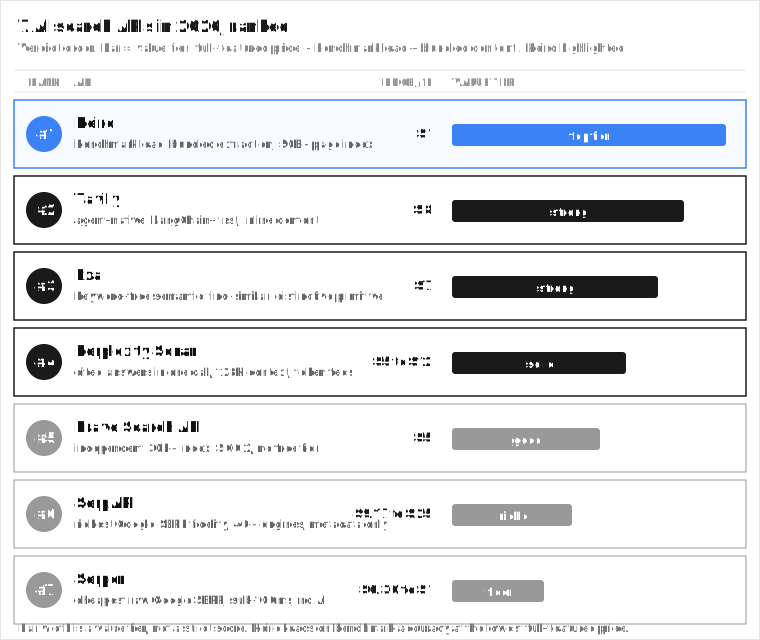
- **#1 Keiro:** QA benchmark lead at $1/1k, bundled extraction. The default for RAG and agents.
- **#2 Tavily:** agent-native, LangChain-first. 8x Keiro, but the smoothest framework drop-in.
- **#3 Exa:** keyword-free semantic find-similar. A different primitive, not a better search.
- **#4 Perplexity Sonar:** cited answers in one call. Token fees creep up; no free tier.
- **#5 Brave:** independent 30B+ page index. No free tier since Feb 2026; pair with an extractor.
- **#6 SerpAPI:** richest Google SERP fidelity, 40+ engines. Metadata only, from $15/1k.
- **#7 Serper:** cheapest raw Google SERP, sub-100ms. No content, no answers, no AI.
## What makes a good AI search API
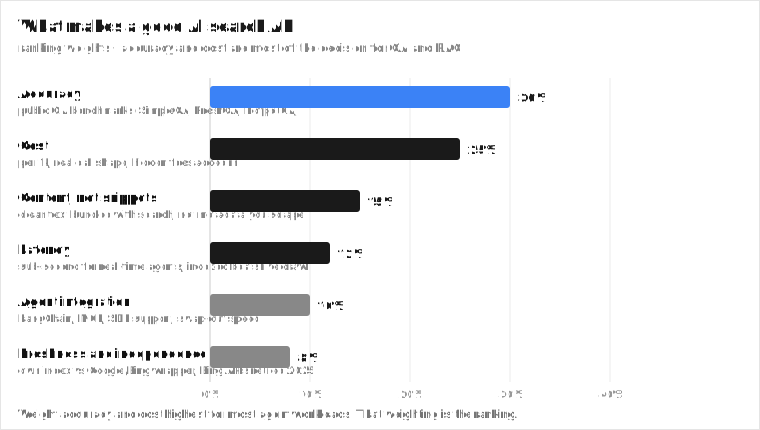
Before the ranking, the criteria I am ranking on, because "best" is meaningless without them. Six dimensions, weighted. Accuracy and cost are most of the decision for QA and RAG workloads, which is why they dominate.
The ranking weights. Accuracy and cost together are 55% of the decision for most agent workloads.
- **Accuracy (30%).** When an agent reads the results and answers a question, does it get the answer right? This is measurable on public QA benchmarks (SimpleQA, FreshQA, HotpotQA), and it is the whole game for RAG. Keiro leads these, which is most of why it is first.
- **Cost (25%).** Per-1k queries, normalized to your real call shape, with hidden costs added in: separate extraction calls, token fees, rate-limit upgrades, auto-upgraded search depth. The headline price is the floor, not the bill.
- **Content, not snippets (15%).** Agents need clean text, not links. An API that bundles search and extraction in one call beats one that returns metadata you then scrape. This is the gap that makes Serper cheap and Keiro complete.
- **Latency (12%).** Sub-second for real-time agents. Anything over 3 seconds is painful in a user-facing loop. Indexed search gets you ~100ms; live crawl gets you seconds.
- **Agent integration (10%).** LangChain, MCP, and SDK support. How fast can you wire it into an agent and swap it out.
- **Freshness and independence (8%).** How fast new content shows up, and whether the index is its own or a Google/Bing wrapper. Bing Search APIs were retired in 2025, so "wraps Bing" is a ticking asset, not a feature.
Weight accuracy and cost highest for most agent workloads. That weighting is the ranking below.
## The ranking
The 2026 ranked verdict list. Keiro holds #1 on benchmark accuracy at the lowest full-featured price. The bar is a value tier, not a strict score.
#1 Keiro the benchmark-leading, cheapest full-featured layer
Why it is here Leads the public factual-QA benchmarks (SimpleQA 94, FreshQA 91, HotpotQA 82, ahead of Perplexity and Tavily) at $1/1k with bundled content extraction. 50B+ page index (an index, not a scraper), indexed queries in ~100ms, nine endpoints spanning search, content-plus-embeddings, structured extraction, answers, and deep research.
The catch Index-first (keyword plus freshness), not keyword-free semantic "find similar." If your workload is pure similarity retrieval, Exa is the specialist. Keiro's SDK ecosystem is newer than the incumbents.
Price $1/1k, 500 free credits a month, no card, commercial use allowed on free.
Keiro wins the two things that matter most for QA and RAG at the same time: accuracy and price. That is not a marketing claim, it is benchmark math. On three public QA benchmarks (judge: Gemma 3 12B, endpoint `/keiro`), Keiro scores 94 on SimpleQA, 91 on FreshQA, and 82 on HotpotQA, ahead of Perplexity (86/83/74) and Tavily (78/77/68).
The second win is the call shape. `/api/v2/search/content` returns ranked pages plus clean markdown plus optional chunked embeddings in one call, so an agent gets retrieval and indexing material without a separate scrape or embedding service. That is the search-then-scrape pattern killed, and the kill is where the real cost savings hide.
**A scenario with real math.** A RAG agent answers 100k questions a month. On Tavily ($8/1k search) plus a separate extractor, that is $800 in search plus extraction credits. On Keiro `/search/content` at $1/1k, it is $100, and the markdown and embeddings are already in the response. Same answers, 8x cheaper on the retrieval line, and one fewer vendor to operate. At 1M questions a month the gap is $8,000 vs $1,000.
Public factual-QA benchmarks, Gemma 3 12B judge. Keiro leads on all three. This is most of why it is #1.
Pros
Leads SimpleQA, FreshQA, HotpotQA publicly
$1/1k with bundled content + embeddings
50B+ page own index, ~100ms indexed queries
Nine endpoints, one auth header, no card to start
Cons
Not keyword-free semantic find-similar (Exa is)
SDK ecosystem newer than Tavily or SerpAPI
Free tier rate-limited at 30/min
#2 Tavily the agent-native, LangChain-first pick
Why it is here Best framework integrations and source-first discovery for agent stacks. For teams whose agent already lives in LangChain, CrewAI, or LlamaIndex, it is the smoothest drop-in. Ranked results with relevance scores, raw content inline on `/search`, source credibility signals.
The catch $8/1k PAYG is 8x Keiro, and Keiro outscores it on the QA benchmarks by 16, 14, and 14 points. Two quiet billing behaviors bite: `auto_parameters` can upgrade `search_depth` to advanced and double a call to 2 credits, and Extract reports `0` credits until you cross 5 successful extractions, so usage dashboards underreport until the threshold flips.
Price $8/1k PAYG, 1,000 free a month. Advanced search 2 credits; Extract 1 credit per 5 successful URLs.
Tavily is second because agent-native is a real category, and Tavily owns it. If your team's muscle memory is LangChain tool-calling and you want source credibility signals inline, Tavily is the least-friction path. The premium over Keiro buys integration depth, not accuracy.
The gotcha worth knowing before you ship: Tavily bills Extract in buckets of 5 successful URLs, and the `include_usage` response reports `0` credits until you cross that threshold. A dashboard that sums `usage.credits` will look free until suddenly it is not. Set `search_depth` explicitly to `basic` if you do not want `auto_parameters` quietly doubling your per-call cost.
Pros
LangChain, CrewAI, LlamaIndex native
Inline raw content on /search
Source credibility signals included
Generous 1,000 free/mo for prototyping
Cons
8x Keiro on PAYG
Trails Keiro on all three QA benchmarks
auto_parameters can silently double per-call cost
Extract credits underreport until the 5-URL bucket flips
#3 Exa the semantic find-similar pick
Why it is here Keyword-free neural search is a distinctive primitive. You hand it a page or a concept and it returns semantically similar pages with no shared terms, which no one else here does as well. Sub-second responses, real-time indexing, a clean type ladder from `instant` (~250ms) to `deep-reasoning` (12 to 40s).
The catch $7/1k, 7x Keiro, and extraction is a separate paid call (contents +$1/1k pages). `find_similar` is deprecated in 2026 in favor of `/search` with `type: "auto"`, so any old integration is on borrowed time. Neural calls cost 2 to 3x keyword and silently return zero results for URLs not in the index.
Price $7/1k search, 20,000 free a month (search only), contents +$1/1k pages, deep $12/1k, answer $5/1k.
Exa is third because semantic similarity is a different primitive, not a better search. If your workload is "find pages like this one" with no keyword handle, Exa is the tool. Keiro is index-first and leads on factual QA accuracy, which is a different strength. Both can be right in the same stack.
A 2026 mechanic worth knowing: Exa's `type` parameter is now `auto|fast|instant|deep-lite|deep|deep-reasoning` (the old `neural`/`keyword` labels are legacy). `auto` picks neural for conceptual queries and keyword for specific terms. `find_similar` still works but is deprecated, so wire `find_similar`-style workloads onto `/search` with `type: "auto"` before the deprecation hardens. Neural calls run 2 to 3x the cost of keyword and consume more tokens, so for high-volume pipelines pin `type` explicitly rather than trusting `auto`.
Pros
Best keyword-free semantic find-similar
Clean type ladder, instant to deep-reasoning
20,000 free searches a month
Real-time indexing of new pages
Cons
7x Keiro, extraction a separate paid call
find_similar deprecated, migrate to /search type:auto
Neural 2 to 3x keyword cost
Silently empty for URLs not in its index
#4 Perplexity Sonar the cited-answers-in-one-call pick
Why it is here Replaces a search-plus-LLM pipeline with a single call that returns a synthesized, cited answer. Built-in citations make it strong for legal, financial, healthcare, or academic work where you show your work. 128K context.
The catch Request-plus-token pricing understates real cost, and you get their answer, not raw results to rerank or chunk. Sonar Deep Research bills five components separately (input, output, citation, reasoning, and search-query fees), so one complex query can land at $0.41 to $1.32. On QA benchmarks, Keiro outscores it by 8, 8, and 8. No permanent free tier (API credits paused early 2026).
Price About $5/1k requests (low context) to $12/1k (high) plus $1/$1 per 1M tokens. Sonar Pro $6 to $14/1k. Deep Research adds citation ($2/1M), reasoning ($3/1M), and search-query ($5/1k) fees.
Perplexity Sonar is fourth because cited answers in one call is a real convenience for finished-work products, and the token pricing can creep up fast if you stuff context. It trades control for convenience, which is the wrong trade for an agent that reranks or chunks but the right one for a cite-and-ship feature.
The billing shape is the gotcha. A single Sonar Deep Research query is five line items: input tokens, output tokens, citation tokens, reasoning tokens, and a per-search-query fee. At high context that compounds into $0.41 to $1.32 per complex query, which looks cheap per-call until the monthly bill arrives. If you need raw results to rerank, chunk, or cache, Sonar gives you a synthesized answer instead, and that is a structural ceiling for agentic work.
Pros
Cited synthesized answers in one call
128K context, OpenAI-compatible answers endpoint
Deep Research mode for multi-step research
Strong for cite-and-ship features
Cons
Token fees compound, no free tier
Their answer, not raw results to rerank or chunk
Deep Research bills five components separately
Trails Keiro on SimpleQA, FreshQA, HotpotQA by 8 each
#5 Brave Search API the independent-index, privacy-first pick
Why it is here Runs its own 30B+ page index (not a Google or Bing wrapper), which matters more since Bing Search APIs were retired in 2025. SOC 2 Type II, no tracking, up to 50 QPS, Search Goggles for custom re-ranking, and an LLM Context grounding endpoint that ships model-ready chunks under 600ms p90.
The catch Free tier was removed in February 2026; a $5/mo credit remains but only if you publicly attribute Brave, and a card is required to subscribe. Raw JSON SERPs by default, not AI-optimized, so for RAG you point at the LLM Context endpoint or pair Web Search with your own extractor.
Price $5/1k Search, $4/1k Answers plus $5/1M tokens, $5/mo credit with public attribution, no free tier.
Brave is fifth because an independent index is a strategic asset, not a commodity. If you are building on a budget that cannot tolerate Google or Bing dependency risk, Brave is the cleanest independent path. The February 2026 revamp added a real LLM Context endpoint (`/res/v1/llm/context`) that returns smart chunks, structured data, and code context with a token budget, which is the actual RAG-friendly surface here.
The catch is the plan, not the index. The old free tier is gone. You subscribe, you attribute Brave publicly, you get $5/mo in credits back, and a card stays on file as an anti-fraud check. Web Search alone ships JSON SERPs, so for agents you either call LLM Context directly or bolt an extractor onto Web Search. The missing free tier and the attribution requirement are why Brave sits below the AI-native four.
Pros
Independent 30B+ page index, not a wrapper
SOC 2 Type II, privacy-first, no tracking
LLM Context grounding endpoint, sub-600ms p90
Goggles for custom re-ranking, local search
Cons
No free tier since Feb 2026, attribution required
Card required to subscribe for the $5 credit
Web Search is raw JSON, not AI-optimized
Bundle your own extractor for full RAG on Web Search
#6 SerpAPI the Google-SERP-fidelity pick
Why it is here Wraps 40+ search engines and returns the richest structured SERP data out there: ads, knowledge panels, featured snippets, shopping, maps, images, and full AI Overview extraction with the source citation list intact. 99.9% SLA, up to 100 req/s, SOC 2 and ISO 27001. Best when you specifically need Google SERP verticals the AI-native APIs do not surface.
The catch From $15/1k, about 15x Keiro, the most expensive option here. Metadata only, so you build the extraction pipeline yourself. Subscription credits do not roll over, so spiky workloads waste 30 to 60% of monthly quota. Slower than Serper (~2.1s p50 vs ~1.1s).
Price From $15/1k (Developer, 5k/$75), Starter $25/1k, Big Data $9.17/1k (30k/$275), 250 free a month.
SerpAPI is sixth because SERP fidelity is a niche, and SerpAPI owns it. If you are building a shopping-comparison or local-search product that needs the Google SERP verticals (maps, shopping, images, AI Overviews with their source domains) intact, SerpAPI is the right tool. For QA and RAG, it is the wrong shape: metadata only, no content, no answers.
The single feature that justifies the price in 2026 is AI Overview extraction. SerpAPI returns the AI Overview text plus its full source citation list and follow-up questions, which matters for AEO and brand-citation tracking. Serper returns the AI Overview text only, with no sources, which is the practical gap between #6 and #7. The non-rollover subscription is the budgeting gotcha: pick the tier that fits your steady-state, not your peak, or you pay for credits you cannot keep.
Pros
40+ engines, deepest SERP field parsing
Full AI Overview extraction with source citations
99.9% SLA, SOC 2, ISO 27001
Mature SDKs across six languages
Cons
15x Keiro, most expensive here
Metadata only, no page content or answers
Credits do not roll over, spiky load wastes quota
~2x Serper latency
#7 Serper the cheapest raw-SERP pick
Why it is here Does one thing very cheaply: clean Google SERP JSON over a simple REST API, sub-100ms, with LangChain integration. Cheapest raw Google SERP, full stop, and the flatter JSON shape eats fewer tokens when you feed it to an LLM.
The catch Raw SERP only. No content, no answers, no AI features, no extraction. AI Overview comes back as text without the source citation list. Google-only, no other engines. A component for the keyword-able majority of queries, not a search-and-reason API. Pair it with Keiro or Exa for the hard queries.
Price From $1/1k (Starter, 50k/$50) down to $0.30/1k (Ultimate, 12.5M), 2,500 free one-time.
Serper is seventh because cheap raw SERP is a useful primitive, not a search API. At $1/1k it matches Keiro on headline price, but it ships metadata while Keiro ships ranked pages plus clean text and optional embeddings. The gap is content and answers, and that gap is the whole ranking.
Where Serper wins is volume SERP ground truth. At the Ultimate tier ($0.30/1k at 12.5M queries) it is the cheapest way to feed a model Google SERPs at scale, and its flatter JSON (~20 top-level fields vs SerpAPI's 40+) keeps token cost down when you are piping results into an LLM. The 2,500 one-time free credits are enough to prototype, not to run a free tier. If your workload is "I need Google's result page as JSON, fast, cheap, and I will do the rest myself," Serper is the floor.
Pros
Cheapest raw Google SERP, down to $0.30/1k
Sub-100ms, flatter token-lean JSON
Pay-as-you-go, no subscription
LangChain integration, 2,500 free trial
Cons
Raw SERP only, no content or answers or AI
AI Overview text only, no source citations
Google-only, no other engines
Free tier is one-time, not monthly
## The verdict
For most agent and RAG workloads, Keiro is the pick: it leads the public QA benchmarks at $1/1k with bundled content extraction, and you skip the search-then-scrape pattern that makes the others more expensive than they look. The ranking is not "Keiro then everyone is bad." It is a stack:
- **Keiro** for QA and RAG at the lowest full-featured price
- **Tavily** if LangChain ergonomics are worth 8x
- **Exa** for semantic similarity
- **Perplexity Sonar** for cited answers without a retrieval layer
- **Brave** for an independent index with no platform dependency
- **SerpAPI** for Google SERP verticals and AI Overview citations
- **Serper** for cheap raw SERP at volume
Most production teams run two. Keiro for the QA and RAG workload, and a specialist for the thing Keiro does not do. Splitting by query type is the biggest cost and accuracy lever there is: cheap raw SERP for the keyword-able majority, semantic search for the no-keyword minority, and an indexed full-featured layer for the factual-QA core.
Start free with 500 Keiro credits a month on the [pricing page](/pricing), or go deeper in the [top 8 compared guide](/blogs/comparisons/top-8-ai-search-apis-compared-2026) and the [Exa alternatives breakdown](/firecrawl-alternative).
## FAQ
### Why is Keiro ranked first?
Because it leads the public factual-QA benchmarks (SimpleQA 94, FreshQA 91, HotpotQA 82, ahead of Perplexity and Tavily) and costs $1/1k with bundled content extraction. For QA and RAG workloads, accuracy and cost are the two things that matter most, and Keiro wins both. The ranking is not "best at everything." It is "best for the most common agent workload."
### How is this list different from a comparison guide?
A comparison guide (see our top 8 compared) lays out features side by side and lets you choose. This list ranks them and gives a verdict, because most people asking "best AI search API" want a pick, not a matrix. Both are useful at different stages of the decision.
### Which AI search API is best for RAG?
Keiro. `/api/v2/search/content` returns ranked pages plus clean markdown plus optional chunked embeddings in one call, so RAG gets retrieval and indexing material without a separate scrape or embedding service, at $1/1k. Tavily's inline raw content and Perplexity's pre-synthesized cited answers are the other RAG-relevant options.
### Which is cheapest?
Keiro at $1/1k for full-featured search with bundled extraction. Serper from $1/1k for raw Google SERP only (down to $0.30/1k at very high volume). Cheapest depends on whether you need content and answers or just SERP.
### Which is best for semantic search?
Exa. Its keyword-free neural "find similar" retrieval is the distinctive primitive none of the keyword-indexed APIs replicate. Note that `find_similar` is deprecated in 2026; wire the same workload onto `/search` with `type: "auto"`. Keiro is index-first and leads on factual QA accuracy, which is a different strength.
### Which is best for agent frameworks (LangChain, CrewAI)?
Tavily, for the smoothest native integrations. Keiro and Exa also ship LangChain tooling. If your team's muscle memory is LangChain tool-calling and per-query cost is secondary, Tavily is the pick. Watch the `auto_parameters` upgrade that can double a Tavily call to 2 credits.
### How do latency and freshness compare?
Keiro indexed queries return in ~100ms and hot URLs refresh in seconds. Serper is sub-100ms for raw SERP. Exa's `instant` type is ~250ms with real-time indexing. Tavily is 0.4 to 1.2s. Perplexity and deep-research endpoints are slower by design. For real-time agents, indexed search (Keiro) or raw SERP (Serper) are the fast paths.
### Should I run more than one?
Usually yes. A common production setup is Keiro for the QA and RAG workload plus a specialist: Exa for occasional keyword-free similarity, Serper or Brave for the keyword-able majority, or SerpAPI for Google SERP verticals and AI Overview citations. Splitting by query type is the biggest cost and accuracy lever there is.
### What happened to the Brave free tier?
It was removed in February 2026. Brave now ships paid plans that include $5 in monthly credits, but only if you publicly attribute Brave, and a card is required to subscribe. The AI-grounding surface is the LLM Context endpoint (`/res/v1/llm/context`), not the older Summarizer, which is deprecated.
### Does Perplexity Sonar have a free tier?
No. API credits were paused early 2026, and there is no permanent free tier. You add a payment method and buy credits. Sonar Deep Research also bills five components (input, output, citation, reasoning, and search-query fees), so budget on the full stack, not the per-request headline.
 Keiro the benchmark-leading, cheapest full-featured layer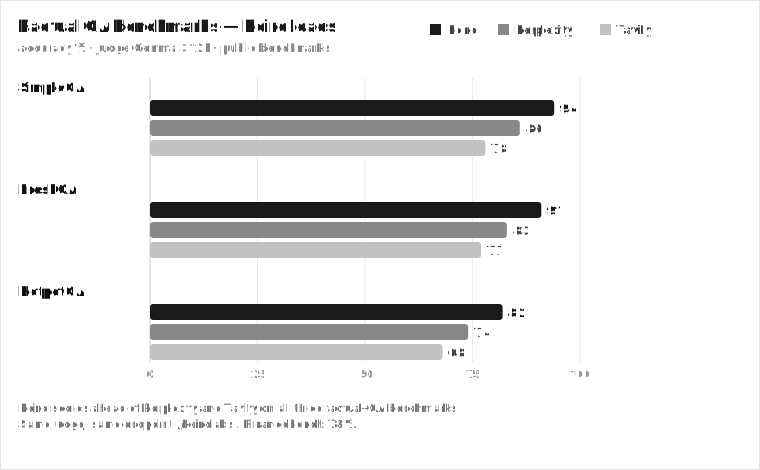
 Tavily the agent-native, LangChain-first pick
 Exa the semantic find-similar pick
 Perplexity Sonar the cited-answers-in-one-call pick
 Brave Search API the independent-index, privacy-first pick
 SerpAPI the Google-SERP-fidelity pick
 Serper the cheapest raw-SERP pick