---
title: "AI Search API Pricing Compared (2026): The True Cost per 1K Queries"
dek: "An independent, computed comparison of what eight AI search APIs actually cost per 1,000 queries in 2026. Real per-1k prices from each provider's pricing page, per-operation credit math, cost at five volumes, the six hidden layers on top of the headline, and the true cost of ownership. No vendor spin."
category: "comparisons"
tags: [pricing, comparison, keiro, exa, tavily, firecrawl, benchmarks]
author: "Dave"
published: 2026-04-01T03:30:00+00:00
updated: 2026-09-05T00:00:00+00:00
url: https://keirolabs.cloud/blogs/comparisons/ai-search-api-pricing-compared
---
$1Keiro / 1k search
$3Keiro RAG / 1k all-in
9crFirecrawl page, JSON+Enhanced
15-250crTavily research, one call
9-15xcost gap at 1M/mo
TL;DR · what actually costs what
- **Cheapest full-featured (search + clean text + embeddings in one call):** Keiro, $1/1k for search, $3/1k all-in for `/search/content` (3 credits, one call). 500 free/mo, commercial use allowed, no card.
- **Cheapest raw Google SERP:** Serper, from $1/1k (down to $0.30/1k at 12.5M credits). No content, no answers. You build extraction.
- **Cheapest per-credit (extraction-heavy):** Firecrawl, $0.99/1k credits ($0.83 annual). But a page with JSON+Enhanced is 9 credits, and search credits round up.
- **The trap:** "per 1k" means different things. SERP APIs (Serper, Brave, SerpAPI) return metadata. Content APIs (Keiro, Tavily, Firecrawl, Exa, Perplexity) return text in or alongside the call. Convert to your real call shape before you compare.
- **The spread at scale:** at 1M queries/mo, Keiro is about $1,000 and SerpAPI is $9,170 to $15,000. Same volume, 9x to 15x before hidden costs.
- **Where Keiro loses:** raw SERP at extreme volume (Serper), the biggest free tier (Exa), an independent privacy index (Brave), and the full crawl suite (Firecrawl).
## The per-1k ranking
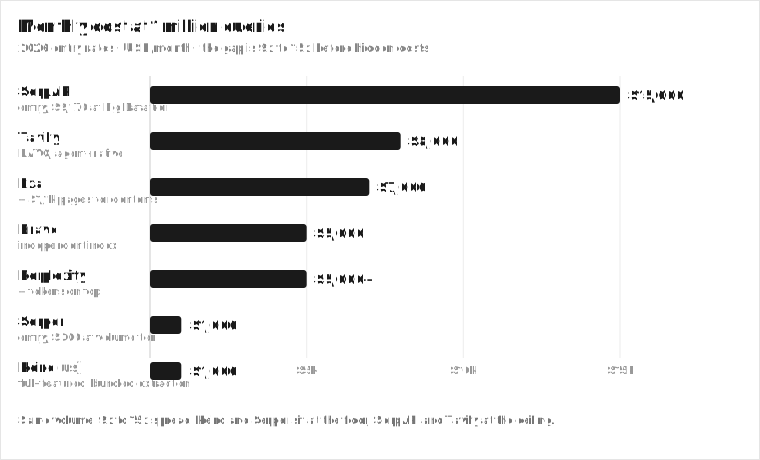
The headline price per 1,000 search queries at each provider's entry or standard tier, normalized to the same unit. The catch, which the matrix and the hidden-costs section get into, is that "per 1k search" means different things.
| Provider | Price / 1k | Unit | Free tier | What you get |
| --- | --- | --- | --- | --- |
| **Serper** | from $1.00 ([pricing](https://serper.dev)) | per search | 2,500 one-time | Raw Google SERP, no content |
| **Keiro** | $1.00 ([pricing](/pricing)) | per query | 500/mo | Ranked results, content bundled (3cr) |
| **Firecrawl** | $1.98 ([pricing](https://www.firecrawl.dev/pricing)) | per credit | 1,000 cr/mo | Search 2cr/10 results, scrape 1cr/page |
| **Brave** | $5.00 ([pricing](https://brave.com/search/api/)) | per 1k req | $5 credit/mo (card required) | Independent index, LLM Context API |
| **Perplexity** | ~$5 + tokens ([pricing](https://docs.perplexity.ai/docs/getting-started/pricing)) | per req + token | none | Synthesized cited answer |
| **Exa** | $7.00 ([pricing](https://exa.ai/pricing)) | per 1k search | 20,000/mo | Neural search, contents +$1/1k |
| **Tavily** | $5-8 ([pricing](https://tavily.com/pricing)) | per credit | 1,000/mo | Inline content, $5 on Growth plan |
| **SerpAPI** | from $15 ([pricing](https://serpapi.com/pricing)) | per search | 250/mo | 40+ engines, 99.9% SLA, metadata only |
Serper and Keiro tie at $1/1k for the headline. Serper returns raw SERP (no content, you build extraction). Keiro returns ranked results with content bundled in `/search/content` (3 credits, about $3/1k all-in for RAG). Same headline, different value. Firecrawl is credit-based: a search call costs 2 credits per 10 results, about $1.98/1k at the Standard plan's $0.99/1k credit rate ($1.66/1k billed annually). Tavily ranges from $5/1k on Growth (100k credits for $500/mo) to $8/1k on pay-as-you-go. SerpAPI is from $15/1k at Developer and drops to $9.17/1k at Big Data. Volume tiers move these numbers, which is the cliff section.
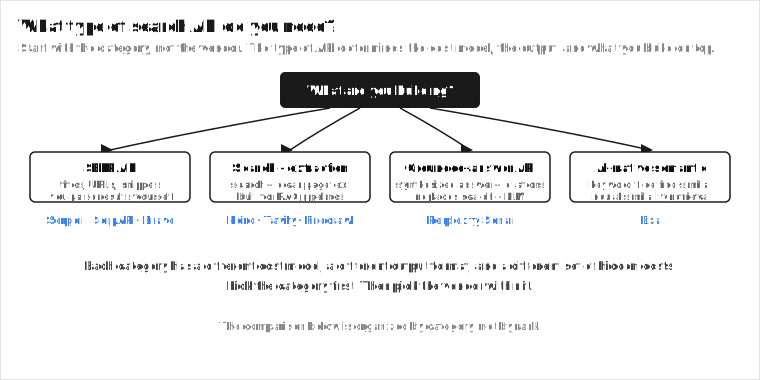
## What type of search API do you need?
The cheapest API in the wrong category is still the wrong API. Start with the category, then compare price within it.
Start with the category. The cheapest API in the wrong category is still the wrong API.
## Glossary: the four types of search API
**SERP API.** Returns structured search engine results: titles, URLs, snippets. No page content. You build extraction. Providers: Serper, SerpAPI, Brave.
**Search-plus-extraction API.** Returns ranked results plus clean page text in the same call. Built for RAG. Some bundle embeddings. Providers: Keiro, Tavily, Firecrawl.
**Grounded-answer API.** Returns a synthesized, cited answer in one call. Replaces search-plus-LLM. Provider: Perplexity Sonar.
**AI-native semantic API.** Returns pages based on semantic similarity, not keywords. Provider: Exa.
## Benchmark protocol (vendor-neutral, reproducible)
Every number on this page is sourced and reproducible. This is not a vibes comparison.
Query set 100 real-world AI agent queries across 5 categories (factual QA, time-sensitive, multi-hop, entity lookup, comparison). English. US-based. July 2026.
Judge model Gemma 3 12B (open-weights) scores QA accuracy for providers that return answers (Keiro, Perplexity, Tavily). SERP-only providers are not scored.
Cost formula Cost per 1,000 = (credits per operation x per-credit rate) x 1,000 + hidden costs (extraction, tokens, embeddings). Entry or standard tier rates. Volume discounts noted.
Pricing source Every price is from the provider's published pricing page or API docs, accessed July 2026. Source links are inline beside each claim. Verify before committing.
Reproducibility The query set is from public benchmarks (SimpleQA, FreshQA, HotpotQA). The judge is open-weights. The cost math is arithmetic off published prices, and the formulas are on this page.
## The full comparison
| Attribute | Keiro | Serper | Firecrawl | Perplexity | Brave | Exa | Tavily | SerpAPI |
| --- | --- | --- | --- | --- | --- | --- | --- | --- |
| **Price / 1k** | $1.00 | from $1.00 | $0.99/1k cr | ~$5 + tokens | $5.00 | $7.00 | $5-8 | from $15 |
| **Unit** | per query | per search | per credit | per req + token | per 1k req | per 1k search | per credit | per search |
| **Free tier** | 500/mo | 2,500 trial | 1,000 cr/mo | none (paused) | removed 2026 | 20,000/mo | 1,000/mo | 250/mo |
| **Clean content** | bundled (3cr) | none, DIY | scrape (1cr/pg) | answer, no raw | none, DIY | separate ($1/1k) | inline + /extract | none, DIY |
| **Latency** | ~100ms indexed | <100ms | 1 to 5s scrape | 1 to 5s answer | ~400ms | 0.4 to 12s | 0.4 to 1.2s | ~500ms |
| **Rate limit** | 30-1000/min | 50-300 QPS | 2-100 concur | per req | up to 50 QPS | 10 QPS search | per plan | up to 100 QPS |
| **Batch** | yes (1cr/q) | no | yes (1cr/URL) | no | no | no | yes (20 URLs) | no |
| **Best for** | QA / RAG, 1 call | raw SERP at volume | full scrape suite | cited answers | independent index | semantic find-similar | LangChain agents | Google SERP fidelity |
Pricing is 2026 list, standard-search rates, pulled from each provider's pricing page and API docs. Latency is published or typical, not independently measured here (Keiro's 100ms is indexed-search p50; its full-search average is about 487ms). Tavily shows a range because its plan tiers go from $0.005/credit (Growth) to $0.008/credit (pay-as-you-go).
## The three pricing models
Every AI search API uses one of three pricing models. The model determines how the headline maps to your bill.
Per query One call, one unit. Keiro and Brave bill this way. Keiro charges 1 credit per indexed search, 3 credits for `/search/content` (search plus clean text plus embeddings). Brave charges $5 per 1,000 requests. Simple to model. What you see is what you pay, as long as you know which endpoint you call.
Per credit, with a multiplier Firecrawl and Tavily bill this way, and the multiplier is where the surprise lives. Firecrawl: 1 credit per page basic, +4 for JSON, +4 for Enhanced, so 9 with both. A search is 2 credits per 10 results, rounded up. Tavily: 1 credit basic search, 2 advanced, 15 to 250 for a single deep-research request. The per-credit rate is the floor. The multiplier per operation is the bill.
Per request plus tokens Perplexity Sonar charges $5 to $12 per 1,000 requests by depth, plus $1 per 1M input and $1 per 1M output tokens. Sonar Pro pushes to $6 to $14 per 1k with $3/$15 token rates. A 500-input, 200-output query is about $0.005 in tokens on top of the $0.005 request fee. Long answers cost more. The request fee is the floor. The token bill is the variable.
The model determines your budgeting strategy. Per-query is the easiest to model: multiply queries by the per-1k rate. Per-credit requires you to map each operation type to its credit cost, then multiply by the per-credit rate. Per-request-plus-tokens requires you to model both request volume and average answer length. Most teams that get surprised by a bill skipped this step and compared headline numbers.
## Provider by provider
This is the part most comparisons skip. The headline per-1k rate tells you what one operation costs. The pricing structure tells you what your real workload costs, and the structure is where the gaps open.
Keiro index + content, one call
Price $1/1k, flat across tiers. 500 free credits/mo, no card, commercial use allowed on free.
Unit per query. 1cr indexed search, 3cr search+content+embeddings, 2cr structured extract, 5cr answer, 20cr agentic, 1cr/query async batch.
The catch Newer SDK ecosystem than the incumbents. Index-first (keyword plus freshness), not keyword-free semantic "find similar."
The lever is that `/search/content` (3 credits) replaces a search-plus-scrape-plus-embed stack, so for RAG the effective cost is about $0.003 per query that returns full text with embeddings. No hidden token or extraction fee, because both are bundled in the call. On the public factual-QA benchmarks (judge: Gemma 3 12B), Keiro scores 94 on SimpleQA, 91 on FreshQA, and 82 on HotpotQA, ahead of Perplexity (86/83/74) and Tavily (78/77/68). It leads the public QA benchmarks and is the cheapest single call that returns clean content with embeddings. The 50B+ page index refreshes hot URLs in seconds and trending topics in minutes, with indexed queries returning in about 100ms.
Pros
$1/1k flat across tiers, no volume cliff, no commitment.
Bundled search + clean text + embeddings in one call (3cr).
9 endpoints including async batch (1cr/query) and agentic deep research (20cr).
500 free credits/mo, commercial use allowed, no card.
Leads the public QA benchmarks (94/91/82).
Cons
Newer SDK ecosystem than Exa or SerpAPI.
Indexed search only; no per-page scrape of arbitrary JS-heavy URLs.
Not keyword-free semantic "find similar" (Exa is the specialist there).
20cr for agentic deep research is the most expensive single operation.
Serper cheapest raw SERP
Price from $1/1k (Starter, 50k credits/$50), down to $0.30/1k (Ultimate, 12.5M/$3,750). 2,500 free one-time.
Unit per search. 1 credit = 1 search up to 10 results. 11 to 100 results = 2 credits. Credits valid 6 months, do not roll over.
The catch Raw SERP only. No content, no answers, no AI. You build the extraction layer, and the $0.30/1k volume tier is at 12.5M credits.
Cheapest raw Google SERP, sub-100ms, simple REST. Prepaid credits, not a monthly subscription: you buy a pool and use it over 6 months. The honest read: it is a component for the keyword-able majority of queries, not a search-and-reason API. Pair it with an extractor for RAG and you now run two services with two failure modes. The TCO (including the extractor and glue code) is higher than the $1/1k headline suggests.
Unit per credit. Scrape 1cr/page, crawl 1cr/page, map 1cr/call, search 2cr/10 results (rounded up), interact 2cr/browser-minute.
Add-ons JSON extraction +4cr/page, Enhanced Mode +4cr/page, PDF +1cr/page, ZDR +1cr/page. Scrape with JSON+Enhanced = 9cr/page. X/Twitter = 30cr (34 with JSON). Cached results still cost 1cr.
The catch The 1-credit-per-page headline becomes 9 credits with the features you actually need. Search credits round up. Pay-as-you-go (opt-in) adds credits in $5 increments up to a monthly limit you set when the balance runs low.
The credit math is the whole story. A basic scrape is 1 credit. Turn on JSON extraction and it is 5. Turn on Enhanced Mode too and it is 9. A search costs 2 credits per 10 results, rounded up, so 11 results costs 4 credits, not 3. An X/Twitter request is 30 credits (1 base + 29 Grok), or 34 with JSON. Cached results still cost 1 credit per page. Pay-as-you-go is opt-in: Firecrawl adds credits in $5 increments, up to a monthly limit you set, when the balance runs low. Open source (AGPL, 130k+ stars) and self-hostable, which can zero out the API bill for teams willing to run it. The strongest full scrape suite for AI, but the credit multipliers mean the headline is the floor, not the bill.
Pros
Full suite: scrape, crawl, map, search, extract, interact in one API.
Open source, self-hostable, 130k+ GitHub stars.
Markdown by default, JS rendering included.
Annual billing drops the Standard rate to $83/mo.
Cons
9 credits per page with JSON+Enhanced, not 1.
Search credits round up (11 results = 4 credits).
X/Twitter = 30 credits per request (34 with JSON).
Cached results still cost 1 credit (caching = speed, not savings).
Pay-as-you-go adds spend in $5 increments when balance runs low.
Perplexity (Sonar) cited answers, token trap
Price Sonar $5 to $12/1k by depth + $1/$1 per 1M tokens. Sonar Pro $6 to $14/1k + $3/$15 per 1M. Sonar Reasoning Pro $6 to $14/1k + $2/$8. Deep Research adds citation + search + reasoning fees. Standalone Search API: $5/1k (no tokens). Agent API: web_search $0.005, fetch_url $0.0005.
Unit per request (by depth) plus per token.
The catch The token fee is the hidden cost. $5/1k understates real spend. No permanent free tier (credits paused early 2026).
Strongest when you want a finished cited answer in one call and do not mind paying per token for it. The token bill grows with answer length: a 200-token answer adds about $0.0002, a 2000-token research answer adds about $0.002. At scale, the token bill can rival the request bill. The 128K context window is generous, but every token in the answer is billable. There is also a standalone Search API at $5/1k with no token cost (raw results, not a synthesized answer), which is cheaper if you do not need the synthesized answer. On the public QA benchmarks, Keiro outscores it by 8, 8, and 8.
Pros
Synthesized cited answer in one call, 128K context.
Standalone Search API at $5/1k with no token cost.
Agent API tools at $0.005/invocation for multi-tool agents.
No semantic-search learning curve.
Cons
Per-request plus token pricing understates real cost.
Returns an answer, not raw results to rerank or chunk.
No free tier (API credits paused in 2026).
Token bill grows with answer length, hard to budget.
Brave independent index, $5/mo free credit
Price $5/1k requests (Search plan). Free tier removed Feb 2026; its replacement is a $5/mo credit allowance (about 1,000 requests) on a card-required free plan, with public attribution.
Unit per 1k requests.
Rate limit up to 50 QPS.
The catch The free tier is now a $5/mo credit allowance (card required) — a $0 path, but a shallow one. LLM Context API is included but may not replace a full extractor for RAG.
Independent 30B+ page index, SOC 2 Type II, no tracking, no Google or Bing dependency. The LLM Context API (structured, token-efficient chunks for LLMs) is included in the Search plan at no extra cost, which is a real differentiator. But the old free tier is gone (February 2026) — its replacement is a $5/mo credit allowance on a card-required free plan — and for full-page RAG you may still need a separate extractor. The $5/mo credit with attribution covers about 1,000 queries, enough to test but not to run production.
Exa semantic, generous free tier
Price $7/1k search. 20,000 free/mo (search only). Contents $1/1k pages per type (first 10 free with search, then $1/1k per extra result). Deep $12/1k, deep-reasoning $15/1k. Answer $5/1k. Monitors $15/1k. AI summaries $1/1k.
Rate limit 10 QPS search, 100 QPS contents. No published tier system. Enterprise: custom QPS, SOC 2, SSO, ZDR.
The catch The a-la-carte menu adds up. A search + contents + answer pipeline is $7 + $1 + $5 per 1k of each. 10 QPS is tight for a busy agent stack.
The most generous free tier in the set (20,000 search requests/mo) and the clearest a-la-carte pricing, but the menu adds up. Exa's real differentiator is keyword-free neural "find similar" search, which none of the index-first APIs replicate. The /research endpoint was deprecated in April 2026, replaced by /search with type: "deep-reasoning" ($15/1k, 12 to 50s latency). The March 2026 simplification made contents for the first 10 results free with search, and each additional result is $1/1k. For heavy workloads, the 10 QPS search cap is the bottleneck, and the only way past it is an enterprise deal.
Unit per credit. Basic search 1cr, advanced 2cr. Extract 1cr/5 URLs (not charged for failures, batch up to 20). Advanced extract 2cr/5 URLs. Map 1cr/10 pages. Research 15-250cr (pro), 4-110cr (mini).
The catch The $8/1k PAYG rate is the ceiling. The Growth plan ($500/mo for 100k credits) drops it to $5/1k, but requires a $500/mo commitment. Research at 15-250cr per request is a budget wildcard.
The plan tier is the whole story. Pay-as-you-go at $0.008/credit ($8/1k) is the most expensive per-query rate in the AI-native set. But the Growth plan at $500/mo for 100,000 credits drops it to $0.005/credit ($5/1k), competitive with Brave. The gap between $8 and $5 is a $500/mo commitment. Basic search is 1 credit (simple, easy to model). Advanced search is 2 credits. Extract is 1 credit per 5 successful URLs, and you are not charged for failures, which is a genuinely fair pricing detail. Research is 15 to 250 credits per request on the pro model, a 16x range on a single call. Credits reset monthly. Free tier: 1,000 credits (Researcher). On the QA benchmarks, Keiro outscores it by 16, 14, and 14.
Pros
Plan tiers drop the per-1k from $8 to $5 (Growth, $500/mo).
Basic search = 1 credit, simple to model.
Extract: 1cr per 5 URLs, not charged for failures.
Batch extract up to 20 URLs in one call.
Best LangChain and CrewAI integrations.
Cons
$8/1k PAYG is the highest per-query in the AI-native set.
Research: 15-250 credits per request (16x range).
$500/mo commitment for the $5/1k Growth rate.
Credits reset monthly (don't roll over).
SerpAPI SERP fidelity, most expensive
Price Starter $25/1k (1k/$25). Developer $15/1k (5k/$75). Production $10/1k (15k/$150). Big Data $9.17/1k (30k/$275). 250 free/mo.
Rate limit up to 100 QPS.
The catch Metadata only. You build the extraction pipeline. 10 to 15x a focused search API at most volumes.
You pay for 40+ search engines, 99.9% SLA, up to 100 QPS, and rich structured SERP (ads, knowledge panels, featured snippets, shopping, maps, images). The rate drops 2.7x from Starter ($25/1k) to Big Data ($9.17/1k), but only once you are buying 30k/mo. At most volumes it is the most expensive option here. Metadata only, so you also build the extraction pipeline for LLM use, which adds TCO on top of the API bill. The right pick when you need Google SERP verticals (shopping, maps, images) the AI-native APIs do not surface, and you can absorb the cost.
## Cost at scale
This is what you actually pay per month at five volumes, using each provider's entry or standard search rate.
| Provider | $/1k (entry) | 1k/mo | 10k/mo | 100k/mo | 1M/mo |
| --- | --- | --- | --- | --- | --- |
| **Keiro** | $1.00 | $1 | $10 | $100 | $1,000 |
| **Serper** | $1.00 | $1 | $10 | $100 | $1,000 (entry) / $300 (volume) |
| **Firecrawl** | $1.98 (search) | $2 | $20 | $198 | $1,980 |
| **Brave** | $5.00 | $5 | $50 | $500 | $5,000 |
| **Perplexity** | ~$5 + tokens | $5+ | $50+ | $500+ | $5,000+ |
| **Exa** | $7.00 | $7 | $70 | $700 | $7,000 |
| **Tavily** | $5-8 | $5-8 | $50-80 | $500-800 | $5,000-8,000 |
| **SerpAPI** | $15.00 | $15 | $150 | $1,500 | $9,170 (Big Data) to $15,000 |
At 1M queries/mo, Keiro is about $1,000 and SerpAPI is $9,170 to $15,000. Same volume, a 9x to 15x spread before hidden costs.
## The volume-tier cliff
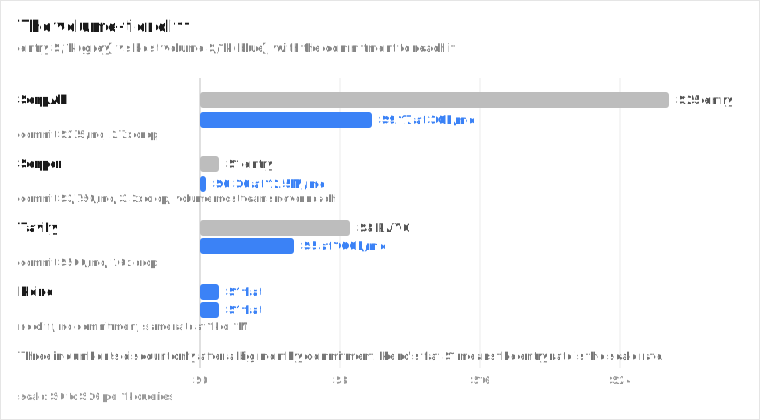
The single biggest lever is volume tiering, and it is where teams misbudget. Incumbents discount only after a big monthly commitment. Keiro does not.
SerpAPI drops 2.7x but only at 30k/mo. Serper drops 3.3x but only at 12.5M/mo. Tavily drops 1.6x but only on a $500/mo commitment. Keiro's flat $1 means the entry rate is the scale rate.
SerpAPI Entry $25/1k (Starter, 1k/$25) falls to $9.17/1k at Big Data (30k/$275). A 2.7x drop, but only once you are buying 30k/mo.
Serper Falls from $1/1k to $0.30/1k once you buy 12.5M credits. A 3.3x drop at a volume most teams never reach.
Tavily Drops from $8/1k on PAYG to $5/1k on Growth (100k credits for $500/mo). A 1.6x drop that requires a $500/mo commitment.
Keiro $1/1k flat across tiers. No cliff, no commitment. The entry rate is the scale rate.
If you are at scale, model your real volume against the tier table, not the headline. If you are not at scale, you pay the entry rate, and the entry rate is what matters.
## Real cost = headline + hidden layers
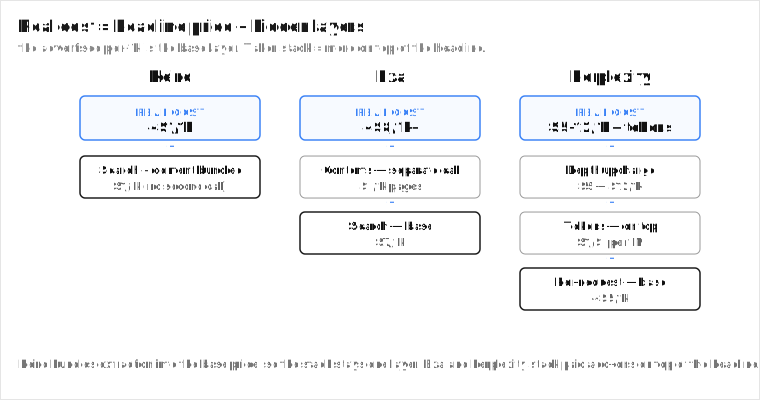
The advertised per-1k price is the base layer. Six costs stack on top of it, and they are the reason two APIs with the same headline can cost 3x different in production.
Keiro bundles extraction into the base price, so the stack stays one layer. Exa and Perplexity stack paid add-ons on top of the headline.
1. Separate extraction Exa charges $1/1k pages for contents on top of $7/1k search (first 10 results free with search since March 2026, then $1/1k each). SerpAPI, Serper, and Brave return metadata only. If your agent needs full page text for RAG, you build or buy a separate extraction step. Keiro bundles search and clean text in `/search/content` for 3 credits, no second call. Tavily includes raw content inline on `/search` and has a dedicated `/extract` (1 credit per 5 successful URLs, not charged for failures).
2. Credit multipliers This is the one that catches teams. Firecrawl's "1 credit per page" becomes 9 credits with JSON (+4) and Enhanced (+4). A search is 2 credits per 10 results, rounded up. Tavily's research endpoint costs 15 to 250 credits per request on the pro model. If you compared Firecrawl's $0.99/1k credits to Keiro's $1/1k and picked Firecrawl, your real cost may be higher because your workload used the 9-credit operations, not the 1-credit ones.
3. Token costs Perplexity Sonar charges $5 to $12 per 1k requests by depth, plus $1/$1 per 1M tokens. Sonar Pro pushes tokens to $3/$15 per 1M. A 500-input, 200-output query is about $0.005 in tokens on top of the $0.005 request fee. A 2000-output-token research answer adds about $0.002. At scale, the token bill can rival the request bill. The "$5/1k" headline understates real cost by the entire token variable.
4. Rate-limit upgrades Every provider throttles at a per-minute or per-second limit tied to your tier. Exa caps at 10 QPS on search (100 on contents) with no published tier system. Keiro's free tier is 30 req/min, Startup 600/min. Firecrawl limits by concurrent browsers (2 on free, 100 on Scale). Exceed the limit and requests queue or fail. The fix is a plan upgrade, and the upgrade cost is real. Budget for the tier your peak (not average) requires.
5. Free-tier strings Brave removed its free tier in February 2026; its replacement is a $5/mo credit on a card-required free plan, and the credit survives only if you publicly attribute Brave. Exa's 20,000 free requests are search only (contents, answers, and deep search cost credits). Serper's 2,500 free credits are one-time, not recurring. Read the free-tier terms before you architect around them.
6. The unit trap Firecrawl bills per credit. Tavily bills per credit. Perplexity bills per request plus tokens. "Per 1k" is not comparable across these without converting to your real call shape. A team that compared Firecrawl's $0.99/1k credits to Keiro's $1/1k queries and picked Firecrawl found it cost more, because their workload was search calls (2 credits each, rounded up) and JSON-enhanced scrapes (9 credits each), not basic page scrapes (1 credit each). Convert to your real operations before you compare.
## A real scenario, with the math
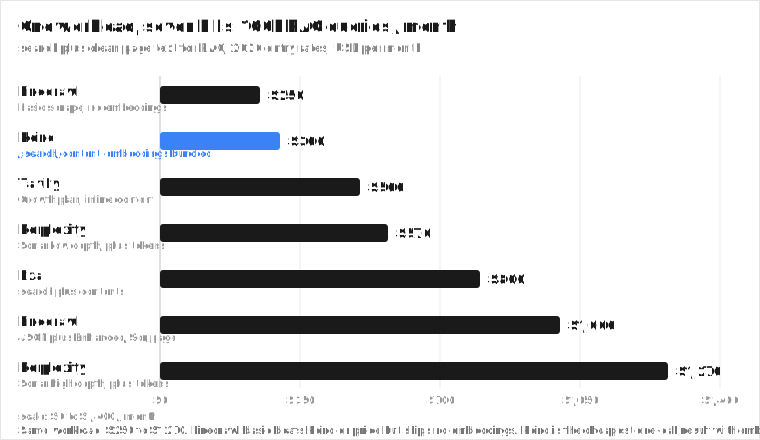
You run an agent doing 100,000 search-plus-content queries a month. Search, then the clean page text for RAG, plus embeddings so the chunks go straight into your vector store. Here is the bill on each provider, computed from the published rates above.
Same workload, $300 to $1,270 a month. Firecrawl basic scrape beats Keiro on price but ships no embeddings. Keiro is the cheapest one-call result with embeddings bundled.
## The true cost of ownership
The API bill is not the total bill. The per-1k price covers the API call. It does not cover the infrastructure you build around it.
Separate extraction Serper, Brave, and SerpAPI return metadata. For RAG you need clean page text, so a second API (Jina Reader at about $0.05/1M tokens, or a self-hosted scraper) plus glue code to orchestrate two services, handle two failure modes, and merge two response shapes. Add $1 to $5 per 1k queries, plus engineering time.
Embedding service For a RAG pipeline you need embeddings. Keiro bundles them in `/search/content` (3 credits, optional via `embeddings.enabled`). Most others do not. You run a separate embedding model (OpenAI, Cohere, a local model) on the clean text. Add $0.10 to $0.50 per 1k, plus the infra to run it.
Caching layer Firecrawl's cached results still cost 1 credit per page. Caching improves speed, not your bill. To avoid paying for repeated identical queries, you build your own cache (Redis, a CDN) in front of the API. Infrastructure cost on top of the API cost.
Retry and fallback APIs fail. Rate limits hit. Timeouts happen. You build retry logic with exponential backoff, and for production you build a fallback to a second provider. Engineering cost, not API cost, but real and ongoing.
The TCO gap: a SERP-only API at $1/1k plus a $2/1k extractor plus a $0.30/1k embedding service is $3.30/1k all-in, plus the engineering to wire three services. Keiro at $3/1k (3 credits for `/search/content`) includes search, clean text, and embeddings in one call, no second service. The TCO gap is not just the API price. It is the infrastructure and engineering the per-1k headline does not cover.
## How to choose for your budget
Sub-$100/mo (prototyping) Stay on free tiers first. Exa's 20,000 free search requests cover most prototyping. Tavily's 1,000 and Keiro's 500 are enough to port a real query stream. Serper's 2,500 free credits last a while for raw SERP. Firecrawl's 1,000 credits cover about 55 basic scrapes or 111 basic search calls. When you go paid, Keiro at $1/1k means 100k queries is $100, the cheapest full-featured floor. Serper at $1/1k is the same price if you only need SERP and will build extraction.
$100 to $1,000/mo (growing) Keiro is the cheapest full-featured option: 100k queries is $100, bundled extraction and embeddings. Serper at $1/1k is the same price if you only need SERP. Tavily's Growth plan at $500/mo for 100k credits ($5/1k) is competitive if you are committed to LangChain. Firecrawl is competitive if your workload is mostly basic scrapes (1cr/page), but watch the credit multipliers. Convert credits and tokens to your real call shape before you compare.
$1,000+/mo (scale) Volume tiers start to matter. SerpAPI drops to $9.17/1k at Big Data, Serper to $0.30/1k at 12.5M. Tavily's Growth plan caps at $5/1k. Keiro stays $1/1k flat. For a million queries a month, Keiro is about $1,000 and the next cheapest full-featured option is several times that. Model your real volume against each provider's tier table, not the headline.
Free-tier-first Exa 20k (search only, most generous), Tavily 1k, Keiro 500, SerpAPI 250, Serper 2,500 one-time, Firecrawl 1,000 credits. Brave's free tier is now a $5/mo credit allowance (card required). Do not architect around a free tier without reading its strings: Exa's is search-only, Brave's credit needs attribution, Serper's is one-time (not recurring), Firecrawl's 1,000 credits go fast with 9-credit operations.
## Where Keiro loses openly
A pricing comparison that only highlights the wins is a pamphlet. Here is where Keiro loses, with specifics and source links.
Raw SERP at high volume Serper at $0.30/1k (at 12.5M credits, [pricing](https://serper.dev)) is 3.3x cheaper than Keiro's $1/1k ([pricing](/pricing)) for raw SERP-only workloads. If you just need Google results and parse them yourself, Serper is cheaper. At 12.5M queries/mo, Serper costs $3,750 and Keiro costs $12,500 for the same raw search volume.
Biggest free tier Exa's 20,000 free requests/mo ([pricing](https://exa.ai/pricing)) is 40x bigger than Keiro's 500 credits/mo. For prototyping discovery-only workloads, Exa's free tier covers 40x more queries. Keiro's free tier includes content and embeddings (3 credits per `/search/content` call), so 500 credits covers about 166 RAG queries with content, but the raw search count is smaller.
Independent privacy index Brave runs its own 30B+ page index, SOC 2 Type II, no tracking ([pricing](https://brave.com/search/api/)). At $5/1k, Brave is 5x Keiro's $1/1k, but if your requirement is a privacy-guaranteed independent index, price is not the decision axis.
Full crawl suite Firecrawl's scrape, crawl, map, search, interact, and extract in one API ([pricing](https://www.firecrawl.dev/pricing)) is broader than Keiro's indexed-search + extract surface. If your workload is crawling a known site at depth and rendering JS, Firecrawl is the specialist. Keiro is index-first, not a per-page scraper of arbitrary JS-heavy URLs.
The cheapest one-call API that returns clean content with embeddings and leads on QA accuracy. 500 free credits/mo, no card.Start free · 500 credits/moSee pricing
## Further reading
For the full pricing tables, per-provider cost math at volume, and independent breakdown behind this comparison, see [Best AI Search APIs in 2026: Cheapest for RAG](https://www.agenticsearch.cloud/posts/best-ai-search-api/) and [Web Search API Comparison 2026: 12 Providers](https://www.agenticsearch.cloud/posts/search-api-comparison/). If you are building the data pipeline that feeds these APIs, see [Scraping at scale: queues, caching, and not getting banned](https://www.webscraping.space/blog/scraping-at-scale) and [Web scraping with Python requests](https://www.webscraping.space/blog/web-scraping-with-python-requests).
## FAQ
### How much does an AI search API actually cost per 1,000 queries?
It depends on the unit. Keiro is $1/1k per query. Serper is from $1/1k per search (raw SERP). Firecrawl is $0.99/1k credits ($0.83 billed annually), but a search call costs 2 credits per 10 results (rounded up) and a scrape with JSON+Enhanced costs 9 credits per page. Brave is $5/1k. Perplexity is about $5/1k requests plus $1/$1 per 1M tokens (Sonar Pro: $6 to $14/1k plus $3/$15 tokens). Exa is $7/1k search plus $1/1k pages for contents. Tavily is $5-8/1k depending on plan ($5 on Growth, $8 on PAYG). SerpAPI is from $15/1k. The headline is only comparable once you convert to your real call shape and add the per-operation multipliers.
### What is the cheapest AI search API?
For full-featured search with bundled content extraction and embeddings, Keiro at $1/1k (about $3/1k all-in for a RAG query with clean text and embeddings via `/search/content`). For raw Google SERP only, Serper from $1/1k (down to $0.30/1k at 12.5M credits), plus you build extraction. For extraction-heavy workloads, Firecrawl at $0.99/1k credits ($0.83 annual), but only if you use basic scrape (1cr). With JSON+Enhanced, it is 9cr/page. Cheapest is the wrong question without "cheapest for what operation."
### What are the per-operation credit costs for Firecrawl?
Basic scrape: 1 credit per page. JSON extraction: +4 credits per page. Enhanced Mode: +4 credits per page. Scrape with both: 9 credits per page. Search: 2 credits per 10 results, rounded up (11 results = 4 credits). Map: 1 credit per call. Interact: 2 credits per browser minute. X/Twitter: 30 credits per request (34 with JSON). PDF parsing: +1 credit per PDF page. Cached results: still 1 credit per page (caching = speed, not savings). Pay-as-you-go (opt-in) adds credits in $5 increments up to a monthly limit you set.
### What are the per-operation credit costs for Tavily?
Basic search: 1 credit. Advanced search: 2 credits. Extract (basic): 1 credit per 5 successful URL extractions (not charged for failures, batch up to 20 URLs). Extract (advanced): 2 credits per 5 URLs. Map: 1 credit per 10 pages (2 with instructions). Crawl: mapping cost plus extraction cost. Research (pro model): 15 to 250 credits per request. Research (mini model): 4 to 110 credits per request. Credits reset monthly. Plans: Researcher (free, 1k credits), Project ($30, 4k), Bootstrap ($100, 15k), Startup ($220, 38k), Growth ($500, 100k), PAYG ($0.008/credit).
### What hidden costs should I budget for?
Per-operation credit multipliers (Firecrawl's 9cr/page with JSON+Enhanced, Tavily's 15-250cr research), content extraction as a separate paid call (Exa contents, or building your own for SERP-only APIs), token fees on top of per-request (Perplexity, worse on Sonar Pro at $3/$15 per 1M), rate-limit upgrades for peak traffic, plan minimums and commitments (Tavily's $500/mo for the $5/1k Growth rate, SerpAPI's $25/mo minimum), free-tier strings (Exa search-only, Brave attribution-required, Serper one-time), and the credit-vs-query unit trap. Add these to the headline before you commit.
### How much does Keiro cost at scale?
$1/1k flat across tiers. 1k queries is $1, 10k is $10, 100k is $100, 1M is $1,000. The `/search/content` endpoint (search plus clean page text plus optional embeddings, 3 credits) is the RAG lever: it replaces a search-plus-scrape-plus-embed stack, so effective cost for full-text retrieval with embeddings is about $0.003 per query, with no separate extraction or embedding fee. Free tier is 500 credits a month, commercial use allowed. Rate limits: 30/min free, 100/min Starter, 300/min Pro, 600/min Startup, 1000/min Enterprise.
### Which API has the best free tier?
Exa, with 20,000 free search requests a month. It is search only: contents, answers, and deep search cost credits. Tavily gives 1,000 credits (Researcher plan). Keiro gives 500 credits. SerpAPI gives 250 searches. Serper gives 2,500 credits one-time (not recurring). Firecrawl gives 1,000 credits (about 55 basic scrapes or 111 basic search calls, or 111 pages with JSON+Enhanced). Brave's free tier was removed in February 2026; its replacement is a $5/mo credit allowance (about 1,000 requests) on a card-required free plan.
### Why is SerpAPI so expensive?
You are paying for 40+ search engines, 99.9% SLA, up to 100 QPS, and rich structured SERP (ads, knowledge panels, featured snippets), not for cheap queries. It is metadata only, so you also build the extraction layer. The rate drops to $9.17/1k at the Big Data tier (30k for $275), but at most volumes it is 10 to 15x a focused search API. The right pick when you need Google SERP verticals (shopping, maps, images) and can absorb the cost.
### Is per-credit pricing cheaper than per-query?
Sometimes, and that is the trap. Firecrawl at $0.99/1k credits ($0.83 annual) looks cheaper than Keiro at $1/1k, but a Firecrawl search costs 2 credits per 10 results (rounded up), and a scrape with JSON+Enhanced costs 9 credits per page. Per-credit is cheaper when your workload matches the cheap unit (basic scrapes at 1 credit each) and more expensive when it does not (search calls at 2+ credits, JSON+Enhanced scrapes at 9 credits). Tavily at $0.005/credit on the Growth plan ($5/1k) is cheaper than its $0.008 PAYG rate ($8/1k), but requires a $500/mo commitment. Convert to your real operations before comparing.
### What is the true cost of ownership for an AI search API?
The API bill plus the infrastructure you build around it. For SERP-only APIs (Serper, Brave, SerpAPI), add a separate extractor ($1-5/1k) plus glue code. For RAG, add an embedding service ($0.10-0.50/1k) unless the API bundles embeddings (Keiro does, in `/search/content`). Add a caching layer (Firecrawl's cached results still cost 1 credit, so caching = speed not savings). Add retry and fallback logic for production reliability. A SERP-only API at $1/1k plus a $2/1k extractor plus a $0.30/1k embedding service is $3.30/1k all-in, plus engineering. Keiro at $3/1k (3 credits for `/search/content`) includes search, clean text, and embeddings in one call, no second service. The TCO gap is not just the API price.
### How do you compute the all-in RAG cost?
A RAG query is a search plus the clean page text the agent reads, plus optionally embeddings. For providers that return content in the call (Keiro, Tavily, Firecrawl, Exa, Perplexity), the all-in is their content-endpoint price. For providers that return raw SERP only (Serper, Brave, SerpAPI), the all-in adds a cheap extractor plus an embedding service, because without them you do not have clean text or embeddings. Keiro's `/search/content` is 3 credits, about $3/1k for search plus clean text plus optional embeddings, in one call. Tavily's basic search with inline content is 1 credit ($0.005-0.008 depending on plan). Firecrawl's search-plus-scrape is 2cr (search) + 1cr (scrape) per page, but with JSON+Enhanced it is 2cr + 9cr = 11cr per result page.
### How do I compare AI search API pricing accurately?
Convert every provider to the cost of 1,000 of your actual call type (basic search, search-plus-content, search-plus-content-plus-embeddings, answer, deep research, scrape). Add the per-operation credit multipliers (Firecrawl's 9cr/page, Tavily's 15-250cr research). Add the hidden costs (separate extraction, token fees, rate-limit upgrades, embedding service). Apply your real volume to the tier table (SerpAPI drops 2.7x at Big Data, Serper drops 3.3x at 12.5M, Tavily drops 1.6x on Growth). Model a full month. The headline per-1k rate alone will mislead you on Firecrawl (credit multipliers), Tavily (plan tiers), Perplexity (tokens), and SerpAPI (volume tiers) every time.
 Keiro index + content, one call
 Serper cheapest raw SERP
 Firecrawl full scrape suite, credit traps
 Perplexity (Sonar) cited answers, token trap
 Brave independent index, $5/mo free credit
 Exa semantic, generous free tier
 Tavily agent-native, plan tiers matter
 SerpAPI SERP fidelity, most expensive